For founders in 2026, key SEO and AEO trends include tracking citations across answer engines, clarifying entities, building crawlable structured pages, publishing fresh original content, and linking AI visibility to pipeline. Technical SEO still provides access; AEO provides the answer. Begin with a small, consistent group of commercial prompts and track them weekly. Sona AI Visibility links those prompts and citations to pipeline and revenue, while revealing AI crawler and agent activity at the start of that journey.
What are the trending SEO and AEO topics founders should act on in 2026?
Answer engine optimization (AEO) increases a brand’s visibility in AI-powered answer engines such as ChatGPT, Perplexity, Gemini, Claude, and other answer engines. For B2B SaaS founders, the priority is earning citations in commercial answers and measuring whether those answers influence pipeline.
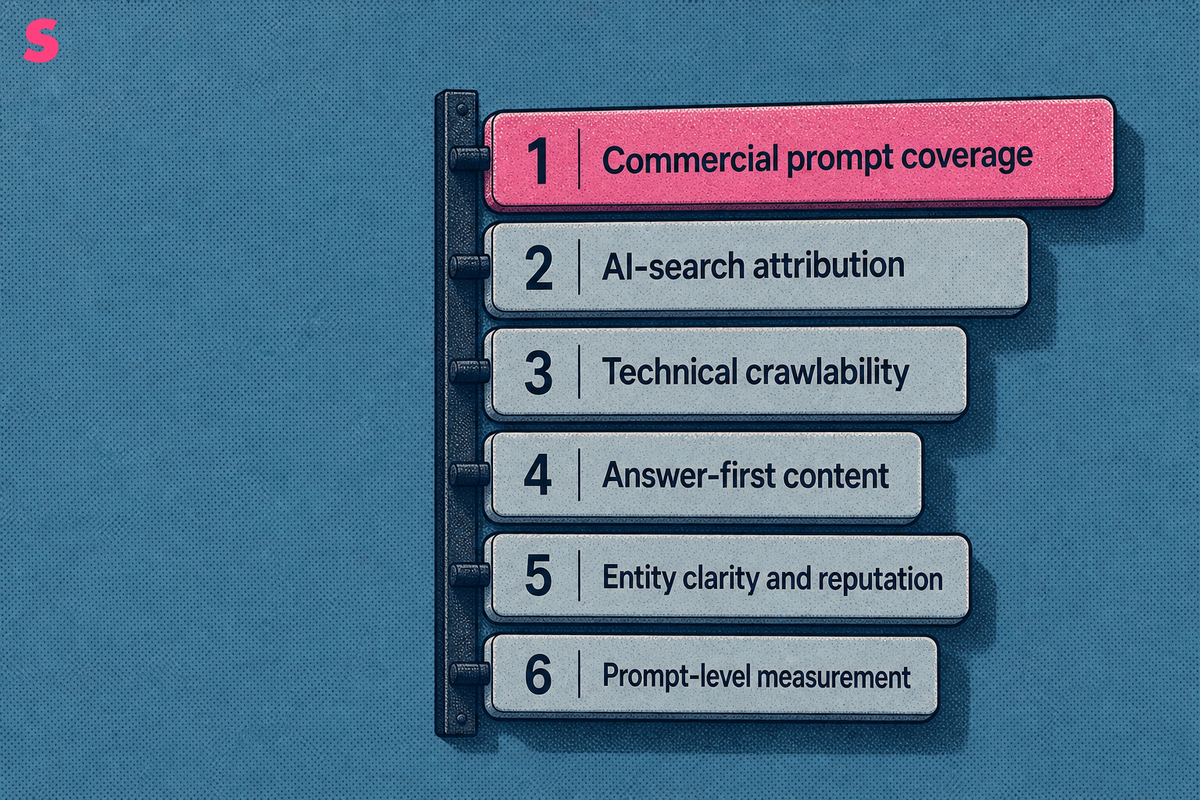
The six highest-impact topics for founders are ranked below. They separate brands AI recommends from brands buyers must search for themselves.
- Commercial prompt coverage. Track the questions buyers ask when comparing, selecting, or replacing software.
- AI-search attribution. Connect citations and AI-referred visits to accounts, opportunities, and revenue.
- Technical crawlability. Make important pages reachable and understandable to search crawlers and answer-engine retrieval systems.
- Answer-first content. Publish concise, self-contained passages that answer a specific buyer question.
- Entity clarity and reputation. Keep product claims, category language, customer proof, and third-party references consistent.
- Prompt-level measurement. Replace a single visibility score with a record of prompts, cited sources, positions, and changes over time.
A buyer may ask, “What is the best attribution platform for B2B SaaS?” An answer engine can synthesize vendor pages, comparison articles, documentation, reviews, and original research. A founder’s task is not merely to publish a category page. The page must be credible, crawlable, specific, and useful enough to become a cited source.
For e-commerce, product availability, merchant data, reviews, and category-page structure move higher on the list. For local businesses, location pages, accurate business information, local reputation, and direct-answer visibility matter because search engines increasingly answer queries without sending users through several results.
What is the business case for AEO in 2026, and what ROI is realistic?
The business case for AEO is a controlled test of whether AI research contributes to qualified demand, not a promise that citations automatically create revenue. Founders should begin with a focused commercial prompt set, establish a baseline, and compare total test cost with attributable gross margin from closed-won customers.
Self-serve AEO software spans roughly $29 to $489 per month, with enterprise plans generally custom-priced, based on pricing reviewed in September 2026. Entry plans commonly fall between $49 and $99 per month, mid-tier tools range from $200 to $700 per month, and enterprise platforms exceed $2,000 per month, per techradar.com, July 30, 2026. AEO and GEO services for most B2B companies cost $2,000 to $10,000 per month in October 2026, while one-off audits cost $1,000 to $4,000.
Full-service agency programs can reach about $15,000 per month, based on pricing reviewed in September 2026. Calculate break-even by comparing total AEO cost, including software, services, content, and implementation, with the gross margin from closed-won customers attributable to the test. Evidence of visibility means the brand appears in relevant answers. Evidence of pipeline influence means AI research appears in documented account or opportunity journeys. Realized ROI requires attributable gross margin from closed-won customers to exceed total AEO cost. Influenced opportunities validate further investigation, but they do not establish positive ROI.
The sceptic’s objection is valid: AI referrals often arrive as direct traffic, produce zero-click research, or appear before a prospect submits a form. Sona AI Visibility connects prompts and citations to pipeline and revenue on one account timeline, and tracks AI crawler activity from server logs or a lightweight edge worker. That evidence supports an AI-search contribution without assuming ROI.
Treat AI visibility as a demand-generation hypothesis. Measure prompt exposure, referral activity, branded search, CRM touchpoints, and sales-call evidence together. A citation is leading evidence. A closed-won deal remains the commercial outcome.
Is AEO just rebranded SEO, and what is it commonly confused with?
No. SEO optimizes web pages for traditional search engines, while AEO prepares information for direct AI answers. SEO provides access through crawlability. AEO makes material synthesizable, meaning an engine can extract, understand, compare, and cite it.
GEO, or generative engine optimization (GEO), is often used as an umbrella term for visibility in generative AI results. AEO is more specific to answer engines and answer-level outcomes. The labels overlap in practice, but neither replaces the other. What matters is whether a buyer can find, interpret, and trust the company’s information during a product decision.
- AEO is not a replacement for technical SEO. A page that cannot be crawled or rendered cannot become a reliable source.
- AEO is not a placement guarantee. Answer engines vary by query, retrieval index, model behavior, and available sources.
- AEO is not generic AI content generation. Publishing more text does not establish evidence, authority, or a useful answer.
- AEO is not only rankings. It adds citation frequency, brand presence, sentiment, share of voice, and answer position.
The rebranded-SEO objection is partly right because the foundations carry over: useful pages, technical hygiene, authoritative evidence, and clear information architecture still matter. AEO adds a measurement layer because answer engines assemble multi-source responses instead of returning a conventional ranked list of blue links.
Which answer engines should a SaaS founder monitor first?
SaaS founders should monitor the answer engines their buyers use for research, beginning with Google AI Overviews, Google AI Mode, ChatGPT, Perplexity, Gemini, Claude, Copilot, and other answer engines. Referral logs and sales-call notes should determine the final monitoring set, rather than assumptions about an engine’s importance.
Google AI Overviews and Google AI Mode matter when the company already depends on Google search demand and sees search-driven evaluation behavior. ChatGPT and Perplexity matter when buyers ask open-ended comparison questions, request recommendations, or summarize alternatives. Gemini, Claude, and Copilot matter when those products appear in referral data, customer conversations, or enterprise workflows.
Sona’s own AI visibility data, September 2026, covers eight answer surfaces: ChatGPT, Google AI Overviews, Perplexity, Google AI Mode, Gemini, Mistral, Qwen and Claude. That coverage shows why founders should not treat AI search as one channel with one response pattern.
A practical monitoring process has three steps:
- Review referral logs for identifiable AI sources and landing pages.
- Ask sales representatives to record the research tools prospects mention during discovery calls.
- Track recurring commercial prompts on engines that produce relevant buyer activity.
Keep a stable core set for trend comparison, then adjust the wider set as customer behavior changes.
Which technical SEO foundations still decide whether an AI engine can cite a page?
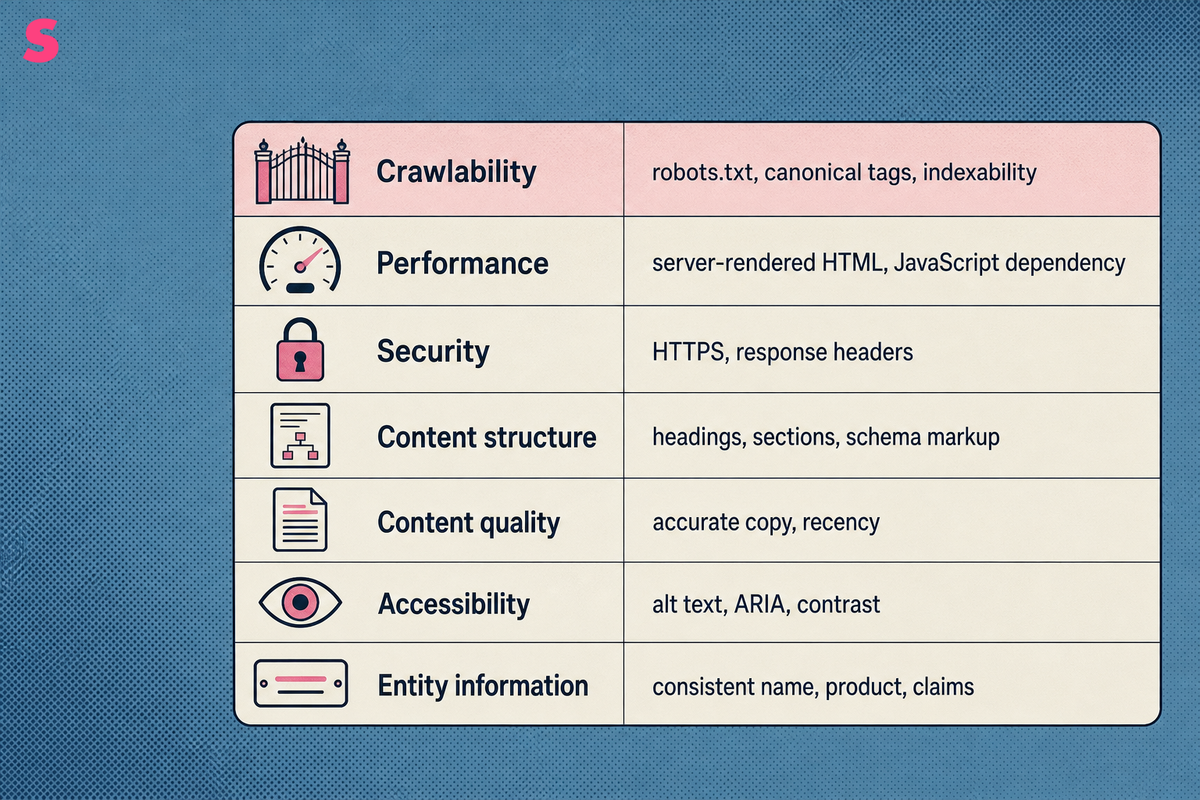
Technical SEO determines whether an AI engine can reach, render, parse, and trust a page. The essential foundations are crawlability, performance, security, content structure, content quality, accessibility, and clear entity information.
Crawlability asks whether crawlers and answer engines can access a page through robots.txt, canonical tags, indexability controls, and server responses. Performance covers rendered experience, server-rendered HTML, and JavaScript dependency. Security includes HTTPS and response-header hygiene. These conditions determine whether a retrieval system can reliably fetch and process source material.
Content structure gives engines semantic handles: descriptive headings, logical page sections, metadata, and valid schema markup. Content quality includes accurate copy and recency. Accessibility includes alt text, ARIA attributes, sufficient contrast, and explicit image dimensions.
Consider a pricing page where plan details load only after a JavaScript application finishes in the browser. A crawler that receives sparse initial HTML can miss prices, plan limits, and comparison language. Server-rendered HTML exposes the relevant copy directly, making the page easier to crawl and synthesize.
Entity clarity complements technical access. Founders should use the same company name, product name, category description, and factual claims across core pages, documentation, profiles, and third-party references. Clear entities reduce ambiguity when an engine determines whether several references describe the same company or product.
How do founders write content that AI engines retrieve, cite and recommend?
Founders should write answer-first pages that state the conclusion, define the relevant conditions, and provide evidence a buyer can verify. The strongest source passage stands alone when lifted from the page because answer engines often retrieve fragments rather than whole documents.
Weak product-page copy: Our platform helps modern teams transform their reporting with a flexible approach built for growth.
Stronger product-page copy: Our B2B attribution platform connects paid, organic, partner, and AI-search touchpoints to account-level pipeline, so demand teams can compare channel contribution before budget planning.
The second passage answers a category question, identifies the buyer, describes the mechanism, and states the business outcome. It also gives an answer engine terms that map to commercial prompts. The goal is not keyword repetition. The goal is a precise claim an engine can retrieve and evaluate.
Original data and first-hand experience improve citation value because they contribute evidence rather than restate common advice. Content freshness matters when product details, pricing, integrations, or market conditions change. Update pages when the underlying fact changes, then present the current information clearly.
In 2026, E-E-A-T, meaning experience, expertise, authoritativeness, and trust, affects the quality and trust signals search and answer engines use when selecting source material. E-E-A-T is not a single standalone score or a guaranteed ranking factor. Demonstrate experience through specific methods, constraints, and examples. Demonstrate expertise through accurate terminology and evidence. Demonstrate trust through clear ownership, careful claims, and corrections when facts change.
Brand reputation signals also influence recommendation-style answers. Third-party reviews, credible editorial coverage, partner references, and consistent customer proof give an engine more corroborating context than a company’s website alone.
Which metrics measure AI-search performance beyond rankings and clicks?
AI-search performance requires a combined view of answer visibility and downstream demand signals. Brand mentions, citation frequency, share of voice, sentiment, answer position, and referral traffic answer different questions and carry different levels of noise.
- Brand mentions and citation frequency show whether the company appears and whether sources support that appearance.
- Share of voice and answer position show relative visibility, but move when prompts and engine behavior change.
- Sentiment helps identify whether the brand is framed positively, neutrally, or critically, but classification needs human review.
- Referral traffic is closer to behavior, although zero-click research can leave no referrer.
- Branded search lift, direct traffic, assisted conversions, and sales-call evidence provide the downstream context needed for attribution.
A single brand-level visibility score is a dated snapshot, not a work item. Sona AI Visibility uses AI Search Insights to show tracked prompts, cited sources, and page performance, so a team can identify the question and source behind a movement rather than reacting to one aggregate number.
The claim that AI answers do not create attributable pipeline is too absolute. Attribution is difficult, especially when buyers research without clicking. Founders should log AI-referred visits where available, compare branded demand over time, inspect assisted conversion paths, and ask prospects how they first encountered the company.
The result should be a comparable operating record. Prompt-level changes, source patterns, landing pages, and sales evidence reveal a more defensible trend than impressions alone.
How can a SaaS company run a defensible AEO test instead of trusting vendor scores?
A defensible AEO test uses a fixed commercial prompt set, repeated samples, raw citation logging, and controlled changes. Vendor visibility scores are not directly comparable because engine coverage, prompt selection, refresh cadence, and scoring rules differ.
- Build a fixed set of prompts across awareness, consideration, decision, and purchase stages.
- Run a baseline and save the full answer, cited sources, brand presence, and answer position for every prompt.
- Run the same prompt list daily. Daily observations reveal patterns that a weekly snapshot can average away.
- Log repeated samples per prompt when responses vary, then separate persistent changes from one-day spikes.
- Refresh the wider prompt set on a regular schedule, while keeping the core set stable for comparison.
- Change one variable at a time, such as a pricing page, comparison page, schema implementation, or evidence section.
Daily monitoring matters because answers shift with retrieval-index changes, model updates, and competitor publishing activity. Define a test window before monitoring, then require repeated observations across that window before treating a change as a trend. Full technical re-audits and positioning reviews belong on a monthly or quarterly clock, not the daily prompt clock.
Answer engines change too quickly for a fixed AEO strategy. Measurement remains useful when AEO operates as an experimentation loop: observe, form a hypothesis, change one input, monitor the result, and retain only what withstands repeated observation.
Which AEO monitoring tools balance engine coverage, prompt volume and price?
AEO monitoring tools should be compared by the engines they cover, the prompt capacity they refresh, the cadence of that refresh, and the business decision the data supports. Entry products from roughly $29 to $99 per month let a founder begin with a focused commercial prompt set, based on pricing reviewed as of October 2026.
Sona AI Visibility connects AI citations and prompts to pipeline and revenue on one account timeline, while also tracking AI crawler activity from server logs or a lightweight edge worker without a JavaScript tag. The comparison below uses published pricing and plan details as of October 2026.
| Tool | Starting price | Agency Plans? (Yes/No) | # of Answer Engines Tracked | Answer Engines | # of Daily Tracked Prompts (entry plan) | Cost per Daily Tracked Prompt | Differentiation |
|---|---|---|---|---|---|---|---|
| Sona AI Visibility | From $75/month, billed annually | Yes | 3 | Not published | 5,000 credits/month, about 166 daily tracked prompts on one model or 56 across three | $0.45 per daily tracked prompt | Connects AI citations and prompts to pipeline and revenue, with AI crawler activity from server logs or an edge worker |
| Profound | Free Trial; Enterprise custom pricing | Yes | 3 | ChatGPT, Gemini, Google AI Overviews | 50 prompts daily for 7 days | Not calculable from free trial/custom pricing | Focus: daily prompt tracking across trial and enterprise plans |
| Peec AI | From $95/month | Yes | 3 | ChatGPT, Google AI Mode, Google AI Overviews | 50 prompts daily | $0.63 per daily tracked prompt | Focus: AI visibility monitoring across self-serve and agency plans |
| Otterly.ai | From $29/month | Yes | 4 | ChatGPT, Google AI Overviews, Perplexity, Microsoft Copilot | 15 prompts daily | $0.48 per daily tracked prompt | Focus: daily prompt monitoring across core answer engines |
Tool selection should follow the measurement requirement. A founder validating whether a few commercial prompts produce relevant brand exposure needs daily history and clear raw answers. A team accountable for revenue needs an attribution path that connects AI research with accounts, opportunities, and closed-won outcomes.
What are the frequently asked questions about AEO for founders?
What is answer engine optimization (AEO)?
AEO increases a brand’s visibility in AI-powered answer engines such as ChatGPT, Perplexity, Gemini, Claude, and other answer engines. A buyer may ask which B2B SaaS platform suits a specific use case. AEO helps the company publish clear, credible source material that an answer engine can retrieve, cite, and use in its recommendation.
Is AEO just rebranded SEO?
No. Technical SEO and content quality remain the foundation because crawlers need access to useful pages. AEO adds answer-level measurement, including citations, brand presence, sentiment, share of voice, and engine-specific responses. SEO supports discoverability in traditional search. AEO evaluates how a brand appears when an engine synthesizes an answer.
How much does AEO cost for a small SaaS company?
Entry AEO software runs roughly $29 to $99 per month, based on pricing reviewed in September and October 2026. AEO and GEO services for most B2B companies cost $2,000 to $10,000 per month in October 2026. One-off audits cost $1,000 to $4,000 in October 2026. The right starting point is a narrow test tied to a defined commercial question.
Do AI answers drive enough pipeline to justify the investment?
AI-answer attribution is difficult, so founders should not justify investment with impressions alone. Connect prompt visibility to branded search, direct traffic, assisted conversions, CRM touchpoints, and sales-call evidence. The evidence becomes stronger when several signals move together after a documented content or technical change.
How often should founders refresh their AEO prompt set?
Founders should keep a stable core of recurring commercial prompts for trend comparison and review the wider prompt set on a regular schedule. Run the stable prompt list daily because repeated observations distinguish a persistent shift from noise. Treat prompt selection as an experimentation loop, not a one-time keyword project.
Do founders still need technical SEO if they invest in AEO?
Yes. Crawlability, rendered content, schema markup, security, and accessibility still determine whether an answer engine can reach and trust a page. AEO builds on technical SEO access, then improves how well a page answers a buyer’s question and earns citation within a multi-source response.
Summarize this article with AI: ChatGPT · Claude · Perplexity · Google AI Mode
Last updated: October 2026