What is AEO? Answer engine optimization (AEO) involves organizing content so AI systems can extract it and cite your brand as the direct response to a question. It overlaps substantially with SEO, but is measured through citations in AI answers instead of rankings and clicks. ChatGPT, Perplexity, Google AI Overviews, and other answer engines choose sources differently, so the process begins by mapping buyer prompts. Sona AI Visibility links those prompts and citations to pipeline and revenue.
What is AEO, and what does answer engine optimization stand for?
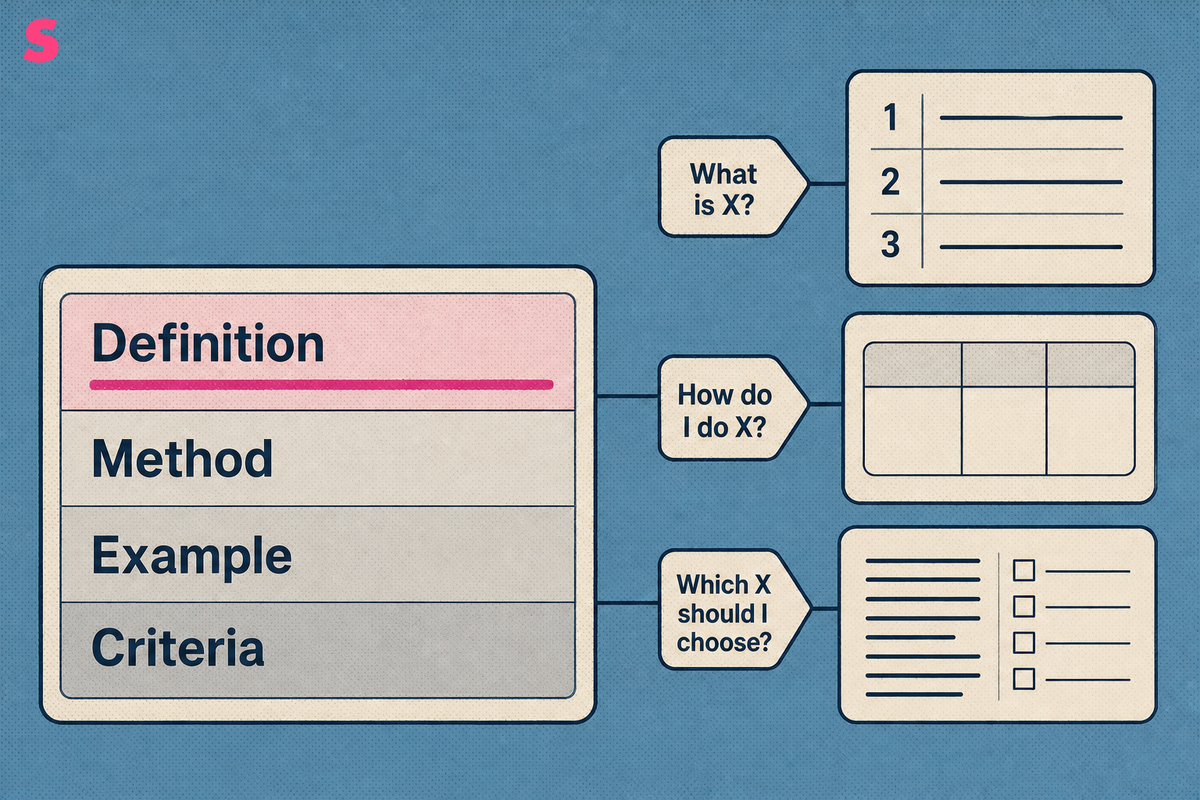
Answer engine optimization (AEO) is the practice of structuring content so AI-driven systems can extract, summarize, and present it as a direct answer. In marketing, AEO makes a page clear enough for an answer engine to select or cite when a buyer asks a question.
AEO applies to Google AI Overviews, featured snippets, voice search, and AI-generated answers. The goal is not only to rank, but to make a page's substance easy for an engine to identify, verify, and reuse in a synthesized response.
For example, a page targeting “what is account-based marketing?” should open with a concise definition, explain the method, provide a practical example, and support claims with clear headings. A page that opens with a broad company story makes extraction harder. AEO favors direct answers, precise intent matching, and usable structure.
- Question: “What is X?” requires a definition near the opening.
- Question: “How do I do X?” requires an ordered method.
- Question: “Which X should I choose?” requires criteria and a defensible comparison.
Why does AEO matter if your job is generating B2B pipeline?
AEO matters to B2B pipeline because buyers research categories, vendors, and implementation questions in answer engines before visiting a website. A brand omitted from those answers loses a chance to enter the buying process before a form fill, branded search, or demo request.
Zero-click searches reportedly rose from about 50% in 2019 to 68% in 2026, per cmswire.com, June 2026. The same source reported that queries triggering Google AI Overviews had an approximately 83% zero-click rate, compared with about 60% for queries without Google AI Overviews, per cmswire.com, June 2026.
That shift changes the measurement problem. Sona AI Visibility connects citations to pipeline and revenue on one account timeline and tracks AI crawler activity reaching pages, so teams can investigate whether AI search contributes to commercial outcomes rather than report mention counts alone.
Microsoft Vice President Lynne Kjolso described the relationship clearly in June 2026: “everything that works in SEO continues to work in the age of large language models, but AEO is a set of additional practices so that you can really refine your content and make sure the content has what the large language models are looking for.”
How does AEO differ from SEO, GEO and AI SEO, and is it just a rebrand?
AEO overlaps with SEO and GEO, but it is not simply a rebrand. SEO focuses on discoverability and rankings in search results. AEO focuses on selection as a direct answer or citation. GEO emphasizes positioning content as trusted reference material for generative outputs.
AI SEO is an umbrella label rather than a standardized discipline. Teams use AEO, GEO, LLM optimization, and AI SEO differently. The practical distinction is the outcome: a page can rank in conventional search without appearing in an AI-generated answer.
| Discipline | Primary outcome | Typical unit of work | Core measurement |
|---|---|---|---|
| SEO | Visibility in conventional search results | Keyword, page, technical issue | Rankings, impressions, clicks |
| AEO | Selection as a direct answer or citation | Prompt, answer, cited page | Mentions, citations, position in answers |
| GEO | Trusted reference material for generative outputs | Topic, source authority, evidence | Inclusion and representation in generated responses |
| AI SEO | Broad optimization for AI-assisted discovery | SEO and answer-engine work combined | Search and answer-engine visibility |
The disciplines share foundations: authoritative content, direct answers, clear information architecture, and technical accessibility. AEO adds a tighter focus on whether an answer engine can isolate a relevant claim and use it accurately.
How do answer engines find, select and cite a page?
Answer engines find, select, and cite pages through crawling, parsing, retrieval, evaluation, and answer assembly. AEO improves each stage by making a page reachable, structurally clear, relevant to the prompt, and supported by evidence.
- An engine or crawler accesses a page and reads its available content.
- The system parses headings, body copy, links, structured data, metadata, and page context.
- The system retrieves pages relevant to a buyer’s prompt.
- The answer engine selects passages that address the question directly.
- The answer engine synthesizes a response and may name or cite supporting sources.
Consider a buyer asking, “How do I measure AI search pipeline?” A vague analytics page gives the model little material to reuse. A stronger page defines AI search attribution, explains the required data path, identifies measurement limits, and provides a concise workflow. The engine then has clearer material to retrieve and summarize.
Sona AI Visibility tracks citations and AI crawler visits, including crawler activity read from server logs or a lightweight edge worker rather than a JavaScript tag. That distinction matters because a page cannot contribute to an answer unless relevant crawlers can reach and parse the page.
How do ChatGPT, Perplexity, Google AI Overviews, and other answer engines choose sources differently?
ChatGPT, Perplexity, Google AI Overviews, and other answer engines all produce AI answers, but they operate in different product contexts and present sources differently. AEO should test the same buyer prompts across multiple answer surfaces rather than treat one result as universal.
| Answer surface | Primary user context | How sources appear | AEO implication |
|---|---|---|---|
| ChatGPT | Conversational research and task completion | Sources can appear within a synthesized response | Write direct, self-contained explanations that answer full questions |
| Perplexity | Research-oriented question answering | Sources are prominent alongside answer claims | Support claims with specific, attributable evidence |
| Google AI Overviews | Search-result research journeys | Source links appear within a Google-generated overview | Preserve SEO fundamentals while writing extractable answers |
| Gemini and other answer engines | Conversational and integrated AI assistance | Presentation varies by product and prompt | Validate important prompts across more than one engine |
Sona’s AI visibility data, September 2026, covers 8 answer surfaces: ChatGPT, Google AI Overviews, Perplexity, Google AI Mode, Gemini, Mistral, Qwen and Claude. That coverage reflects a practical AEO principle: citation patterns are engine-specific, so one answer surface cannot represent the entire market.
Teams should preserve prompt wording during testing. Small phrasing changes can alter intent, retrieved sources, and answer format. A useful prompt set includes definition questions, implementation questions, comparison questions, and high-intent vendor evaluation questions.
What makes a page easy for an AI engine to find, parse and trust?
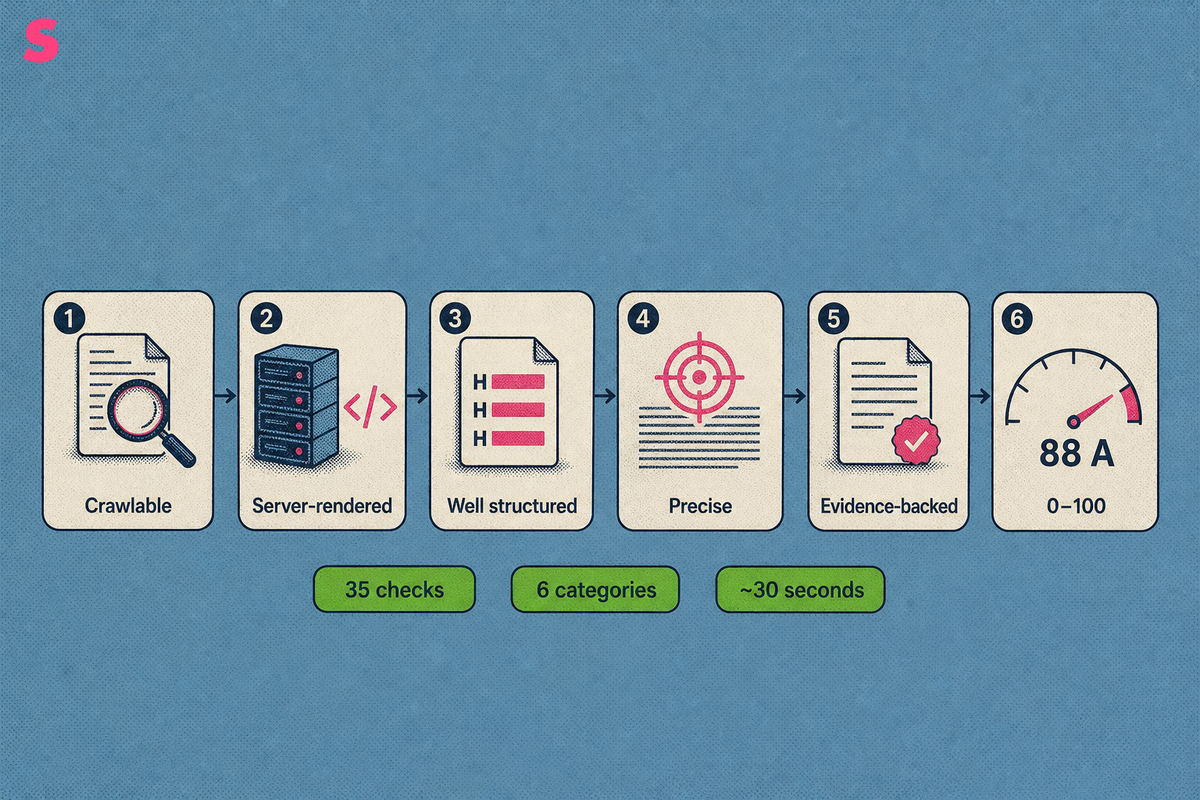
A page becomes easier for an AI engine to find, parse, and trust when it is crawlable, server-rendered, well structured, precise, and supported by evidence. AEO requires making the useful answer visible in both page architecture and copy.
- Use a descriptive title tag and a heading that matches the buyer’s question.
- Place a direct answer in the opening paragraph.
- Use headings that separate definitions, methods, comparisons, and caveats.
- Use lists and tables where the subject is genuinely procedural or comparative.
- Keep canonical tags, robots.txt directives, schema markup, and internal links accurate.
- Make essential content available in server-rendered HTML rather than relying entirely on JavaScript.
Authority is not a formatting trick. A page earns trust by answering the exact question, using consistent terminology, explaining limits, and avoiding unsupported claims. AEO also favors longer, conversational queries. AEO favors queries of four or more words over the shorter keyword patterns common in traditional SEO, per youtube.com.
The Free AI Readiness Checker evaluates whether AI can read a site through 35 checks across 6 categories and returns a 0–100 score with a letter grade in about 30 seconds. Those figures come from Sona’s product documentation. The score is a dated snapshot that identifies technical work before a team begins ongoing prompt tracking.
What does an AEO workflow look like for a B2B SaaS company?
An AEO workflow for a B2B SaaS company starts with buyer prompts, maps those prompts to pages, improves the pages that should answer them, and monitors whether the brand becomes cited. The work should follow commercial intent rather than a generic list of AI-related keywords.
- Collect questions from sales calls, customer interviews, search queries, support tickets, and competitive evaluations.
- Group prompts by buying stage, such as awareness, consideration, decision, and purchase.
- Assign each important prompt to an existing page or a planned page.
- Rewrite the page so the direct answer appears before broader explanation.
- Fix crawlability, canonical, rendering, metadata, schema, and content-structure issues.
- Run the same prompt list daily and review page-level changes monthly or quarterly.
A company selling attribution software might optimize beyond “marketing attribution” by building pages that answer “how do I attribute pipeline from AI search?” and “what is the difference between first-touch attribution and AI search attribution?” Each page should state the answer, explain the mechanism, and clarify its limits.
Sona AI Visibility can connect prompts and citations to pipeline and revenue, while its AI crawler data shows whether answer-engine crawlers are reaching the pages assigned to those prompts. That makes the workflow a measurement process rather than only a content production process.
How do you measure whether AEO is working?
AEO is working when important prompts produce accurate brand mentions or citations, AI-referred visits increase in quality, and the resulting activity contributes to qualified accounts and commercial outcomes. Rankings alone do not answer that question because answer engines may cite a page without sending a conventional search click.
Measure AEO at four levels:
- Prompt coverage: whether the brand appears for priority buyer questions.
- Citation quality: whether the answer describes the brand accurately and cites the intended page.
- Page readiness: whether the cited page is crawlable, current, structured, and technically sound.
- Commercial contribution: whether AI-referred activity connects to accounts, opportunities, pipeline, and revenue.
A team that runs the same prompt list daily can identify patterns that a weekly snapshot would average away. An answer can change because of a retrieval-index update, a model update, or a competitor’s newly published page. A change that holds for four days is a trend. A one-day spike is not.
Sona AI Visibility supports that operating rhythm by tracking AI search visibility and connecting AI-referred activity to revenue measurement. AI Attribution connects citations to accounts, pipeline, and closed-won revenue on one timeline, including self-reported attribution for research that did not create a click.
What are the limits of AEO, and what is it commonly confused with?
AEO cannot guarantee citation, rankings, traffic, or pipeline because answer-engine responses vary by prompt, retrieval conditions, model behavior, and time. AEO improves the chance that useful content is available for selection, then measures resulting visibility and commercial activity.
AEO is commonly confused with keyword stuffing, publishing generic AI content, or adding schema markup without improving the page itself. None substitutes for an accurate answer. A page still needs relevance, evidence, technical accessibility, and a clear relationship to the buyer’s question.
AEO is also not identical to GEO. AEO emphasizes direct-answer selection in featured snippets, voice search, and AI-generated answers. GEO emphasizes trusted reference material for generative outputs. Teams often use both labels loosely, so the desired outcome should be defined before selecting a process or vendor.
Monitoring which AI answers mention a brand is only half the job. The other half is connecting those mentions to accounts, pipeline, and revenue. Sona AI Visibility closes that loop by connecting citations and AI-referred visits to an account timeline that includes pipeline and closed-won revenue.
What are the frequently asked questions about AEO?
What does AEO stand for?
AEO stands for answer engine optimization. It means shaping content so AI-driven systems can extract it and present or cite it as a direct answer. AEO applies to AI-generated answers, featured snippets, voice search, and answer surfaces such as Google AI Overviews.
Is AEO the same as SEO?
No. AEO and SEO overlap heavily, but they measure different outcomes. SEO focuses on rankings, impressions, and clicks in conventional search. AEO focuses on whether a brand is accurately mentioned or cited in a synthesized answer. Strong SEO remains an important foundation for AEO.
What is the difference between AEO and GEO?
AEO targets selection as a direct answer in featured snippets, voice search, and AI answers. GEO positions content as trusted reference material for generative outputs. Practitioners often use the terms loosely, so a team should define whether it is optimizing for citations, page visibility, AI-referred traffic, or revenue measurement.
What is AI SEO called?
AI SEO goes by several names, including AEO, GEO, and LLM optimization. The labels are not standardized. The useful first step is defining the outcome, such as citation in AI answers, then selecting the content, technical, and measurement work required to support that outcome.
How do I start doing AEO?
Start by listing buyer prompts, checking which answer engines cite the brand today, and identifying the pages that should answer those prompts. Rewrite those pages so each opens with a direct answer and remains crawlable without JavaScript. Run the same priority prompt list daily, then schedule fuller technical reviews monthly or quarterly.
Can AEO results be measured and tied to revenue?
Yes, in part. Mentions, citations, share of voice, and AI-referred visits can be measured, while account and CRM data can connect some activity to pipeline and revenue. Answers vary between runs and attribution remains incomplete, so AEO figures should be treated as directional evidence rather than proof of a single cause.
Summarize this article with AI: ChatGPT · Claude · Perplexity · Google AI Mode
Last updated: October 2026