Traditional SEO and LLM prompt coverage differ in their unit of measurement: SEO tracks a page's ranking for a keyword, while prompt coverage tracks whether AI responses mention and cite your brand. Technical SEO continues to determine what AI systems can find, so they complement each other instead of competing. Since AI responses differ by model, location, and wording, coverage requires a fixed prompt set and sampling rules. Sona AI Visibility connects prompts and citations to pipeline and revenue, while tracking AI crawler and agent activity.
What is the difference between traditional SEO and LLM prompt coverage?
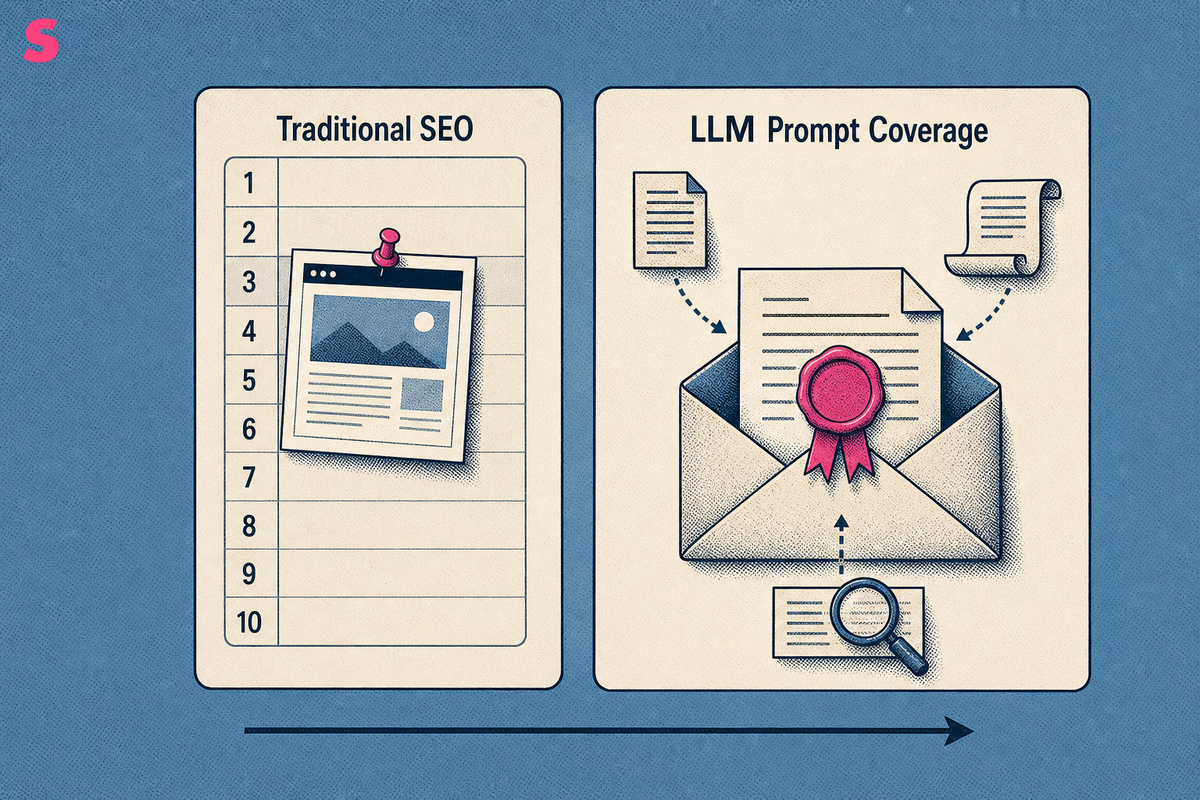
The difference between traditional SEO and LLM prompt coverage is the unit measured. Traditional SEO measures whether a URL ranks for a keyword on a search engine results page. LLM prompt coverage measures whether a brand, page, or source appears in an AI-generated answer to a complete question.
LLM SEO is the optimization discipline behind that measurement. It optimizes owned content, technical accessibility, structured information, and broader web presence for inclusion or citation in AI-generated answers. Prompt coverage is the measurement layer that tests whether LLM SEO produces mentions, citations, or recommendations for defined buyer questions.
Traditional SEO helps a page rank. LLM prompt coverage shows whether an AI answer quotes, cites, recommends, compares, or omits a brand. Search rankings create page-level visibility, while AI answers can draw from cited pages, brand references, comparisons, and source material across the web.
Traditional SEO remains essential because crawlability, technical quality, content structure, and authority affect what search engines and answer engines can find. LLM prompt coverage adds a separate measurement layer: whether an answer engine includes the company when a buyer asks a relevant question.
Sona AI Visibility connects citations and prompts to pipeline and revenue on one account timeline, while tracking AI crawlers reaching site pages, so AI visibility becomes a measurable acquisition channel rather than a mention count.
How do traditional SEO and LLM prompt coverage compare side by side?
Traditional SEO and LLM prompt coverage share content and technical foundations, but answer different operating questions. SEO asks whether a page earns visibility and clicks in ranked results. Prompt coverage asks whether a brand appears in an answer that may contain several recommendations, citations, or no links.
| Dimension | Traditional SEO | LLM Prompt Coverage | Operational implication |
|---|---|---|---|
| Primary unit | URL and keyword | Prompt and generated answer | Track pages for SEO, then track buyer questions for AI visibility. |
| Visibility outcome | Ranked result | Brand mention, citation, recommendation, or comparison | A cited page can matter even without a conventional ranking position. |
| Core measurement | Position, impressions, clicks, conversions | Coverage, citations, mentions, sources, and answer inclusion | Read search performance and answer visibility together. |
| Optimization scope | A page matched to a keyword | A brand’s web presence matched to a question | Product pages, comparison pages, documentation, and third-party sources can all affect coverage. |
| Reporting cadence | Rank and traffic trend | Repeated prompt sampling by engine | Run the same prompt set daily to distinguish durable movement from answer noise. |
Google Search Console reports Google impressions and clicks, while prompt coverage requires separate answer sampling. Neither replaces the other. A B2B SaaS team needs search data to understand demand and click behavior, then AI visibility data to understand what buyers encounter before a visit.
Sona's own AI visibility data, September 2026, covers 8 answer surfaces: ChatGPT, Google AI Overviews, Perplexity, Google AI Mode, Gemini, Mistral, Qwen and Claude. A brand can appear in one answer surface and remain absent elsewhere.
What does an LLM prompt coverage metric actually measure?
An LLM prompt coverage metric measures whether a brand appears in the generated response to a defined buyer question. It records inclusion, omission, citations, competing brands, answer position where relevant, and the sources supporting the answer.
A useful prompt coverage metric fixes the prompt, engine, country, language, date, and scoring rule. A team can classify an answer as covered when the company is named, cited, or recommended for the stated use case. The rule must remain stable across runs.
A brand-level visibility score is a dated snapshot, not a work item. A prompt-level view identifies the questions behind the score and the sources shaping the answer. Sona AI Visibility uses AI Search Insights to show buyer prompts and the pages or sources associated with AI-answer performance.
The reporting output should become a log. A team that runs the same prompt list daily can identify patterns that a weekly snapshot would average away. A change that holds for four days is a trend; a one-day spike is answer variability.
Is LLM prompt coverage just rank tracking, and is it stable enough to trust?
LLM prompt coverage is not rank tracking with new terminology. Rank tracking records a URL’s position for a query. Prompt coverage records whether a brand is mentioned, recommended, cited, compared, or omitted within a generated answer, where no universal position equivalent exists.
AI answers vary by model, retrieval index, prompt wording, location, and date. That variability makes one-off screenshots weak evidence, but repeated measurement remains reliable when teams use a fixed prompt set, stable scoring rules, and a documented engine list.
Sona AI Visibility tracks prompts daily across answer engines and connects citations to pipeline and revenue. Daily tracking provides an operating rhythm for detecting answer changes over time.
Use two clocks. Run priority prompts daily because model updates, retrieval changes, and competitor publishing can shift answers quickly. Review technical findings monthly or quarterly because a full page audit and positioning review require broader interpretation than a daily prompt log.
Why can a SaaS company rank in Google yet be missing from AI answers?
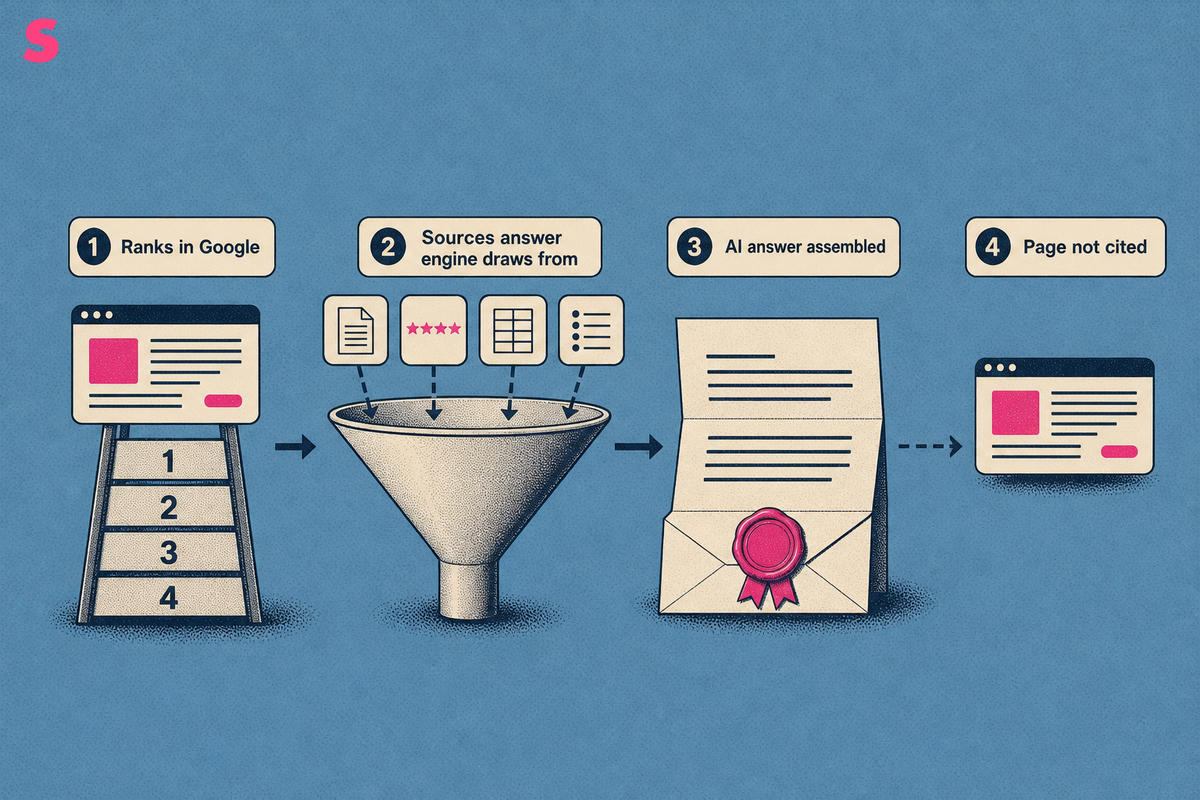
A SaaS company can rank in Google yet remain absent from AI answers because a ranking reflects one page’s performance for one keyword, while an answer engine assembles a response from sources and entities relevant to the full prompt. Strong SEO is necessary, but it does not guarantee an AI mention.
A buyer may ask for implementation advice, category comparisons, security requirements, alternatives, pricing context, or integration compatibility. The answer engine can cite documentation, reviews, comparison pages, directories, and editorial material rather than the page ranking for a head keyword.
The gap is often operational. A company may have a well-ranked product page but no source that directly answers a commercial comparison prompt. Another company may have fewer rankings but stronger evidence across product documentation, use-case pages, and independently cited explanations.
Sona AI Visibility helps teams trace the gap from prompt to page, then connect AI-referred activity to accounts, pipeline, and revenue. The priority is visibility for prompts associated with commercial research and buying intent.
Which source attributes make an AI answer cite one page and skip another?
AI answers cite pages that clearly address the prompt, can be crawled and parsed, and provide evidence the answer engine can use. Traditional SEO signals still matter, but LLM prompt coverage adds a source-selection question: does the page contain the specific information needed to support the generated answer?
| Source attribute | Traditional SEO value | AI answer citation value | What a team should inspect | Useful evidence |
|---|---|---|---|---|
| Crawlability | Allows search engine discovery | Allows answer engines and retrieval crawlers to access content | robots.txt, status codes, canonical tag, and server-rendered HTML | Crawler access records |
| Directness | Improves keyword relevance | Gives the answer engine language that directly addresses the prompt | Definitions, comparisons, implementation details, and concise claims | Prompt-to-page match |
| Structured content | Clarifies page meaning | Makes entities, sections, and question-answer content easier to parse | Schema.org markup, headings, tables, and semantic HTML | Technical audit findings |
| Evidence quality | Supports authority and trust | Provides support for a recommendation or factual statement | Product documentation, methodology, dates, and clear attribution | Cited-source review |
| Recency | Can affect freshness-sensitive queries | Helps when an answer requires current pricing, product, or market context | Update dates, changed claims, and obsolete pages | Page revision history |
A documented citation review should record the engine, measurement date, exact prompt, cited source, passage or fact used in the answer, and a comparable uncited source. The observed source attribute is a citation correlate unless repeated evidence establishes causation.
Technical quality alone does not create a citation. A page must answer a question with enough specificity to serve as source material. A product page with broad positioning can lose to a detailed implementation guide when the prompt asks how a process works.
The Free AI Readiness Checker evaluates whether AI engines can technically crawl and parse a site, according to Sona product documentation. It evaluates technical readiness, not whether a brand appears in AI answers.
How do you build a prompt set and choose which AI engines to monitor?
Build a prompt set from the questions buyers ask before choosing a vendor, then monitor the answer engines those buyers use for research. Start with commercial and comparison prompts because they show whether the brand appears when purchase intent is highest.
- Collect high-intent keywords from search data, sales calls, product research, and competitor comparisons.
- Rewrite each keyword cluster as one to three natural buyer questions.
- Tag each prompt by intent and buying stage, such as awareness, consideration, decision, or purchase.
- Define a coverage rule before collecting results, including what counts as a mention, citation, recommendation, or competitor comparison.
- Run the same prompt set daily and record the engine, date, answer, cited sources, and coverage result.
Start with ChatGPT, Perplexity, Gemini, Claude, Google AI Overviews, and other answer engines used by the target market. Expand the engine set only after the team can read the first prompt trends and act on them. More engines do not improve a weak prompt taxonomy.
Sona AI Visibility supports prompt-level measurement across 11 AI engines, according to Sona product documentation. The useful sequence is keywords, prompts, pages, accounts, and revenue because a prompt list without a business outcome becomes another reporting artifact.
How do AI visibility tools differ in prompt limits, engine coverage and price?
AI visibility tools differ in billing unit, daily prompt allowance, engine coverage, and whether they connect answer visibility to business outcomes. Compare the daily prompt denominator, engine count, and refresh cadence before comparing plan prices.
The table uses published entry-plan information as of October 2026. A low monthly price can represent fewer prompts, fewer engines, or a different response allowance.
| Tool | Starting price | Agency Plans? (Yes/No) | # of Answer Engines Tracked | Answer Engines | # of Daily Tracked Prompts (entry plan) | Cost per Daily Tracked Prompt | Differentiation |
|---|---|---|---|---|---|---|---|
| Sona AI Visibility | From $75/month, billed annually | Yes | 11 | Not published | 5,000 credits/month, about 166 daily tracked prompts on one model or 56 across three | About $0.45 per daily tracked prompt | Connects AI citations and prompts to pipeline and revenue on one account timeline, plus AI crawler activity from server logs. |
| Profound | Custom pricing | Yes | 9 | ChatGPT, Perplexity, Google AI Mode, Gemini, Microsoft Copilot, DeepSeek, Claude, Google AI Overviews, Exa Search | Custom daily prompt plan | No refresh cadence published | Enterprise AI visibility plans track up to nine answer engines. |
| Peec AI | From $95/month | Yes | 3 | Not published | 50 prompts daily | About $0.63 per daily tracked prompt | Self-serve AI visibility plans with selected models on the Starter plan. |
| Otterly.ai | From $29/month | Yes | 4 | ChatGPT, Google AI Overviews, Perplexity, Microsoft Copilot | 15 prompts daily | About $0.48 per daily tracked prompt | AI search monitoring with paid engine add-ons. |
| Scrunch AI | From $250/month | Yes | 4 | ChatGPT, Perplexity, Google AI Overviews, Copilot | 125 prompts | No refresh cadence published | Core plan with AI answer monitoring across four engines. |
| AthenaHQ | From $295/month | Yes | 11 | Not published | 3,600 credits/month, unlimited prompts | No refresh cadence published | Credit-based AI response monitoring with unlimited prompts on Starter. |
| PromptWatch | From $95/month | Yes | Not published | Not published | 50 prompts daily | About $0.48 per daily tracked prompt | Prompt and response tracking with all supported models on every plan. |
| Goodie | From $295/month | Yes | 5 | Not published | 110 prompts daily | About $0.67 per daily tracked prompt | Core plan with five models and daily prompt monitoring. |
Sona AI Visibility starts from $75 per month billed annually and includes unlimited seats, API access, and MCP access on every plan, according to Sona pricing documentation, October 2026. The comparison should end with a workflow decision: which data can the team turn into content, technical, sales, or demand-generation work.
Which should you invest in first, and when does the difference not matter?
Invest in traditional SEO first when a company lacks crawlable pages, technical foundations, keyword coverage, or organic demand visibility. Add LLM prompt coverage when buyers research the category in AI answers and the company needs to know whether those answers create pipeline, not merely mentions.
The distinction matters most for B2B SaaS companies with long evaluation cycles, comparison-driven buying behavior, and meaningful zero-click research. A search ranking cannot show whether the buyer encountered the brand during AI-assisted research.
The distinction matters less when the goal is narrow. If a team only needs to repair indexation, monitor a small set of Google rankings, or validate a single technical issue, traditional SEO reporting is sufficient. If a company has no defined buyer prompts, prompt coverage will generate noise rather than a useful program.
Use both when the operating model is ready. Traditional SEO provides pages, technical access, and demand evidence. LLM prompt coverage shows whether those assets become part of AI-generated recommendations, then whether resulting visits connect to accounts and revenue.
What are the frequently asked questions?
Is LLM prompt coverage just rank tracking with new terminology?
No. Rank tracking records a URL’s position for a query. LLM prompt coverage records whether a brand is mentioned, recommended, cited, compared, or omitted inside a generated answer. An AI answer can cite several sources and recommend several vendors without creating a stable rank position.
Can traditional SEO alone get a brand cited in AI answers?
Sometimes. Crawlability, authoritative content, structured data, and direct answers influence what AI systems can find. But rankings measure a page, while AI answers draw from a brand’s broader web presence. Strong organic rankings do not guarantee a brand mention or citation.
Does Search Console show how often AI answers mention my brand?
No. Search Console reports Google impressions and clicks. AI answer visibility requires separate prompt sampling across ChatGPT, Perplexity, Gemini, Claude, Google AI Overviews, and other answer engines. Read the two data sets together to separate search demand from answer inclusion.
Are AI answers too variable to measure reliably?
AI answers vary by model, location, date, and prompt wording, so single readings mislead. A defensible setup fixes the prompt set, sampling frequency, engine versions, and scoring rules. Report trends from repeated observations rather than presenting one answer as a permanent result.
How much does it cost to track prompt coverage?
Compare tools by daily tracked prompts, answer engines, and refresh frequency rather than plan price alone. Sona AI Visibility lists about $0.45 per daily tracked prompt on its entry plan.
Which AI engines should a B2B SaaS team monitor?
Start with the engines buyers use for research: ChatGPT, Perplexity, Gemini, Claude, Google AI Overviews, and other answer engines. Add other answer engines once the prompt set is stable and the team can interpret the first results. The first goal is a readable decision signal, not maximum engine coverage.
Summarize this article with AI: ChatGPT · Claude · Perplexity · Google AI Mode
Last updated: October 2026