Query fan-out is how AI search engines divide one prompt into multiple sub-queries, process them concurrently, and combine the findings into one answer. Reported sub-query counts vary because vendors count different things: generated, executed, or observable searches. Forecast fan-outs are estimates, not documented engine behavior. The practical method is to set a measurement boundary first, then test a fixed prompt set and focus on sub-queries your content can actually answer.
What is query fan out and how is it different from a keyword search?
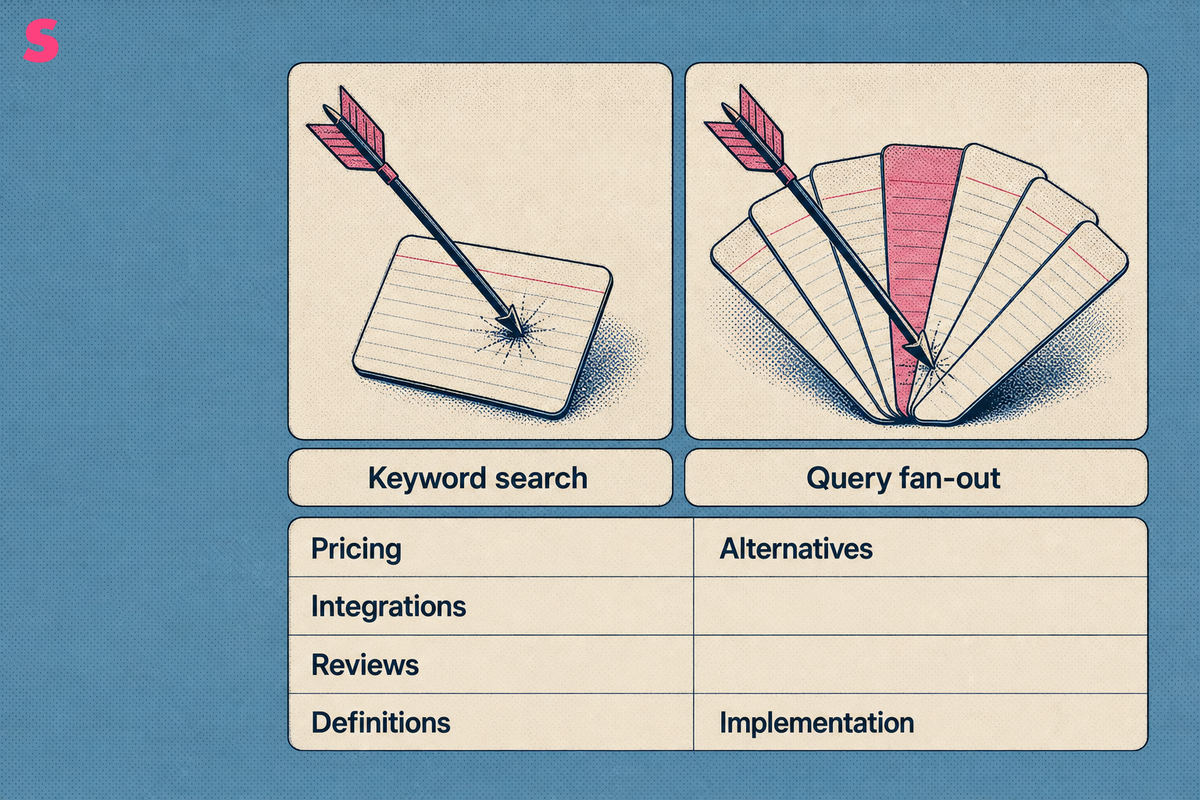
Query fan out is a retrieval process in which an AI search engine turns one user prompt into several narrower searches, gathers evidence for each, and combines the results into one answer. A keyword search generally sends one short query to an index. Fan-out begins with a fuller question and decomposes its intent.
For a B2B SaaS marketer, the distinction changes the unit of work. A buyer asking for the best attribution platform is expressing more than a head term. The engine can investigate pricing, integrations, reviews, alternatives, definitions, and implementation requirements before writing its response.
Query fan-out is a retrieval technique, not a new ranking system. The answer engine runs sub-queries, often in parallel, to gather evidence from different angles and synthesize a cited response. A page can appear because it answers one branch well, even when it does not rank for the buyer’s original wording.
Query fan-out is also distinct from keyword clustering. Keyword clustering groups search terms for marketers to plan around. Fan-out is an engine’s process for researching a prompt. Its branches may resemble keywords, but they gather evidence rather than organize campaigns.
How does query fan-out work step by step in ChatGPT, Google AI Mode and other AI search engines?
Query fan-out decomposes a prompt, retrieves evidence for several sub-questions, and synthesizes that evidence into one answer. Web-enabled answers in ChatGPT, Google AI Mode, Google AI Overviews, Perplexity, Gemini, Claude, and other answer engines can use this retrieval pattern.
Consider a buyer prompt: Which marketing attribution platform is best for a B2B SaaS company with Salesforce? The engine identifies several intents within the request: category definition, product comparison, Salesforce integration, pricing, implementation, and independent evaluation.
- Decompose the prompt. The engine turns the broad request into narrower research tasks, such as attribution platform Salesforce integration, B2B SaaS attribution pricing, and attribution platform reviews.
- Retrieve in parallel. The engine searches for pages that answer each task. Parallel retrieval matters because one comparison page rarely provides reliable detail on integrations, pricing, and technical setup.
- Evaluate evidence. The engine selects sources relevant to each branch and resolves conflicts or gaps before drafting.
- Synthesize an answer. The engine returns one response, often with recommendations, caveats, and citations drawn from different retrieved pages.
higoodie.com describes query fan-out as executing multiple sub-queries in parallel before the engine compiles one answer. The visible answer is the output. The hidden research path is the fan-out.
What kinds of sub-queries does an AI engine generate from one prompt?
An AI engine can generate sub-queries for comparison, reviews, pricing, alternatives, definitions, and integrations. The branches reflect the evidence needed to answer a complex prompt, rather than a fixed template used by every engine.
For the B2B SaaS attribution prompt, each branch points to a different content asset. A product page may answer a pricing branch, while a buyer’s guide, integration documentation, or implementation article answers other branches.
| Sub-query type | Example sub-query | Question being resolved | Content asset that answers it |
|---|---|---|---|
| Comparison | best marketing attribution platforms for B2B SaaS | Which products fit the category? | Comparison guide with selection criteria |
| Review | marketing attribution platform reviews B2B SaaS | What do users and evaluators say? | Customer evidence and review-focused page |
| Pricing | marketing attribution platform pricing | What does adoption cost? | Current pricing page and packaging explanation |
| Alternatives | marketing attribution platform alternatives | What other approaches exist? | Alternatives page with use-case distinctions |
| Definition | what is multi-touch attribution for SaaS | What problem does the category solve? | Category explainer with a worked example |
| Integration | marketing attribution platform Salesforce integration | How does the product fit the stack? | Integration documentation or technical guide |
Sub-query types can overlap. An alternatives branch may also seek pricing, while an integration branch may trigger a review search. Group recurring intents in content planning instead of creating a separate page for every wording variation.
How many searches can one prompt produce, and why do reported counts conflict?
One prompt can produce anything from a handful of searches to several hundred because reported counts use different measurement boundaries. A study may count generated sub-queries, executed searches, or only searches visible through an API or interface.
A proprietary explainer dated July 19, 2026 described five to 15 sub-queries for simple prompts and several hundred for complex deep-search tasks. Those are reported ranges, not settled industry benchmarks. Prompt complexity, engine behavior, and research mode affect the total.
| Measurement boundary | Reported figure | What the figure counts | Evidence status |
|---|---|---|---|
| Simple-prompt range | 5–15 | Reported sub-queries for simple prompts | Proprietary explainer, July 19, 2026 |
| Deep-search range | Several hundred | Potential branches in complex research tasks | Proprietary explainer, July 19, 2026 |
| Average reported volume | 9–11 | Average fan-outs per prompt | Proprietary study, March 2, 2026 |
| Lower reported band | 59% | Prompts triggering 5–11 searches | Proprietary study, March 2, 2026 |
| Higher reported band | 24% | Prompts triggering 12–19 searches | Proprietary study, March 2, 2026 |
| Reported maximum | 28 | Maximum fan-outs in one cited sample | Proprietary study, March 2, 2026 |
The figures conflict because their units differ. A generated branch may never execute, an executed search may not appear in a recorder, and an API-visible query may represent only part of a larger retrieval process. Record the measurement boundary before comparing counts.
Why does fan-out matter for SEO and AI search visibility?
Fan-out matters because ranking for a head query is no longer the whole SEO task. AI citations can come from pages retrieved for comparison, review, pricing, implementation, or alternatives branches that the original prompt never states explicitly.
A proprietary analysis dated July 22, 2026 examined 322,485 recorded fan-out searches across more than 130 brands. In that analysis, 80% of prompts triggered at least one search for a best or top option, while 38% triggered at least one review search. Commercial evidence was therefore a material part of the recorded retrieval path.
The same proprietary analysis dated July 22, 2026 found that 14% of recorded searches included the word review. A B2B SaaS team that publishes only category definitions can miss branches where buyers seek social proof, trade-offs, and implementation details.
Sona AI Visibility connects AI citations and AI-referred visits to pipeline and revenue on one account timeline. That measurement distinguishes branches that create exposure from branches associated with accounts, opportunities, and closed-won revenue.
How can you test query fan-out reproducibly?
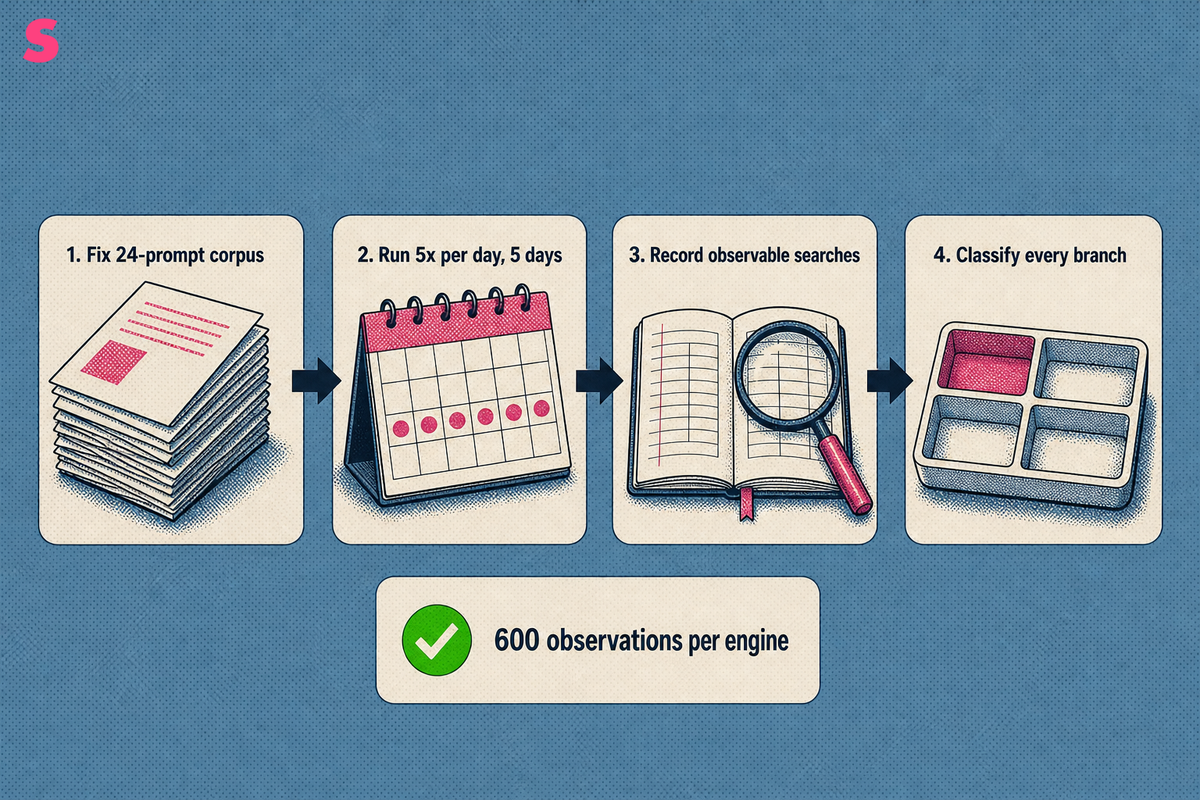
You can test query fan-out reproducibly by fixing a prompt set, running each prompt repeatedly, recording observable searches, and classifying every branch with the same rubric. The goal is a comparable record of visible retrieval behavior, not proof of an engine’s hidden reasoning.
Use this frozen 24-prompt corpus: what is marketing attribution; what is multi-touch attribution for SaaS; how does marketing attribution work; best marketing attribution platforms for B2B SaaS; marketing attribution platform comparison; marketing attribution platform reviews; marketing attribution platform pricing; marketing attribution platform alternatives; marketing attribution platform Salesforce integration; marketing attribution implementation; best attribution platform for a B2B SaaS company with Salesforce; how to choose marketing attribution software; attribution platform for HubSpot and Salesforce; attribution platform for paid search; attribution platform for account-based marketing; attribution platform for product-led growth; first-touch versus multi-touch attribution; marketing attribution reporting examples; how long does marketing attribution implementation take; marketing attribution data requirements; marketing attribution software for enterprise SaaS; marketing attribution software for startups; marketing attribution platform customer support; and marketing attribution platform ROI.
- Set repeat runs. Run every prompt five times per day for five consecutive days, creating 600 observations per engine. Start every run in a fresh signed-out session with the same location, language, engine, and mode. A failed run receives one retry in a new fresh session. Log the retry separately and exclude it from the primary dataset unless the original run failed to return an answer.
- Capture observable branches. Save the exact prompt, visible searches, citations, answer text, and retrieval timestamp. Record a no-search run as zero observable branches. Do not infer unseen sub-queries from the final prose.
- Normalize and deduplicate. Lowercase visible searches, trim punctuation and extra spaces, and normalize singular and plural forms. Treat normalized searches with identical wording as one branch within a run. Keep different wording as separate branches, even when the intent appears similar.
- Classify each branch. Apply one rubric: definition, comparison, review, pricing, alternatives, integration, implementation, or other. Give every branch one primary class.
- Log context. Record engine, date, location, language, signed-in state, model or mode where visible, and whether the result was an original run or retry.
Calculate recurrence as the number of original runs containing a normalized branch divided by 25 original runs for that prompt. Score each branch on four 0–2 factors. Recurrence scores 0 below 20%, 1 from 20% to 59%, and 2 at 60% or more. Business intent scores 0 for informational research, 1 for evaluation, and 2 for pricing, comparison, alternatives, or implementation intent. Content ownership scores 0 when a credible owned page answers the branch, 1 when an owned page partly answers it, and 2 when no credible owned page answers it. Plausible retrievability scores 0 when the topic lacks an appropriate page or evidence, 1 when a relevant page needs material work, and 2 when a current, directly relevant, structured page can answer the branch. The 8-point total prioritizes visible behavior without claiming to represent internal logic.
Sona AI Visibility can support the operating rhythm by tracking prompt performance daily and retaining prompt history. A one-day spike is noise. A change that holds for four days merits investigation.
How do you find, simulate and track fan-out queries for your own topics?
You can find fan-out branches through manual prompting, simulators, recorders, and visibility trackers. Simulators estimate likely branches from a prompt. Recorders observe searches an engine exposes. Treat those as different evidence types rather than merging them into one dataset.
| Approach | What it does | Best use | Main evidence type |
|---|---|---|---|
| Manual prompting | Runs representative prompts and records visible answer behavior | Early research and prompt discovery | Direct observation |
| Simulators | Estimate plausible retrieval branches from one prompt | Content ideation and gap hypotheses | Prediction |
| Recorders | Capture searches or citations exposed during an answer session | Studying observable engine behavior | Observed retrieval traces |
| Visibility trackers | Track whether a brand appears for a maintained prompt set | Trend monitoring and competitive reporting | Repeated visibility observations |
Sona’s own AI visibility data, September 2026, covers eight answer surfaces: ChatGPT, Google AI Overviews, Perplexity, Google AI Mode, Gemini, Mistral, Qwen and Claude. A prompt set should identify the answer surfaces that matter to the buying process before a team interprets visibility changes.
A brand-level visibility score is a dated snapshot, not a work item. Sona AI Visibility connects citations and prompts to pipeline and revenue, while also tracking AI crawler activity from server logs; AI Search Insights shows the prompts buyers ask and the sources AI cites, so a team can investigate the page and prompt behind a result.
Which fan-out sub-queries should your content answer first?
You should answer recurring sub-queries with commercial intent, no credible owned answer, and a plausible retrieval path. Assess recurrence, ownership, and retrievability, then decide whether to build, update, or skip.
Measure recurrence by counting how often the same branch appears across repeat runs. Assess ownership by checking whether an existing page answers the branch clearly. Assess retrievability by reviewing direct topical relevance, current information, useful structure, and evidence appropriate to the question.
- Build when a branch recurs, has material buyer intent, and no owned page answers it.
- Update when a relevant page exists but lacks the specific comparison, pricing, integration, or review evidence the branch requires.
- Skip when the branch rarely recurs, does not fit the product truthfully, or would require unsupported claims.
Sona AI Visibility supports prioritization by connecting prompts to pages that appear in AI answers and identifying pages that should surface for relevant prompts but do not. Use the output as a content work queue, not a larger keyword list.
What is query fan-out not, and what are the limits of optimizing for it?
Query fan-out is not query expansion, related searches, People Also Ask, a multi-step agent workflow, or a ranking factor. It is a retrieval technique that breaks a complex prompt into narrower searches before an answer engine compiles a response.
Query expansion proposes additional terms to improve a search. Related searches and People Also Ask expose options for a human user. A multi-step agent workflow completes tasks across tools and systems. Fan-out may inform those experiences, but it specifically describes the branching retrieval path behind one generated answer.
Predicted branches are not evidence of engine behavior. A simulator can form content hypotheses, but only recorded searches or repeated visibility observations show what an engine exposed during a particular run. The term is not standardized, so studies can use different boundaries and reach different counts.
More content does not guarantee citations. Authority, freshness, structured data, page relevance, and location affect retrieval and citation selection. The Free AI Readiness Checker evaluates whether AI can crawl and parse a site, but it does not measure whether a brand appears in AI answers.
What are the frequently asked questions about query fan-out?
What does query fan-out mean in plain terms?
It means an AI search engine breaks one prompt into several narrower searches, runs them at once, and merges the results into one answer. The user sees one response, while the engine may research comparison, review, pricing, and integration branches behind the scenes.
Is query fan-out the same as query expansion or related searches?
No. Query expansion and related searches suggest alternative terms for a human to choose. Fan-out runs sub-queries automatically and feeds the results into a single generated answer. Marketers must study the evidence branches, not only visible suggestions.
Does ChatGPT use query fan-out?
In answers that use web search, ChatGPT can run several searches per prompt. An analysis published October 13, 2026 reported that 57% of ChatGPT research answers used multi-query research in August 2026, compared with 2% previously reported by the same study source. The share varies by prompt type and measurement method.
Can I see the exact fan-out queries behind my own prompts?
Only partly. Some engines expose the searches they run, and recorder tools capture those visible searches. Simulators predict likely branches and should be treated as estimates. A reproducible test logs the engine, date, location, prompt, repeat run, and whether a branch was directly observed.
Do I need a separate page for every sub-query?
No. Group sub-queries by intent, cover recurring branches in self-contained sections, and skip branches your organization cannot answer credibly. One robust comparison guide can answer several closely related comparison branches without creating thin pages for every wording variation.
Why do different sources report different fan-out counts?
Different sources count different things, including generated sub-queries, executed searches, and searches visible through an API or interface. They also sample different engines, modes, prompt types, locations, and dates. Treat reported figures as bounded observations rather than universal benchmarks.
Summarize this article with AI: ChatGPT · Claude · Perplexity · Google AI Mode
Last updated: October 2026