Leading figures in generative engine optimization are those whose research, frameworks and hands-on work shape how brands are cited in AI-generated answers. Frequently mentioned names include Kevin Indig, Olaf Kopp, Ross Simmonds and Jason Barnard, yet repeated mentions do not prove results, and published expert rankings seldom reveal their methodology. Categorize every person by their contribution, whether terminology, research, practice or software, then evaluate their guidance against the prompts an actual B2B SaaS buyer enters.
Who are the thought leaders in generative engine optimization?
Generative engine optimization (GEO) makes owned content discoverable and trustworthy to AI-driven generative models, per LinkedIn. For marketing teams, GEO determines whether category expertise, product information, and leadership perspectives surface in AI-generated answers.
Thought leaders in generative engine optimization work across distinct lanes. Some analyze how AI search changes discovery. Others apply AEO methods, build entity authority, or create distribution systems that place credible material where answer engines retrieve it.
| Person | Why they are cited | Primary lane | Contribution to GEO discussions |
|---|---|---|---|
| Kevin Indig | SEO and AI-search analyst | Analysis | Interprets how AI search changes discovery, content demand, and search strategy. |
| Olaf Kopp | SEO and AEO practitioner | Practice | Connects established SEO work with answer-engine visibility. |
| Ross Simmonds | Content and distribution strategist | Content distribution | Focuses on how useful content reaches relevant audiences and publications. |
| Jason Barnard | Kalicube Process and entity understanding | Entity authority | Frames brand clarity, entity relationships, and corroborating sources as discoverability inputs. |
| Donald Thompson | Positions GEO around discoverable brand, product, and leadership content | Practice | Connects executive thought leadership with visibility in AI-generated responses, per WRAL. |
| David Quaid | Listed among 2026 GEO experts | Practice | Appears in current expert roundups covering GEO work. |
| Edward Sturm | Listed among 2026 GEO experts | Practice | Appears in current expert roundups covering GEO work. |
| Ryan Jones | Listed among 2026 GEO experts | Practice | Appears in current expert roundups covering GEO work. |
Identify each expert’s lane before adopting the advice. An entity specialist clarifies who a company is. A distribution specialist helps credible material reach relevant publications. An analyst interprets market changes. A practitioner turns those ideas into work across content, technical SEO, digital PR, and answer surfaces.
What separates a terminology pioneer, an independent analyst, a practitioner and a software vendor?
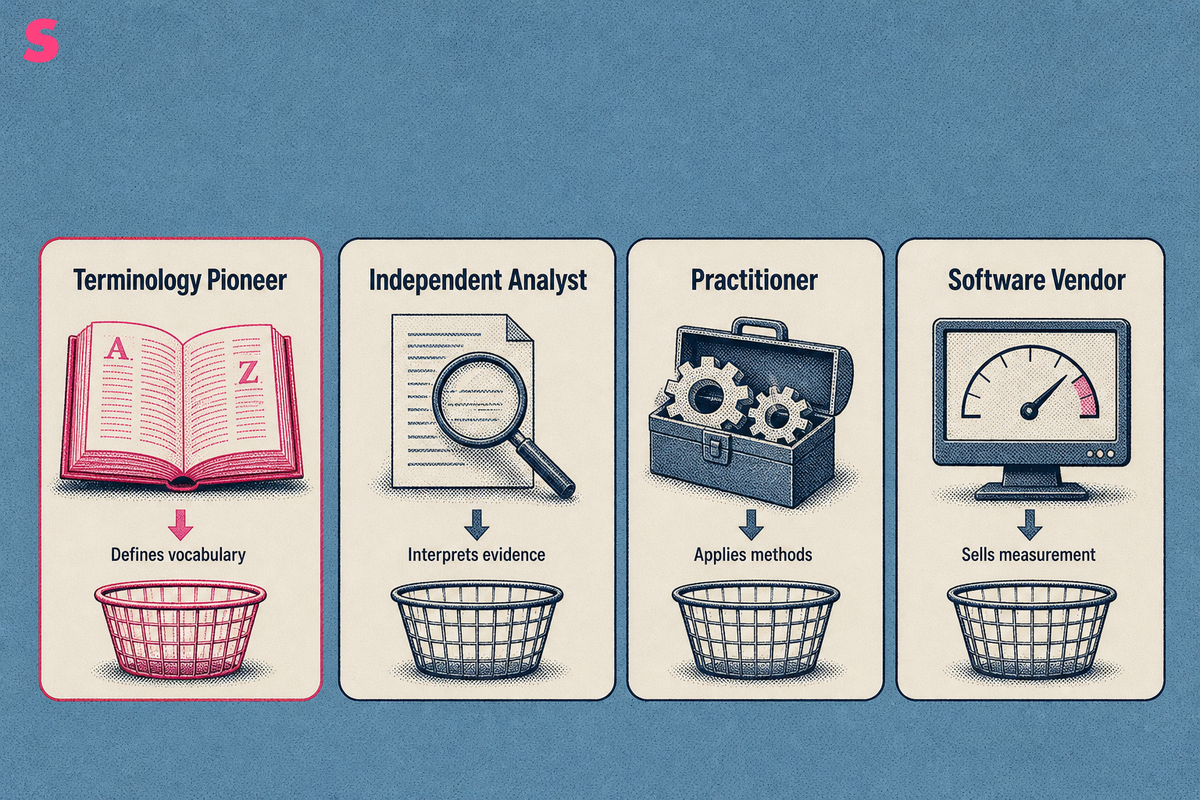
GEO commentary comes from four groups with different incentives. Terminology pioneers define categories, independent analysts interpret evidence, practitioners apply methods for clients or employers, and software vendors sell measurement. Each group can contribute useful insight, but none deserves automatic authority.
- Terminology pioneers create vocabulary and frameworks. Their work makes new problems legible, but a new term does not prove commercial impact.
- Independent analysts interpret changes in search, retrieval, and AI answers. Their strongest work shows the evidence behind each conclusion.
- Practitioners turn concepts into content, entity, PR, and technical work. Their advice is most useful when it identifies the operating conditions behind a result.
- Software vendors provide tracking, reporting, and workflow systems. Their research can reveal useful patterns, but readers should account for their commercial interest.
A large following, conference slot, or tool launch does not establish that a GEO method works. Defined contributions, transparent reasoning, reproducible observations, and disclosed commercial interests carry more weight than confident claims.
Thought leadership should generate questions, not replace measurement. A B2B team should assess what an expert contributed, what evidence supports the claim, and whether the proposed method matches its buyer journey.
How are thought leaders actually being cited in AI-generated answers?
Thought leaders surface in AI-generated answers when answer engines retrieve or recall pages that establish their name, expertise, and relationship to GEO. Expert listicles, bylined guides, entity profiles, and syndicated press coverage can supply those signals.
For a query such as “who are the thought leaders in GEO,” a search-based answer engine might retrieve a current expert list, a bylined guide on AI search, and WRAL coverage of Donald Thompson. It can synthesize a response from entities and claims repeated across those pages.
Training-based models rely on prior data rather than live retrieval alone, so a person’s name can persist through broadly available material that predates the query. Search-based systems place greater weight on current, indexable pages. Both systems reward a clear entity trail.
PR, data leadership, and sustained thought leadership create independently readable material about a person or company. Evergreen Media identifies strategic PR, data leadership, and thought leadership as GEO authority drivers. Sona’s own AI visibility data, September 2026, covers eight answer surfaces: ChatGPT, Google AI Overviews, Perplexity, Google AI Mode, Gemini, Mistral, Qwen, and Claude.
Is generative engine optimization just rebranded SEO?
GEO is not simply rebranded SEO, though it relies on much of the same discipline. Traditional SEO seeks visibility in ranked search results. GEO seeks discoverability, trust, citations, and mentions within generated answers that synthesize material from several sources.
- Traditional SEO focuses on crawlability, rankings, organic traffic, and search-result pages.
- AEO focuses on helping a source become useful for direct answers across search and AI answer surfaces.
- AI search optimization describes work for answer engines, including Google AI Overviews and assistant-led search experiences.
- GEO is the broader practice of earning visibility and trust across generative models.
GEO extends classic SEO rather than replacing it. Strong content, technical hygiene, digital PR, and entity building still matter. The extension is prompt-level visibility, whether a brand appears when a buyer asks a detailed category, comparison, or implementation question.
GEO is not content spinning for chatbots, a guarantee of citations, or a replacement for product positioning. It also differs from keyword ranking. A keyword is a short search expression. A prompt is a fuller question that expresses a buyer’s context and decision criteria.
Do these experts’ frameworks hold up against a B2B SaaS buying journey?
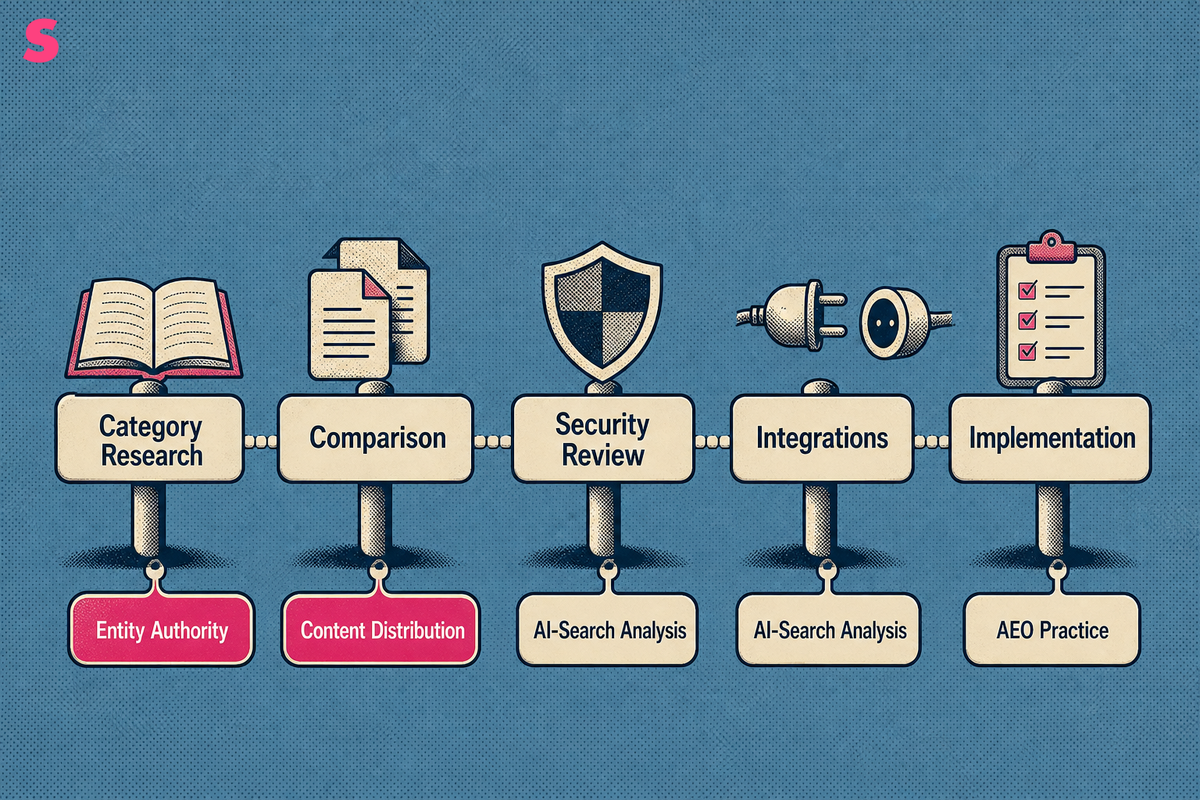
GEO frameworks work for B2B SaaS when they help teams answer buyer questions at each buying stage. The test is whether an approach strengthens the pages, entities, and evidence required for category research, comparisons, security review, integrations, and implementation.
- Entity authority has its strongest role in category and vendor-comparison prompts. Ask whether a framework clarifies the company, product, leadership team, and proof sources.
- Content distribution matters most in awareness and consideration. Ask whether the approach creates credible third-party discovery paths for guides and research.
- AI-search analysis helps across the journey. Ask whether the analysis distinguishes broad educational prompts from commercial decision prompts.
- AEO practice matters most for evaluation and purchase questions. Ask whether product, security, integration, and implementation pages answer the specific question cleanly.
Sona AI Visibility connects citations to pipeline and revenue on one account timeline, which makes the buyer-journey test more concrete than a brand-mention total. A marketing leader can assess whether a prompt category supports awareness, evaluation, or active purchase research.
Thought leadership becomes operational when it changes a content decision. A category guide needs a different evidence structure from a security page. An integration page needs different proof from an executive perspective piece. One generic GEO checklist cannot resolve those differences.
What should marketers adopt from GEO thought leaders, and what should they skip?
Marketers should adopt pillar content, in-depth guides, and thought leadership pieces that answer specific questions with clear evidence. They should skip unsupported tactics and advice that depends on one answer engine’s temporary behavior.
A citation-ready passage stands on its own. It names the subject, answers the question directly, defines specialized terms, and supplies the evidence or qualification a reader needs. That structure helps human readers and retrieval systems understand what the passage establishes.
Authority work extends beyond owned pages. Strategic PR, original data, and credible leadership perspectives create corroborating material across the web. Evergreen Media identifies PR, data leadership, and thought leadership as GEO authority drivers, but marketers should connect those activities to the prompts their buyers use.
Sona AI Visibility tracks which AI crawlers are reaching pages alongside citations connected to pipeline and revenue. A strong guide cannot feed an answer engine if relevant crawlers never reach the page.
How reliable are GEO expert rankings and the evidence behind their advice?
GEO expert rankings are useful discovery tools, but they are weak evidence when they do not publish a method. Vendor, agency, and affiliate lists can introduce commercial incentives. AI-generated answers can also vary by prompt wording, location, personalization, and model updates.
One vendor-run expert assessment weighted original thought leadership at 35% and found seven experts above the 80th percentile across its four measures. That scoring rule is more informative than a list without criteria, but it still reflects the assessment designer’s definitions and weighting choices.
Campaign-level evidence can also be thin. Medium reports 748% ROI over three years for a thought leadership SEO campaign that included generative optimization. The figure concerns one self-reported campaign, not a result that every GEO program should expect.
Most expert rankings publish no scoring method. Treat a ranking as a shortlist, then inspect each person’s published work, stated contribution, evidence quality, and commercial interest. Sona Marketing Measurement provides the attribution foundation that lets AI search be evaluated alongside other marketing channels rather than treated as an isolated trend.
Which metrics and AI engines should a B2B SaaS team track to act on this advice?
A B2B SaaS team should track mentions, citation share, answer visibility, sentiment, source frequency, and prompt coverage across ChatGPT, Perplexity, Gemini, Claude, and other answer engines. Google AI Overviews deserves separate monitoring because it is a Google search feature rather than a standalone assistant.
Run the same prompt list daily to identify meaningful changes. Retrieval indexes, model updates, and competitor publishing can alter an answer. A move that holds for four days is a trend. A one-day spike is noise.
A brand-level visibility score is a dated snapshot, not a work item. Sona AI Visibility connects prompts and citations to pipeline and revenue, while AI Search Insights shows the prompts buyers ask and the sources AI cites. That prompt-level view identifies the question and source pattern behind the score.
Mention counts do not equal pipeline. Sona AI Visibility tracks AI crawler and agent activity at the front of the path, then connects AI-referred visits to accounts, pipeline, and closed-won revenue. Mention and competitor tracking remains the baseline in this category, but revenue measurement determines whether visibility produced commercial value.
What do GEO software vendors charge, and what does a listed price leave out?
GEO software pricing ranges from entry plans to custom enterprise contracts, but list prices leave out refresh cadence, prompt allowance, engine coverage, and agency workspace needs. Engine breadth alone is misleading because a long engine list says nothing about prompt limits per engine or update frequency.
Sona AI Visibility starts from $75 per month, billed annually. Rankscale is listed from $17 per month on its Essentials plan and covers 17+ engines, while LLM Pulse starts at €49 per month for 50 prompts tracked weekly across five engines. Neither belongs in the comparison table below because the table uses the consistent core shortlist.
| Tool | Starting price | Agency Plans? (Yes/No) | # of Answer Engines Tracked | Answer Engines | # of Daily Tracked Prompts (entry plan) | Cost per Daily Tracked Prompt | Differentiation |
|---|---|---|---|---|---|---|---|
| Sona AI Visibility | From $75/month, billed annually | Yes | 11 | ChatGPT, Gemini, Google AI Mode, Google AI Overviews, Perplexity, Claude, DeepSeek, Grok, Copilot, Qwen, Mistral | 5,000 credits/month, about 56 prompts tracked daily across three engines | $0.45 per daily tracked prompt | Connects AI citations to pipeline and revenue, and tracks crawler activity from server logs or a lightweight edge worker without a JavaScript tag. |
| Profound | Custom pricing | Yes | 9 | ChatGPT, Perplexity, Google AI Mode, Gemini, Microsoft Copilot, DeepSeek, Claude, Google AI Overviews, Exa Search | Not published | No per-prompt figure available | Focus: enterprise AI visibility with daily prompt plans and agency workspaces. |
| Peec AI | From $95/month | Yes | 3 | Not published | 50 prompts daily | $0.63 per daily tracked prompt | Focus: AI visibility tracking for self-serve brands and agency plans. |
| Otterly.ai | From $29/month | Yes | 4 | ChatGPT, Google AI Overviews, Perplexity, Microsoft Copilot | 15 prompts daily | $0.48 per daily tracked prompt | Focus: prompt tracking across core answer engines, with additional engine add-ons. |
| Scrunch AI | From $250/month | Yes | 4 | ChatGPT, Perplexity, Google AI Overviews, Microsoft Copilot | 125 prompts, refresh cadence not published | No refresh cadence published | Focus: AI search visibility for brand and agency programs. |
Across the wider market, DIY tools run from $10 to $1,000+ per month and agency services from $1,500 to $50,000+ per month. Entry-level GEO engagements run from $2,500 to $5,000 per month as of September 2026. A listed subscription price measures software access, not the full cost of content production, technical work, PR, or reporting.
What are the frequently asked questions?
What is generative engine optimization in one sentence?
Generative engine optimization (GEO) makes owned content discoverable and trustworthy to AI-driven generative models so that a brand is mentioned and cited in their answers, per LinkedIn.
How can I tell a credible GEO expert from a self-promoter?
Check whether the person states what they contributed, such as a term, study, framework, or tool. Then assess how they reached the claim, what evidence they provide, and whether they disclose a commercial interest in the advice.
Can I trust a list of top GEO experts published by a software vendor?
Treat a vendor or agency list as a starting point, not a verdict. Vendors and agencies have commercial interests, and most rankings publish no scoring method, so verify each name against the person’s published work and stated contribution.
Is generative engine optimization different from answer engine optimization (AEO)?
The two overlap heavily. AEO focuses on being the answer in AI and search answer surfaces, while GEO is the broader practice of earning visibility and trust across generative models.
How much does generative engine optimization cost?
DIY GEO tools run from $10 to $1,000+ per month and agency services run from $1,500 to $50,000+ per month. Entry-level engagements range from $2,500 to $5,000 per month as of September 2026.
Do mentions in AI answers lead to pipeline?
Not automatically. A brand can appear often without generating qualified visits or deals, so mention counts need to connect to visits, accounts, pipeline, and revenue before they count as business results.
Summarize this article with AI: ChatGPT · Claude · Perplexity · Google AI Mode
Last updated: October 2026