AI GEO, meaning generative engine optimization, involves ensuring your content is easy for AI search engines like ChatGPT, Perplexity, Google AI Overviews, and other answer engines to discover, interpret and cite. It overlaps with SEO, yet is evaluated through mentions and citations in responses rather than rankings. Most tools only count those mentions; Sona AI Visibility connects the prompts and citations driving them, plus preceding AI crawler activity, to pipeline and revenue. Track that result, not just the score.
What is AI GEO, and how is it different from GeoAI?
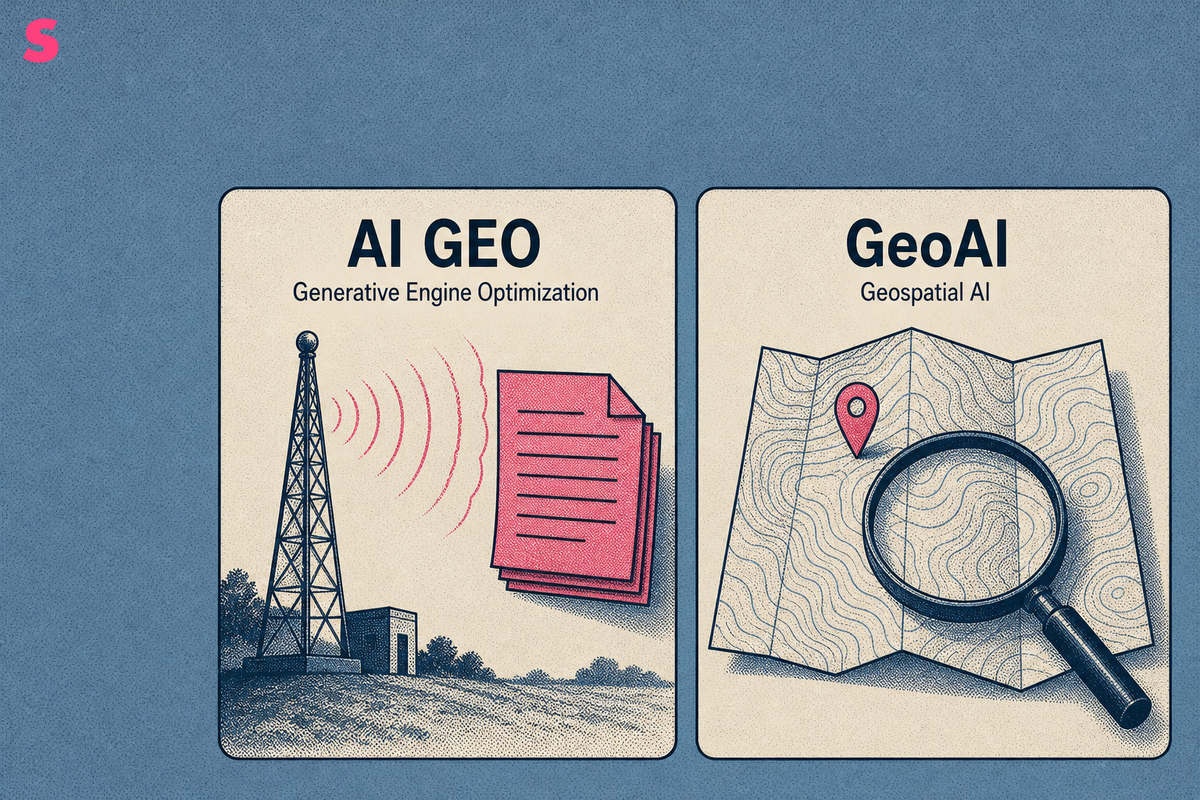
AI GEO, or generative engine optimization, is the practice of optimizing content so AI search platforms can discover, understand, and cite it. It is also called answer engine optimization (AEO) and artificial intelligence optimization (AIO), per Wikipedia.
The goal is not merely to rank in traditional search. Generative engine optimization makes a page easier for ChatGPT, Perplexity, Google AI Overviews, Gemini, Claude, and other answer engines to retrieve and use as evidence in generated answers.
GeoAI is unrelated. GeoAI applies artificial intelligence to geospatial data, mapping, and spatial analysis. The GeoAI Python package describes itself as a bridge between AI and geospatial data analysis, per opengeoai.org. The names overlap, but the disciplines do not.
Why does AI GEO matter for a B2B SaaS team with a pipeline target?
AI GEO matters because buyers increasingly research software categories and vendors in answer engines before visiting a website. A B2B SaaS team with a pipeline target needs to know whether those answers create qualified visits, identified accounts, opportunities, and revenue.
Budget allocation reflects that pressure. Per the 2026-08-14 listing, 69% of surveyed organizations had budget for AI search optimization in 2026, compared with 38% in 2025. Per the 2026-10-16 listing, client visits from ChatGPT, Gemini, Perplexity, Copilot, and Claude grew 86% year over year in one reported dataset.
Demand is broadening as well. General AI-topic search demand rose from about 91 million to 327 million annual searches over three years, per the 2026-09-23 listing. That does not prove every AI citation produces pipeline. A mention becomes commercially useful only when a team measures the visit, resolves the account, and follows the buyer journey through revenue.
Sona's own AI visibility data, September 2026, covers 8 answer surfaces: ChatGPT, Google AI Overviews, Perplexity, Google AI Mode, Gemini, Mistral, Qwen, and Claude. B2B teams need that breadth because a buyer’s research path can cross several answer surfaces before a demo request appears.
How do AI engines like ChatGPT, Perplexity, and other answer engines decide which sources to cite?
AI engines retrieve material relevant to a prompt, evaluate which sources answer the underlying questions, and compose a response from selected evidence. Retrieval and citation processes differ by product, but content must be available, comprehensible, and credible.
Consider a buyer searching for the best customer data platforms for a mid-market SaaS company. ChatGPT or Perplexity can expand that query into sub-queries about pricing, integrations, implementation, security, and category comparisons. The engine retrieves candidate pages, then synthesizes an answer that cites pages supporting specific claims.
- Technical GEO helps an AI crawler fetch and parse the page.
- Entity GEO helps the engine recognize the company, product, category, and claims.
- Brand authority GEO helps the engine trust the source enough to cite it.
Google AI Overviews produces Google’s AI-generated search summaries, while Gemini, Claude, Microsoft Copilot, ChatGPT, Perplexity, and other answer engines produce their own AI answers. Customer reviews are becoming an important recommendation signal in AI search, including for ChatGPT and Google AI Overviews, per the October 2026 listing. A page can answer the right question yet lose a citation if the brand lacks credible supporting evidence elsewhere.
How does GEO differ from SEO and AEO?
GEO overlaps with SEO and AEO, but each discipline has a different primary output. Traditional SEO seeks visibility in ranked search results. AEO structures material for direct answers. GEO seeks inclusion and citation in AI-generated responses.
GEO is not simply rebranded SEO. Technical SEO, authoritative content, digital PR, and structured data still matter because they make a site discoverable and intelligible. The success measure changes from rank position and click volume to whether an answer engine mentions and cites the relevant page.
| Criterion | Traditional SEO | AEO | GEO |
|---|---|---|---|
| Primary target | Search-result rankings | Direct answer surfaces | AI-generated answers and citations |
| Unit of success | Rank, impressions, clicks | Answer inclusion | Mention, citation, and downstream impact |
| How content is selected | Keyword relevance and ranking signals | Question-answer relevance | Retrieval relevance, entity recognition, and source trust |
| Main content format | Landing pages, articles, category pages | Concise answers, FAQs, definitions | Evidence-led pages, comparisons, expert guidance, structured answers |
| Key signals | Technical health, links, topical relevance | Clarity, concise extraction, structure | Crawlability, entities, authority, freshness, and citations |
| Measurement | Rankings, traffic, conversions | Answer visibility and traffic | Prompt coverage, citations, traffic, accounts, and revenue |
| Typical tools | Rank trackers and web analytics | Structured-data and content tools | AI visibility and attribution platforms |
Comparison tables express relationships in a format generative engines can parse without ambiguity, per eseospace.com. A well-maintained table can serve readers comparing vendors and engines retrieving a precise side-by-side fact.
What does an AI engine check before it cites a page?
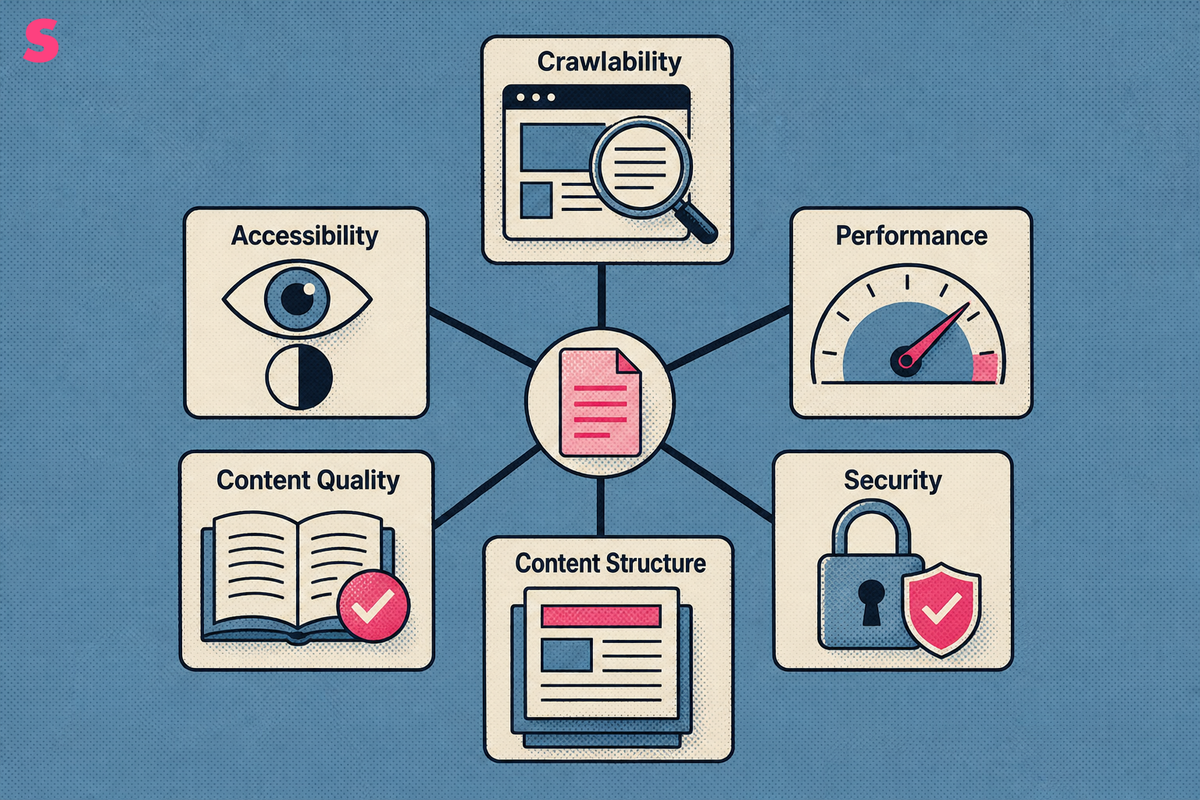
An AI engine needs a page it can reach, render, understand, and trust before the page can become citation material. GEO readiness spans six connected dimensions: crawlability, performance, security, content structure, content quality, and accessibility.
Crawlability asks whether AI crawlers can fetch a URL. Performance covers rendered experience and JavaScript dependence, especially when essential copy is unavailable in server-rendered HTML. Security includes transport and header hygiene. Content structure includes semantic headings, metadata, and schema markup that explain page contents.
Content quality addresses whether copy answers a buyer’s question with evidence and remains current. Accessibility includes alt text, ARIA attributes, contrast, and explicit image dimensions. These details help people use a page and machines interpret its elements.
Sona AI Visibility re-audits key pages on an ongoing basis across 35 checks in six categories, with fixes ranked by severity. A readiness score is a dated snapshot. The operational value comes from the severity-ranked fix attached to the page requiring work.
What technical GEO mistakes keep AI engines from finding your pages?
Technical GEO mistakes prevent answer engines from retrieving or reliably interpreting pages, even when the content is strong. First, confirm that relevant AI crawlers can reach the page through robots.txt, CDN rules, and the origin server.
- Blocking crawlers in robots.txt or a CDN: the crawler cannot fetch the page, so the page has little opportunity to enter retrieval results. Fix the relevant allow and firewall rules after deciding which bot categories the business permits.
- Putting key copy behind JavaScript: an engine receives incomplete content when essential text loads only after client-side execution. Fix the page with server-rendered HTML for core claims, tables, and definitions.
- Missing or inconsistent schema markup: the engine receives weaker machine-readable context about entities, products, and FAQs. Fix the schema implementation and validate that it matches visible content.
- Incomplete image markup: missing dimensions and alt text weaken accessibility and make page elements harder to interpret. Fix explicit width and height attributes plus descriptive alt text.
- Weak transport or header hygiene: security signals are incomplete. Fix HTTPS configuration and relevant security response headers.
Sona AI Visibility tracks AI crawler activity from server logs or a lightweight edge worker with no JavaScript tag, so ad blockers do not hide crawler traffic. That gives a team evidence of crawler visits before it spends time rewriting pages that bots cannot reach.
What content mistakes stop AI engines from citing your brand?
Content mistakes stop citations when a page fails to answer a specific buyer prompt clearly, credibly, and in an extractable format. Subject matter expertise alone is insufficient if the answer appears late, lacks evidence, or does not match the question behind retrieval.
A common mistake is writing only for keyword rankings. A page about customer data platform software may rank for a broad term while failing to answer which platforms suit a mid-market SaaS team with limited engineering capacity. Put a direct, supportable answer near the top, then substantiate it with product detail, constraints, and structured comparisons.
Other failures are practical: stale key pages weaken content quality, absent comparison tables remove useful structure, and thin brand signals make entity recognition harder. Ignoring customer reviews also leaves recommendation evidence underdeveloped. One generic category page cannot satisfy every prompt a buyer uses.
Sona AI Visibility includes AI Search Insights, which shows the prompts buyers ask and how pages perform in AI answers. Its Site Pages gap prompts identify, page by page, prompts where a site should appear but does not. That turns a visibility problem into a specific content assignment.
What measurement mistakes make GEO results misleading?
GEO measurement becomes misleading when teams treat one answer as proof, compare incompatible scores, or stop at citation counts. AI answers vary with model updates, retrieval indexes, location, personalization, and prompt wording, so a single run is an observation rather than a conclusion.
A team should run the same prompt list daily to identify patterns that a weekly snapshot could obscure. Full technical re-audits can run monthly or quarterly because they answer a different operational question.
Measure mentions, citations, sentiment, share of voice, prompt coverage, traffic, and conversions, but do not assume vendors calculate visibility or sentiment scores the same way. Sona AI Visibility resolves anonymous accounts behind AI-referred visits, 100% cookieless, and assigns each account an intent score from 0 to 100. That helps a B2B team distinguish a broad informational citation from research by an account approaching a commercial decision.
Which AI GEO tools are best, and what do they cost?
The best AI GEO tool for a B2B SaaS team measures relevant prompt coverage and shows whether AI visibility contributes to commercial outcomes. Sona AI Visibility connects citations and prompts to pipeline and revenue, while other platforms focus on citation, mention, and answer-engine monitoring.
The following prices, engine coverage, and allowances are published figures as of October 2026. Software pricing across the market ranges from about $10 to more than $1,000 per month, while agency services range from $1,500 to more than $50,000 per month, per the October 2026 listing.
| Tool | Starting price | Agency Plans? | # of Answer Engines Tracked | Answer Engines | # of Daily Tracked Prompts (entry plan) | Cost per Daily Tracked Prompt | Differentiation |
|---|---|---|---|---|---|---|---|
| Sona AI Visibility | From $75/month, billed annually | Yes | 11 | ChatGPT, Gemini, Google AI Mode, Google AI Overviews, Perplexity, Claude, DeepSeek, Grok, Copilot, Qwen, Mistral | 5,000 credits/month, about 56 prompts tracked daily on 3 engines | $0.45 per daily tracked prompt | Connects AI citations and prompts to pipeline and revenue on one account timeline, and tracks AI crawler activity from server logs or a lightweight edge worker. |
| Profound | Custom pricing | Yes | 3 | ChatGPT, Gemini, Google AI Overviews | 50 prompts daily for 7-day trial | Not published | AI visibility tracking across answer engines, with agency workspaces available from $99/month. |
| Otterly.ai | From $29/month | Yes | 4 | ChatGPT, Google AI Overviews, Perplexity, Microsoft Copilot | 15 prompts daily | $0.48 per daily tracked prompt | Monitoring AI search visibility across four answer engines on its Lite plan. |
| AthenaHQ | Free tier, paid plans from $295/month | Not published | 11 | Not published | 3,600 credits/month, unlimited prompts on Starter | No refresh cadence published | AI visibility monitoring with a free Essential tier and Starter model coverage. |
| Scrunch AI | From $250/month | Yes | 4 | ChatGPT, Perplexity, Google AI Overviews, Microsoft Copilot | 125 prompts, frequency not stated | No refresh cadence published | AI search visibility monitoring for brands and agencies. |
Monitoring which AI answers mention a brand does not establish commercial impact. Sona AI Visibility connects citations and AI-referred visits to pipeline and closed-won revenue on one account timeline.
What are the frequently asked questions about AI GEO?
Is AI GEO the same as GeoAI?
No. AI GEO is generative engine optimization, the practice of earning citations in AI answers. GeoAI is geospatial artificial intelligence, which applies AI to location, mapping, and spatial data. The confusion comes from the naming overlap.
Is GEO just rebranded SEO?
GEO overlaps with SEO, but it is not identical. Technical SEO, authoritative content, and structured data still help a page become discoverable. GEO is judged by whether an AI answer mentions and cites the page rather than by rank position alone.
Can you measure AI answers if they change every time?
Yes, by sampling many prompts repeatedly and tracking trends rather than treating a single answer as truth. Model updates, location, retrieval changes, personalization, and prompt wording create variation. A daily prompt log helps a team separate sustained movement from a temporary result.
How much does GEO cost?
Per the October 2026 listing, GEO software costs from about $10 to more than $1,000 per month, while agency services range from $1,500 to $50,000 per month. The right budget depends on the required coverage and whether the tool connects citations to revenue.
Does being cited in AI answers lead to pipeline?
Only when citations bring qualified visits that can be traced to accounts and deals. Mention counts alone do not establish commercial impact. A B2B team needs to measure AI-referred traffic, conversions, identified accounts, pipeline creation, and closed-won revenue.
Does blocking AI crawlers hurt AI visibility?
Yes. A page that an AI crawler cannot reach is far less likely to be found and cited. Check robots.txt, CDN and firewall rules, server logs, and crawler activity before changing content. The Sona AI Crawl Checker tests access for 45 AI crawlers and identifies the reason a crawler is blocked.
Summarize this article with AI: ChatGPT · Claude · Perplexity · Google AI Mode
Last updated: October 2026