An SEO writer AI is software that creates search-optimized content from a target keyword, applying SERP research and on-page scoring that a general AI chatbot lacks. Choose one by testing each candidate against the same B2B brief and evaluating factual accuracy, editing time, and cost for every publishable article, because feature lists alone reveal little about actual output. View the draft as a starting point: rankings still rely on domain authority, links, and expert review. Verify any AI-search tracking claim yourself, because reported engine counts differ.
What is an SEO writer AI and how does it differ from a general AI writer?
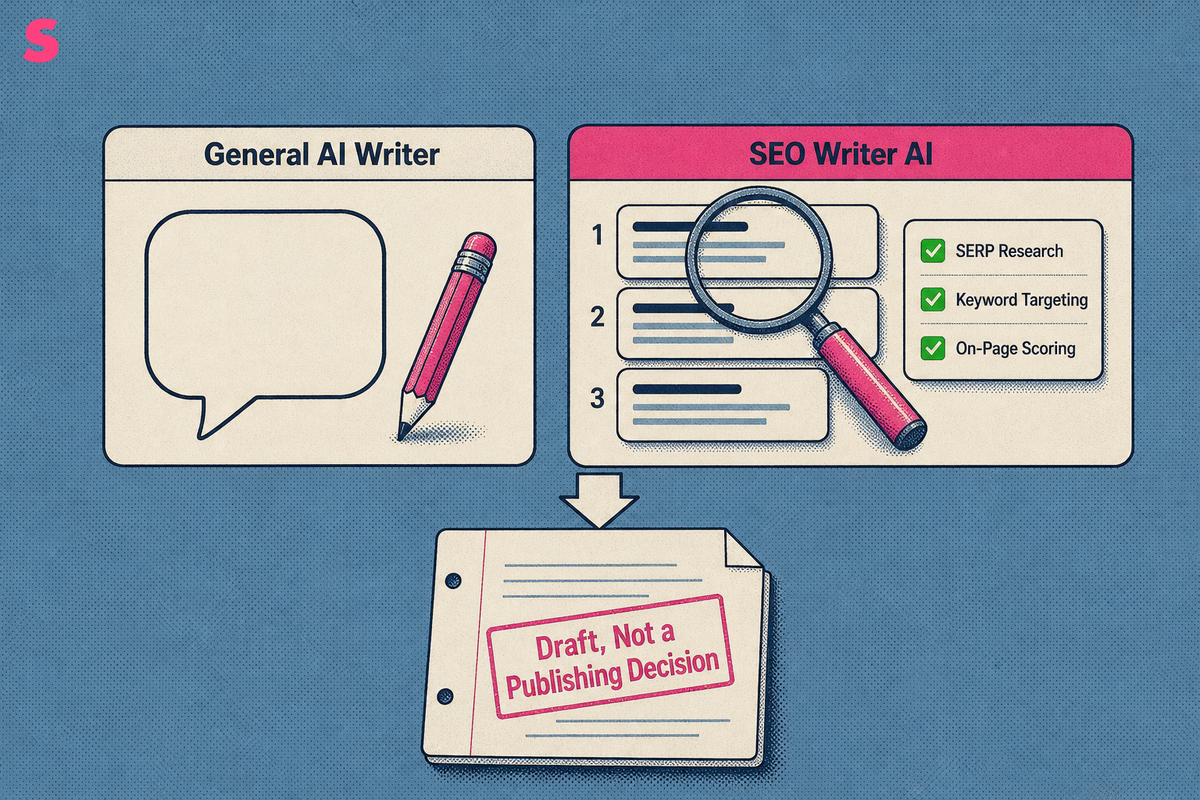
An SEO writer AI generates search-focused articles from a keyword by using SERP research, keyword targeting, and on-page scoring. AI writing tools for SEO create automated content with artificial intelligence and machine learning, per the October 2026 listing.
Unlike a general chatbot, an SEO writing platform supports a search workflow. A chatbot can draft from instructions, but it does not inherently assess the pages ranking for a query, the concepts those pages cover, or the on-page requirements in an editorial brief.
For a marketing team with a publishing calendar, the goal is not simply to produce words. The goal is a credible draft that addresses defined search intent, follows the content brief, and does not create more editorial work than it saves.
An SEO writer AI produces a draft, not a publishing decision. Search performance also depends on editorial judgment, evidence, internal links, technical implementation, authority, and distribution.
How does an SEO writer AI turn one keyword into a publishable draft?
An SEO writer AI turns a target query into a draft through five stages: research, drafting, optimization, refreshing, and publishing. For a B2B SaaS keyword such as customer onboarding software, the system organizes the workflow, while a marketer determines the commercial angle, evidence, and final claims.
- Research: The tool reviews ranking-page patterns and suggests themes, questions, headings, and related terms. A human selects the audience, search intent, positioning, and source material.
- Drafting: The tool produces an outline and first draft from the keyword and brief. A human adds product expertise, customer context, examples, and points of view that competing pages cannot reproduce.
- Optimization: The tool checks headings, term coverage, readability, and keyword use. A human rejects recommendations that make copy repetitive, vague, or detached from the buyer's question.
- Refreshing: The tool identifies pages that need updated sections, titles, or supporting information. A human validates each changed claim against current documentation and approved sources.
- Publishing: The tool can format a draft for a CMS. A human approves links, metadata, schema, images, legal review, and the final publish decision.
Some platforms provide one-click generation, bulk generation, and CMS auto-publishing. SEO Writing is described as generating one-click SEO-optimized articles, blog posts, and affiliate content, with bulk generation and WordPress auto-publishing, per the October 2026 listing.
The workflow works when generation begins production rather than ends it. Risk increases when a draft reaches a CMS before an editor confirms that it answers the intended query with original, supported information.
What is an SEO writer AI not, and what is it commonly confused with?
An SEO writer AI is not a general chatbot, a content grader alone, an AI visibility tracker, a ranking guarantee, or a replacement for subject-matter review. It produces and improves search drafts, but it cannot establish whether every claim is true or whether a page deserves to rank.
Content scoring tools are often confused with writing tools because both assess headings, terms, readability, and keyword coverage. A score can identify omissions, but it can also reward keyword repetition and competitor-derived language. High-scoring copy can still contribute little original analysis.
AI visibility tracking is a separate discipline. Sona AI Visibility connects AI citations to pipeline and revenue, while SEO writing software focuses on producing pages. A visibility score is a dated brand snapshot, not a work item. Sona AI Visibility uses prompt-level and source-level analysis to show which questions and cited sources create the result, helping a team identify a page and prompt to address.
Rankings also reflect domain authority, backlinks, internal linking, technical SEO, and distribution. The October 2026 listing describes Semrush's SEO Writing Assistant as providing on-page checks for keyword use, readability, and tone, but no on-page check removes the need for expert review or strengthens a site’s authority by itself.
Why do B2B marketing teams use an SEO writer AI, and where does it stop helping?
No single AI SEO writing tool suits every B2B marketing team. The best fit scores highest on the team’s repeatable test, especially for brand voice, collaboration, approval controls, CMS publishing, reusable templates, source citation, and fact-checking support.
B2B teams use these systems to move faster from brief to draft and refresh pages on a schedule. This matters when a content lead coordinates subject-matter experts, freelancers, reviewers, product marketing, and a fixed publishing calendar without rebuilding every brief.
Fluent output is not evidence. Technical SaaS content often includes implementation details, pricing logic, security requirements, integrations, and product limitations that require subject-matter review before publication. A polished false statement creates more work than a blank page.
- Brand voice: Can the tool follow approved terminology, audience expectations, and messaging rules?
- Collaboration: Can writers, experts, and approvers work through a controlled editorial process?
- Publishing: Can the team move a reviewed draft into the CMS without manual formatting work?
- Templates: Can the team reuse proven brief structures for comparison, category, and use-case pages?
- Evidence support: Can writers attach sources and make claims easy for reviewers to verify?
For teams that need to connect content outcomes to revenue, Sona AI Visibility connects citations and AI-referred visits to pipeline and revenue. That measurement does not replace editorial review, but it helps the content owner assess whether published pages contribute to commercial outcomes.
How do you test an SEO writer AI fairly before you buy?
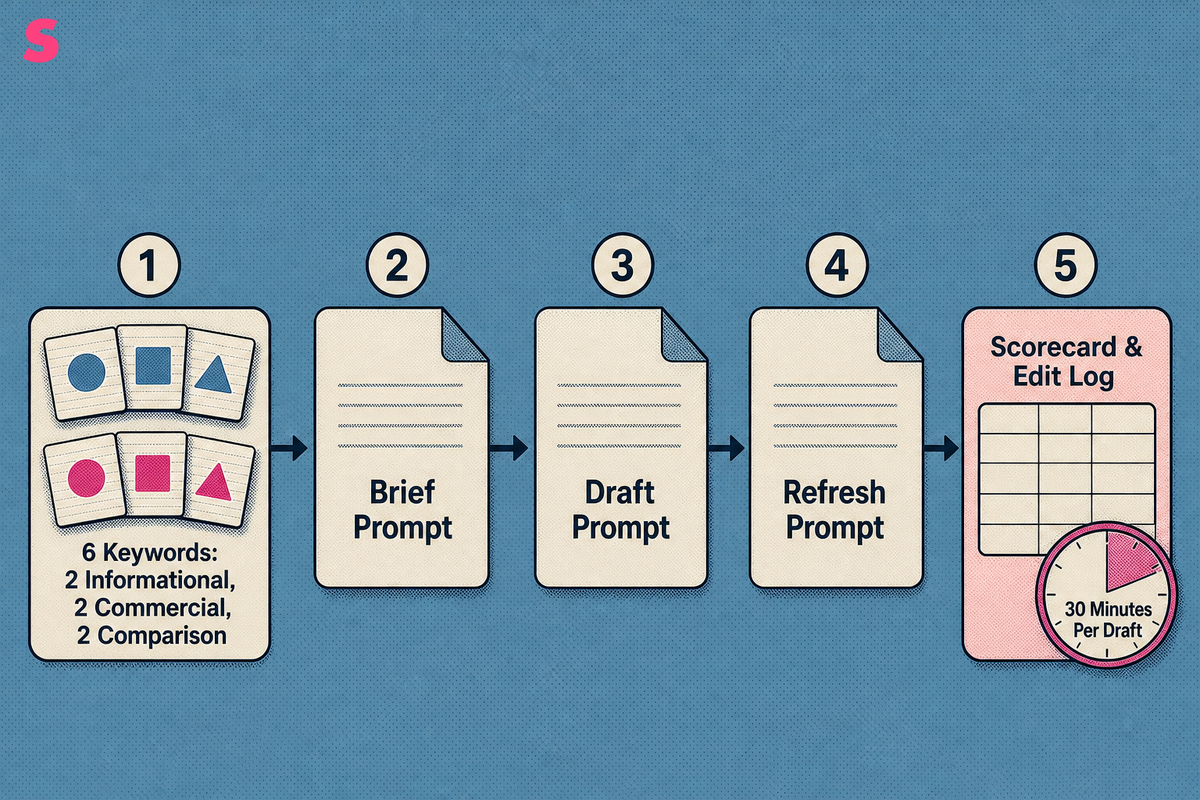
Test each SEO writer AI with the same B2B SaaS brief, target keyword, prompt set, source pack, brand-voice requirements, and human-editing time budget. Select six keywords from one approved backlog before testing: two informational, two commercial, and two comparison queries. Use keywords with comparable source-pack depth, randomize tool order, and run three fresh drafts per keyword and tool.
A fair test compares controlled inputs rather than feature lists, pricing pages, or affiliate reviews. One six-month test of a Jasper and Surfer SEO pairing reported 22 articles, a 59% Page 1 rate, and an 88-day average time to rank, per the 2026-04-01 listing. That is one dated result for one pairing, not a reusable selection method.
Use the following prompt templates unchanged for each tool:
- Brief prompt: “Create an outline for [target keyword] for [B2B SaaS audience]. Address [search intent], use the supplied source pack only for factual claims, and include a comparison section, implementation considerations, and a clear conclusion.”
- Draft prompt: “Write a draft from the approved outline. Use the supplied brand voice requirements. Mark any claim that lacks support from the source pack. Do not invent statistics, customer examples, integrations, or product capabilities.”
- Refresh prompt: “Review this existing page against the source pack and target keyword. Identify outdated claims, missing buyer questions, redundant passages, and sections that need original expert input.”
Allow 30 editor minutes per draft. Record what the editor changed, removed, rewrote, and fact-checked. If a generation fails, save the failed output and assign that run a zero. Retry only a documented platform error once, then retain the replacement output and failure record. Produce a scorecard and edit log rather than a subjective impression after one generated article.
How should results from an SEO writer AI test be scored?
Score each of the 18 drafts on an explicit 0–5 scale. For originality, SERP alignment, citation quality, publishing readiness, AI-search visibility, and cost per publishable article, use 0 for absent or unusable, 3 for usable after normal editorial work, and 5 for a complete result that meets the brief without material correction. Weight factual accuracy at 30%, originality at 15%, SERP alignment at 15%, citation quality at 10%, edit time at 10%, publishing readiness at 10%, AI-search visibility at 5%, and cost per publishable article at 5%.
- Factual accuracy: Score 5 for at least 95% verified factual claims, 4 for 90–94%, 3 for 80–89%, 2 for 70–79%, 1 for 1–69%, and 0 when no factual claims can be verified.
- Originality: Assess whether the draft adds useful analysis, examples, or structure rather than restating common competitor language.
- SERP alignment: Check whether the draft meets search intent and covers necessary topics without copying a ranking-page template.
- Citation quality: Assess whether sources are identifiable, relevant, and correctly connected to claims.
- Edit time: Score 5 for 15 minutes or less, 4 for 16–30 minutes, 3 for 31–45 minutes, 2 for 46–60 minutes, 1 for more than 60 minutes, and 0 for an unusable draft.
- Publishing readiness: Check formatting, metadata fields, CMS handoff, internal-link placement, and review controls.
- AI-search visibility: Measure whether the page is cited or referenced in relevant AI answers after publication.
- Cost per publishable article: Compare plan cost and editor time only after the draft clears the pass thresholds.
Set the pass threshold before testing: at least 90% verified factual claims and no more than 30 editor minutes. For example, a sample draft scoring 4 for accuracy, 3 for originality, 4 for SERP alignment, 4 for citation quality, 4 for edit time, 3 for publishing readiness, 2 for AI-search visibility, and 3 for cost receives 72 out of 100: (4×30 + 3×15 + 4×15 + 4×10 + 4×10 + 3×10 + 2×5 + 3×5) ÷ 5. It passes because accuracy is 91% and editing takes 24 minutes.
Calculate cost per publishable article as (plan cost + editor time cost) divided by articles that clear the threshold. Sona AI Visibility can support the AI-search visibility portion through AI Search Insights, which shows the prompts buyers ask and the sources AI answers cite. The calculation remains the team’s own model, based on its plan, staffing cost, and pass rate.
How do the main types of SEO writer AI tools compare on price, features and limits?
The following matrix uses the same workflow criteria for each tool. Sona AI Visibility measures post-publication AI citations and revenue outcomes, while Jasper, Surfer SEO, Frase, SEO Writing, and Semrush's SEO Writing Assistant address writing, optimization, research, or publishing tasks.
| Tool | Core workflow | SERP research | Drafting | Optimization | Source handling | CMS support | Collaboration | Limits | Dated price |
|---|---|---|---|---|---|---|---|---|---|
| Sona AI Visibility | Post-publication AI citation, AI-referred visit, pipeline, and revenue measurement. | Prompt-level and source-level analysis. | Not applicable. | Identifies prompts and cited sources that create visibility results. | Source-level analysis. | Not published. | Unlimited seats. | Starter includes 5,000 credits monthly, about 56 prompts tracked daily on 3 engines. | From $75/month billed annually, as of October 2026. |
| Jasper | AI drafting assistant. | Not published. | Drafting support. | Not published. | Not published. | Not published. | Teams plan listed. | Not published. | $49/month Creator, $99/month Teams, and custom Business pricing, per the 2026-10-06 listing. |
| Surfer SEO | SERP-based content optimization. | SERP-based workflow. | Not published. | On-page coverage, readability, and keyword-use guidance. | Not published. | Not published. | Not published. | Essential includes 30 audits and Advanced includes 80 audits. | $89/month Essential, $179/month Advanced, and $299/month Max, per the 2026-10-06 listing. |
| Frase | Research and brief workflow. | Search themes, outlines, and questions. | Not published. | Not published. | Document-based research. | Not published. | Team plan listed. | 1 document on Solo, 30 on Basic, and unlimited on Team. | $14.99/month Solo, $49.99/month Basic, and $74.99/month Team, per the 2026-10-06 listing. |
| SEO Writing | One-click and bulk article generation with auto-publishing. | SEO-optimized article generation. | Articles, blog posts, and affiliate content. | SEO-optimized generation. | Not published. | WordPress auto-publishing. | Not published. | Not published. | Starter at $14/month billed $168/year, Professional at $59/month billed $708/year, and Professional Plus at $1,428/year, as of October 2026. |
| Semrush's SEO Writing Assistant | On-page content optimization. | Not published. | Not published. | Checks keyword use, readability, and tone. | Not published. | Not published. | Not published. | Not published. | Not published. |
Usage limits use different units, including audits, documents, credits, and generated articles. Compare cost per publishable article rather than plan price alone. A low entry price has little value if the included allowance cannot support the team’s publishing volume and review process.
Can an SEO writer AI track visibility and rankings in Claude and other AI search engines?
An SEO writer AI can draft and optimize pages, but AI-search tracking is a separate function that reports whether Claude, ChatGPT, Gemini, Perplexity, Google AI Overviews, and other answer engines cite those pages. Some writing platforms add tracking, but engine counts are not standardized.
Writesonic was described as tracking six platforms, including Claude, in a triedbyhumans.com description dated 2026-10-10. A separate 2026-06-11 listing cited tracking across up to 10 AI engines. The discrepancy warrants verification of current coverage, refresh cadence, and engine definitions before purchase.
Sona AI Visibility connects prompts and citations to pipeline and revenue, and it tracks AI crawler and agent activity from server logs or a lightweight edge worker. Mention and competitor tracking are the baseline. Sona’s own AI visibility data covered 8 answer surfaces, ChatGPT, Google AI Overviews, Perplexity, Google AI Mode, Gemini, Mistral, Qwen, and Claude, in September 2026.
For this test protocol, run the same prompt list daily after publication and classify a change as a trend only when it holds for four consecutive days. Teams should set that threshold before testing, then apply it consistently across engines and prompt sets. A one-day spike remains a recorded observation rather than a trend score.
How do you use an SEO writer AI so the content ranks and earns citations?
Use an SEO writer AI as a controlled drafting layer: provide a real source pack, add original expert input, fact-check every claim, and publish only after review. The writing tool is one input into rankings and citations, alongside authority, backlinks, internal linking, technical SEO, and distribution.
- Give the tool approved product documentation, research, customer evidence, and editorial rules.
- Ask a subject-matter expert to validate technical claims, comparisons, and implementation guidance.
- Reject content-score recommendations that create keyword repetition or generic language.
- Add relevant internal links, metadata, schema, and a distribution plan before publishing.
- Refresh pages on a schedule, with a full content and positioning review conducted quarterly.
- Use CMS publishing only after the editor approves the final version.
After publication, measure organic rankings, AI citations, qualified visits, pipeline, and revenue. Sona AI Visibility connects AI citations and AI-referred visits to pipeline and closed-won revenue on one account timeline, so a content owner can assess commercial impact rather than only count mentions.
Use daily prompt tracking for the questions that matter most, then review the results quarterly. The useful output is not a single visibility score. It is a comparable series showing whether the same page gains or loses presence across repeated prompts over time.
What are the frequently asked questions about SEO writer AI?
What is an SEO writer AI?
An SEO writer AI generates search-focused articles from a target keyword by using SERP research, keyword targeting, and on-page scoring. It differs from a general chatbot because its workflow is designed around search intent and content optimization rather than text generation alone.
Is an SEO writer AI the same as ChatGPT?
No. A general chatbot drafts text from a request. An SEO writing platform adds keyword research, competitor SERP analysis, content scoring, and often CMS publishing around the draft. The added workflow helps a team create search-oriented content, but it does not remove the need for editorial review.
Do SEO writer AI tools replace human editors for B2B SaaS content?
No. Drafts can be fluent but factually wrong on technical SaaS topics. Subject-matter review remains necessary before publication, especially for product capabilities, integrations, pricing, security claims, and implementation details.
Can an SEO writer AI show whether Claude cites my content?
Only some writing platforms add AI-search tracking. Reported engine counts vary between sources, so confirm which answer engines a tool covers, including Claude, and whether its prompt tracking runs daily or on another schedule.
How much does an SEO writer AI cost?
Entry prices in one 2026-06-11 comparison ranged from $0 to $79 per month, with higher tiers costing more. Limits use different units, including documents, audits, credits, and generated articles, so compare cost per publishable article rather than plan price alone.
Will an SEO writer AI alone get a page onto page one?
No. Rankings also depend on domain authority, backlinks, internal linking, technical SEO, distribution, search intent, and editorial quality. An AI writing tool can improve drafting efficiency, but it cannot guarantee search rankings or citations.
Summarize this article with AI: ChatGPT · Claude · Perplexity · Google AI Mode
Last updated: October 2026