An AI SEO company is a firm or software vendor that increases how frequently a brand is cited in responses from ChatGPT, Perplexity, Gemini, Google AI Overviews, and other answer engines. Buyers should distinguish four models: monitoring software, specialist consultants, managed agencies and white-label providers. Sona’s done-for-you services, starting at $5,500 monthly in addition to a Sona AI Visibility plan, illustrate the managed model. Assess providers using fixed prompt sets, repeated measurement and a connection between citations and pipeline.
What is an AI SEO company and what services does it provide?
An AI SEO company helps a brand earn citations and mentions in AI-generated answers, including ChatGPT, Perplexity, Gemini, Claude, Google AI Overviews, and other answer engines. Its work combines technical SEO, content development, entity optimization, digital PR, prompt research, and measurement.
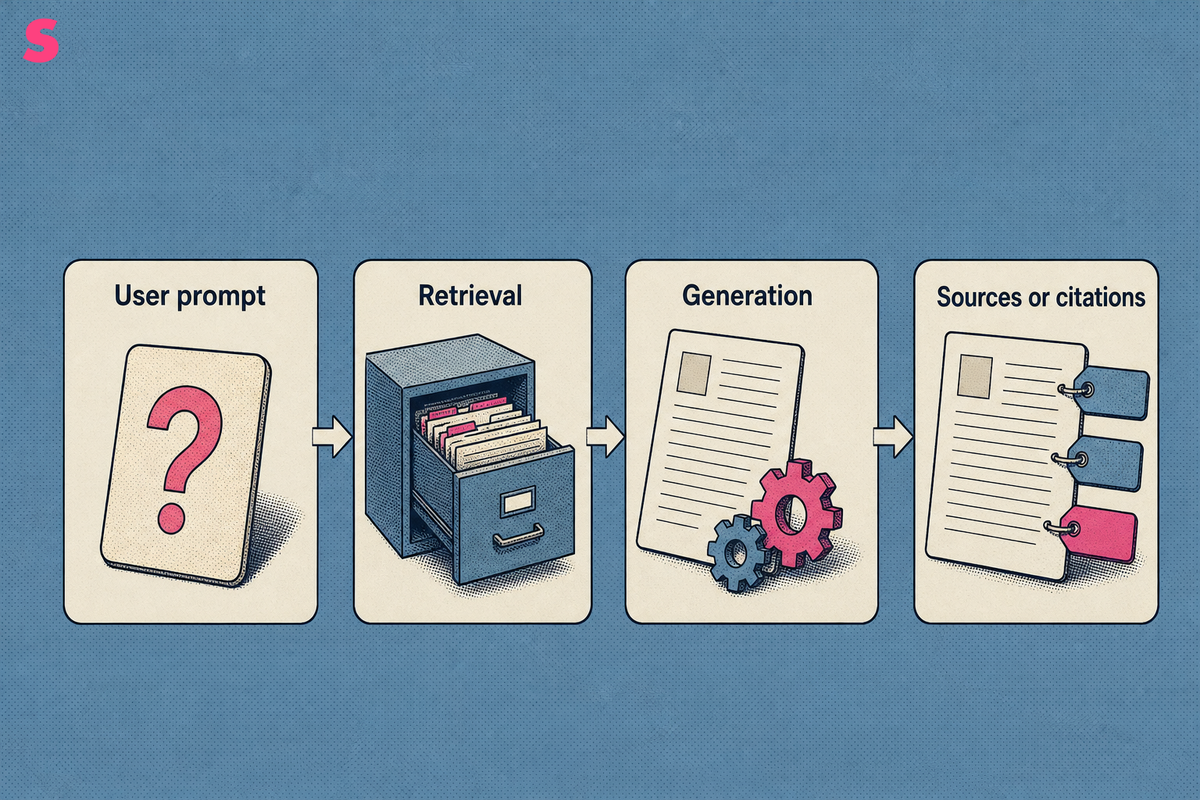
Artificial intelligence (AI) is software that recognizes patterns in data to classify information, make predictions, retrieve relevant material, or generate content. For AI search, models are trained on large collections of text and other data, then use inference to respond to a new prompt. Retrieval systems can identify relevant web pages or documents, and a generative model synthesizes an answer that may include sources or citations.
Relevant AI system categories include generative models that produce text, retrieval systems that locate source material, predictive models that score likely outcomes, and workflow agents that perform defined tasks. Businesses use these systems in customer support, software development, research, sales operations, healthcare administration, financial analysis, and marketing. Common benefits include faster research, broader information access, and more consistent operational workflows.
- User prompt: A buyer asks a question.
- Retrieval: The system identifies relevant pages, documents, or indexed sources.
- Generation: An AI model synthesizes an answer from available information.
- Sources or citations: The answer may name, link to, or draw from selected sources.
AI deployment also requires privacy controls, bias review, intellectual-property safeguards, appropriate disclosure, and human review for consequential decisions. An AI SEO company should account for those requirements when it creates content, uses customer data, or reports on buyer behavior.
The goal is inclusion in relevant AI answers, not only higher rankings in traditional search results. An AI SEO engagement examines buyer questions, the sources answer engines cite, and the pages that can answer those questions credibly. Services commonly include an AI-readiness audit, prompt tracking, content briefs, schema improvements, source-gap analysis, and citation reporting.
For example, a B2B software company seeking visibility for vendor-comparison prompts needs relevant commercial prompts, competitive source analysis, stronger comparison pages, supporting documentation, and cited evidence. The work is complete when the team can observe whether those pages appear in relevant answers.
- Technical work: crawlability, server-rendered HTML, canonical tags, structured data, and page performance.
- Content work: pages that answer specific buyer prompts with current, attributable evidence.
- Authority work: digital PR, brand mentions, and source development where relevant.
- Measurement work: fixed prompt sets, repeated observations, citation tracking, and business reporting.
Is AI SEO just traditional SEO with a new label?
No. An AI SEO company uses core SEO disciplines, but targets inclusion in generated answers rather than rankings and clicks alone. Traditional SEO remains necessary because answer engines retrieve, parse, and cite web pages. AI search adds questions about prompt wording, source selection, citations, and zero-click research.
An AEO strategist or AI SEO consultancy should define the boundary clearly. Traditional SEO concentrates on organic visibility in search results. AI SEO examines whether an answer engine can understand, retrieve, trust, and cite a page when a buyer asks a conversational question.
The practices overlap in technical hygiene. Weak crawlability, poor metadata, stale content, and unclear information architecture make pages harder for search systems to use. AI SEO does not replace sound SEO, paid acquisition, product marketing, or sales enablement. It adds a distinct measurement and optimization discipline to those activities.
Sona’s own AI visibility data, September 2026, covers eight answer surfaces: ChatGPT, Google AI Overviews, Perplexity, Google AI Mode, Gemini, Mistral, Qwen and Claude. A provider should define the answer surfaces, prompts, locations, and reporting rules before work begins.
How does an AI SEO engagement work in practice?
An AI SEO company should follow a repeatable cycle: establish a prompt baseline, identify technical and content gaps, prioritize work by commercial relevance, publish improvements, and measure the same prompts again. The engagement should create an operating system rather than isolated content recommendations.
- Build the prompt set. An AEO manager groups buyer questions by topic, commercial intent, buying stage, and target market.
- Record the baseline. The team captures whether the brand appears, which sources are cited, and how competitors surface.
- Map prompts to pages. Each priority prompt needs a credible destination page, evidence source, or content brief.
- Fix and publish. The agency addresses technical barriers, content gaps, citations, and off-site authority work.
- Review the log. The team compares recurring observations and decides the next work queue.
A team that runs the same prompt list daily can identify patterns that a weekly snapshot obscures. Answer engines shift with retrieval-index changes, model updates, and newly published competitor material. Sustained movement across repeated observations is more meaningful than an isolated spike.
Sona AI Visibility connects citations to pipeline and revenue on one account timeline, and tracks which AI crawlers reach pages. That measurement lets an AI search visibility consultant prioritize work by commercial outcomes rather than mention counts alone.
Why does AI search visibility matter to a team with a pipeline target?
AI search visibility matters because buyers can research a category, compare vendors, and form a shortlist before visiting a website. A team with a pipeline target needs to know which questions drive that research, which pages support citations, and whether AI-referred visits become identifiable opportunities.
Visibility before the click changes the measurement problem. A buyer may read an answer, remember a brand, then return through a direct visit, branded search, or colleague referral. An AI SEO provider should report citation exposure alongside referral traffic, self-reported attribution, CRM activity, and pipeline movement.
For a B2B software firm, the most valuable prompts are rarely generic definitions. Commercial prompts such as vendor comparisons, implementation questions, integration requirements, and pricing criteria sit closer to a buying decision. The best AI SEO company for that firm prioritizes prompts by revenue relevance, not apparent search demand alone.
As of October 2026, Sona AI Visibility tracks 11 engines and connects AI-referred visits to accounts, pipeline, and closed-won revenue. That distinction matters when leadership must decide whether an AI search program deserves further investment.
What is the difference between an AI SEO specialist, AEO manager, strategist, consultant and agency?
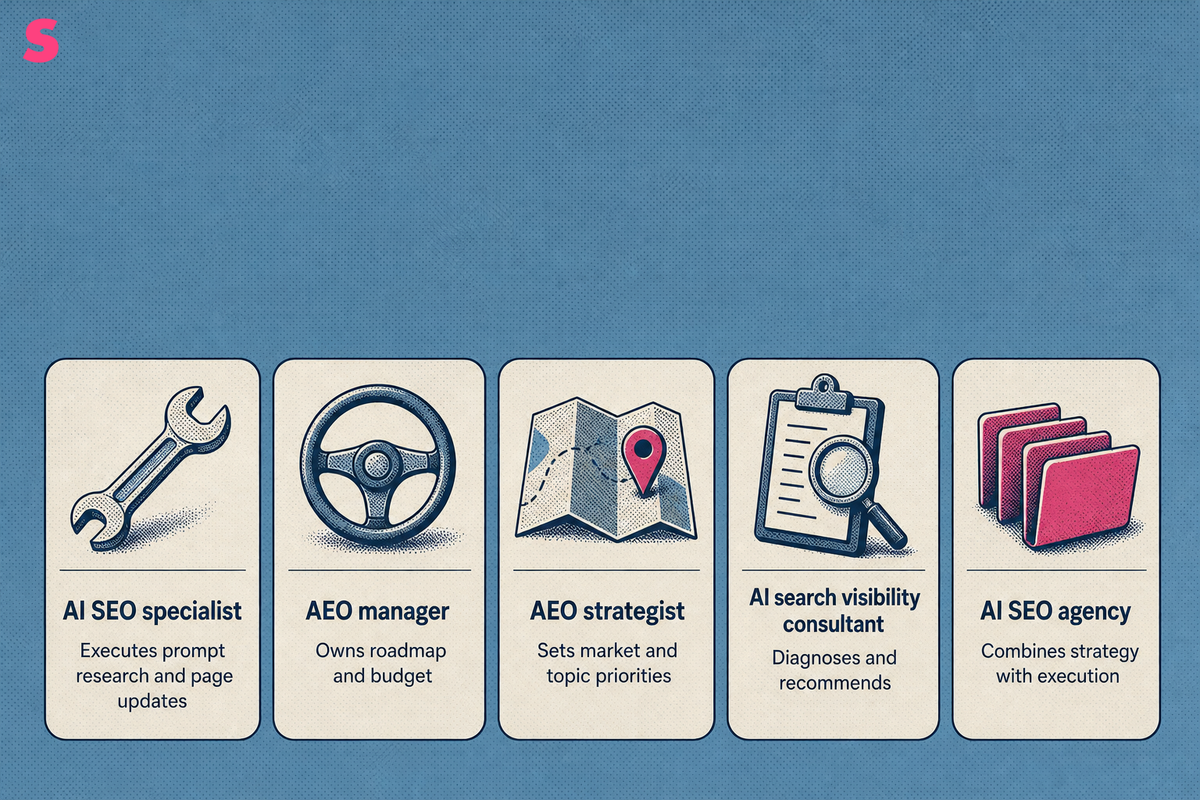
The titles describe different scopes of responsibility. An AI SEO specialist executes focused work, an AEO manager owns the internal program, an AEO strategist sets priorities, an AI search visibility consultant diagnoses and advises, and an agency supplies a broader delivery team.
- AI SEO specialist: handles prompt research, page optimization, structured data, content updates, or reporting.
- AEO manager: owns the internal roadmap, stakeholder approvals, budget, and connection to pipeline goals.
- AEO strategist: decides which markets, topics, prompts, and source gaps deserve investment.
- AI search visibility consultant: provides a diagnostic, measurement design, and prioritized recommendations.
- AI SEO consultancy or agency: combines strategy with execution across technical SEO, content, digital PR, and reporting.
The right role depends on the bottleneck. A company with strong writers and developers may need a strategist and measurement framework. A lean marketing team with no execution capacity needs an agency. A company with mature SEO operations may need a consultant to redesign its prompt set and reporting model.
Ask who owns each decision. If the provider cannot identify the internal approver for content, technical changes, legal review, and CRM reporting, the engagement will stall regardless of the job title.
When should you hire an agency, an in-house AEO manager, a software platform or a white-label provider?
Hire an agency when the company needs strategy and execution, an in-house AEO manager when the program requires daily ownership, a software platform when internal teams can act on the data, and a white-label provider when an agency needs to deliver services under its own brand.
Managed AI SEO retainers for many mid-market engagements are reported at $2,500–$10,000 per month, while premium enterprise work can reach $12,000 or more per month, per sona.com, September 24, 2026. Sona categorizes full-service enterprise engagements at $15,000 or more per month when they include dedicated teams, migration support, multi-market programs, and custom reporting, per sona.com, September 24, 2026.
An internal AEO manager is the strongest choice when AI search is a durable channel and the business already has content, engineering, and analytics resources. That person should own the prompt list, define commercial priorities, and make decisions when the data changes. Agencies suit teams that need speed and breadth before building internal capacity.
Sona AI Visibility offers done-for-you services, with a Sona team handling AI search optimization and technical fixes on top of an AI Visibility Growth plan or above. White-label providers require extra diligence: establish who performs the work, who owns client reporting, what data the client can access, and whether the underlying platform remains available after the engagement ends.
How do the leading AI SEO agencies compare?
The leading AI SEO agencies differ in B2B focus, delivery scope, contract structure, and published pricing. A B2B SaaS buyer should choose a provider whose customer profile, engagement model, and execution capabilities match the company’s internal resources.
Agency scope and pricing in this comparison were checked in October 2026. Sona service details come from Sona’s product description checked in October 2026. Published pricing helps establish a budget range, but it does not replace a discussion of ownership, reporting, content approvals, and technical implementation.
| Agency | Focus | What's included | Pricing |
|---|---|---|---|
| Sona | AI search optimization and measurement for brands using Sona AI Visibility, connecting AI citations and prompts to pipeline and revenue | Content, AI search optimization, technical fixes, strategy, and reporting | Launch from $5,500/month, Accelerate $7,500/month, Amplify $9,500/month, on top of Growth or above |
| DerivateX | Full-service SEO and GEO for B2B SaaS | GEO, LLM SEO, entity optimization, content, digital PR, technical SEO, and migrations | $5,000–$12,000/month; Enterprise scoped individually |
| Breaking B2B | SEO and AI search for B2B and SaaS | AEO, GEO, technical SEO, content, link building, Reddit, and YouTube marketing | Growth plans $5,500–$9,700/month (Silver, Gold, Diamond), Category King $20,000+/month; Enterprise plans $8,500–$14,700/month, Category King $40,000+/month; tailored narrower-scope plans from $4,000/month |
| Discovered Labs | AEO, GEO, and SEO for hypergrowth B2B companies | AEO, Reddit marketing, technical SEO, content SEO, digital PR, link building, and AI Visibility Tracker | Establish €6,995/month, Compete €10,995/month (month-to-month); Outlier & Custom from €15,995/month |
| Omniscient Digital | SEO and GEO for B2B software brands | LLM optimization, citation analysis, GEO assessment, content, digital PR, and visibility monitoring | From $10,000/month |
| iPullRank | AI search and GEO through relevance engineering | Relevance engineering, GEO, content strategy, technical SEO, attribution, measurement, and brand monitoring | Not published (quote only) |
| Foundation | GEO for B2B companies | GEO strategy, technical SEO, LLM advertising, content distribution, thought leadership, digital PR, and analytics | Not published (quote only) |
| TripleDart | AI-native organic growth for B2B SaaS | GEO/AEO, technical SEO, content production, programmatic optimization, and paid media | From $5K/month |
Several agencies in the comparison state a B2B or SaaS focus. The right fit depends on whether the company needs an initial diagnostic, a content-heavy retainer, technical migration work, or a broader organic-growth program.
How do you evaluate an AI SEO company before you sign?
Evaluate an AI SEO company by its measurement design, delivery plan, and commercial reporting. A credible provider can show how it chooses prompts, what work it will perform, who owns implementation, and how it will assess progress.
- Ask for a fixed initial prompt set, including commercial, comparison, implementation, and category prompts.
- Ask how the provider controls for prompt wording, location, answer engine, and observation date.
- Ask which technical fixes, content deliverables, and authority activities are included in the retainer.
- Ask for the reporting cadence, the data owner, and the CRM fields used to connect results to pipeline.
- Ask which work requires your developers, subject-matter experts, legal team, or product marketers.
A score is a dated snapshot. The useful output is a comparable series of observations that shows whether a change held over time, followed by a severity-ranked fix for the affected page. Require the agency to distinguish daily prompt monitoring from monthly technical audits and quarterly strategy reviews.
Do not buy guarantees of inclusion in a specific answer engine. A credible AI search visibility consultant can promise disciplined research, transparent reporting, prioritized work, and repeated measurement. No provider controls a model’s output.
What should an AI SEO company report each month?
An AI SEO company should report commercial prompt visibility, citations and cited sources, completed work, technical findings, AI-referred traffic, and the business outcomes connected to that activity. The report should explain movement rather than present a collection of screenshots.
- Prompt performance: the fixed prompt set, answer engines checked, dates observed, brand appearance, position, and cited sources.
- Work completed: published pages, refreshed content, technical fixes, digital PR activity, and unresolved dependencies.
- Page-level findings: crawlability, structured data, content quality, and severity-ranked remediation items.
- Business evidence: AI-referred sessions, identified accounts, opportunities, pipeline, and closed-won revenue where attribution supports the connection.
The monthly report should preserve daily prompt observations as a log. That record separates a sustained answer-engine change from a single anomalous response. Quarterly reviews can then reassess positioning, prompt coverage, and competitive priorities.
Monitoring which AI answers mention a brand is only half the job. Sona AI Visibility connects citations and AI-referred visits to accounts, pipeline, and revenue on one account timeline.
What are the frequently asked questions?
Can an AI SEO company guarantee my brand will appear in ChatGPT or Google AI Overviews?
No. No credible provider controls model outputs, retrieval systems, source selection, or answer formatting. A defensible promise is a measurable process that improves the probability of citation for relevant prompts. Walk away from guarantees of inclusion in ChatGPT or Google AI Overviews.
Is AI SEO the same as AEO and GEO?
The terms overlap heavily. AI SEO is the broad label, while answer engine optimization (AEO) and generative engine optimization (GEO) describe work intended to earn inclusion and citations in AI answers. Providers use the labels loosely, so ask what each deliverable includes: technical remediation, content production, digital PR, prompt tracking, or reporting.
What is white label AI SEO?
White label AI SEO is an arrangement where an agency resells another provider’s AI search work under its own brand. Before relying on one, establish who performs the work, who owns the prompt data, who produces reports, what the client can access, and what happens if the reseller relationship ends.
Do I still need an AEO manager if I hire an agency?
Often, yes, but in a lighter form. Someone inside the company should own the prompt set, approve content, prioritize technical changes, and connect results to pipeline. The agency can handle research and execution, but internal ownership keeps the program aligned with commercial priorities.
How can I tell whether an AI SEO company's results are credible?
Ask for fixed prompt sets, repeated observations, timestamps, and confidence limits. Answers vary by model, prompt wording, location, and date. One screenshot is not evidence. A credible report shows the prompt, answer engine, observation date, source citations, and comparison method.
Which AI SEO companies suit B2B SaaS?
The comparison includes agencies that state a B2B or SaaS focus in service descriptions checked in October 2026. Match each firm’s stated company size, engagement terms, delivery scope, and price structure to your operating model before selecting a partner.
Summarize this article with AI: ChatGPT · Claude · Perplexity · Google AI Mode
Last updated: October 2026