In 2026, generative engine optimization (GEO) trends focus on earning citations in AI responses rather than link rankings, as Google AI Overviews and zero-click searches reduce the value of ranking alone. Brand size establishes the baseline: according to a June 2026 study on alphaxiv.org, niche brands appeared in 11% of relevant first-run AI answers. Page structure is the factor teams control, while Sona AI Visibility links the prompts and citations behind those answers to pipeline and revenue. Treat vendor benchmarks as directional until they disclose their prompts.
How often do brands appear in AI answers in 2026, and which sources get cited?
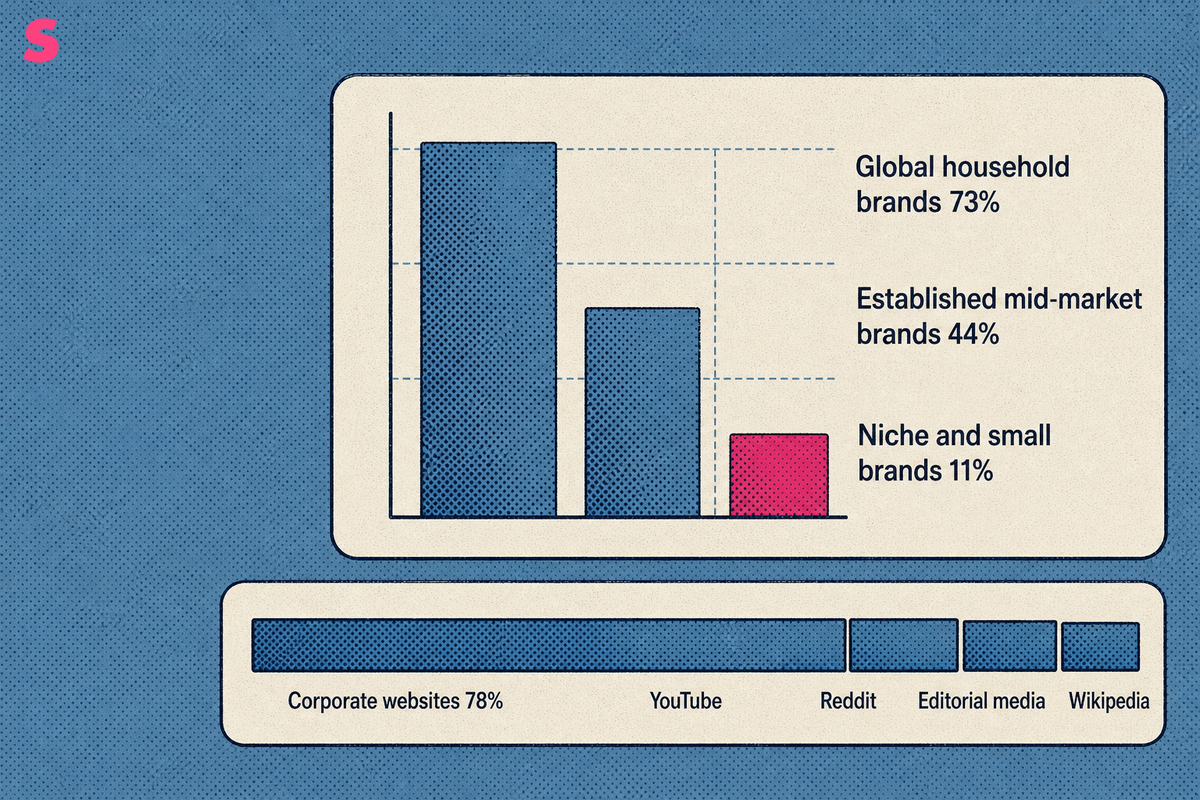
Generative engine optimization GEO trends 2026 show a sharp visibility gap between large and small brands. A June 2026 study of more than 100,000 prompt responses across more than 100 brands found that global household brands appeared in 73% of relevant first-run AI answers, per alphaxiv.org, June 2026.
Established mid-market brands appeared in 44% of relevant first-run answers, per alphaxiv.org, June 2026. Brand familiarity, category authority, and available source material influence which entities an answer engine selects.
Niche and small brands appeared in 11% of relevant first-run AI answers, per alphaxiv.org, June 2026. Smaller companies can still earn citations, but they need pages that answer specific buyer questions with clearer evidence than a broad brand page.
Corporate websites accounted for about 78% of cited sources in the study, per alphaxiv.org, June 2026. Among non-corporate sources, YouTube ranked ahead of Reddit, editorial media, and Wikipedia. Answer engines retrieve, select, and synthesize material into one response, so visibility depends on owned pages and credible third-party evidence.
This article treats AI search as eight answer surfaces: ChatGPT, Google AI Overviews, Perplexity, Google AI Mode, Gemini, Mistral, Qwen, and Claude, per Sona's own AI visibility data, September 2026. An answer surface does not promise identical results for individual users.
How are Google AI Overviews and zero-click search changing GEO and SEO in 2026?
Google AI Overviews change GEO and SEO because search results can satisfy a question before a visitor reaches a website. Google AI Overviews appeared in 43% of sampled U.S. desktop Google results, per the October 2026 listing.
Zero-click behavior has risen alongside answer-led search. Between January and April 2026, 68.01% of U.S. Google searches produced no website click, compared with 60.5% in 2024, per the April 2026 listing. A brand can influence a buyer without receiving a conventional organic session.
When Google AI Overviews appeared, the top organic result’s click-through rate fell from 20.02% to 9.69%, per the October 2026 listing. Organic rank still matters, but rank alone no longer explains how a buyer encountered a brand.
GEO optimizes a brand or entity to appear in AI-generated outputs, while SEO targets rankings and clicks from traditional search results. Both disciplines rely on technical foundations, useful content, crawlability, and authority. GEO adds answer-level measurement, citation analysis, and prompt coverage where Google rankings and AI visibility diverge.
How should a page be structured so AI engines extract and cite it?
AI engines can extract a page more easily when it presents a direct claim, supporting evidence, and unambiguous structure. Answer engines need material they can retrieve and synthesize into a response.
Brands using five reported structured elements reached 60–80% AI coverage, compared with 23–35% without them, per the October 2026 listing. That relationship is reported, not controlled proof, but it gives content teams a practical standard for turning vague copy into extractable evidence.
| Pattern | Before and after example | Why it makes extraction easier |
|---|---|---|
| Q&A block | Before: “Our platform helps teams understand buyer activity.” After: “How does the platform identify buyer activity? It connects anonymous visits to accounts and records the pages, channels, and actions associated with that account.” |
The question establishes retrieval context, and the answer supplies a self-contained response. |
| Assertion plus proof | Before: “AI search is becoming important for B2B teams.” After: “AI search can influence vendor research before a buyer visits a website. The zero-click rate in sampled U.S. Google searches reached 68.01% between January and April 2026, per the April 2026 listing.” |
A clear claim paired with dated evidence gives an answer engine a statement it can cite and qualify. |
| Entity-first opening | Before: “This helps organizations improve their reporting.” After: “A B2B SaaS attribution platform connects marketing touches, account activity, pipeline, and revenue in one buyer journey.” |
The subject, category, and outcome appear before pronouns or product language obscure the meaning. |
| Definition-first paragraph | Before: “Teams are spending more time on GEO.” After: “Generative engine optimization is the practice of optimizing content so AI search engines cite it in their responses.” |
A precise definition can be reused directly in a synthesized answer. |
| Comparison table | Before: “SEO and GEO overlap, but they are different.” After: “SEO measures rankings and clicks. GEO measures appearances, citations, and answer-level visibility in AI-generated outputs.” |
Parallel fields make distinctions explicit without requiring the engine to infer a comparison. |
| Short FAQ block | Before: “There are several considerations for AI visibility.” After: “Does schema markup guarantee an AI citation? No. Schema markup clarifies page meaning, but citation selection also depends on relevance and source quality.” |
Compact questions capture common query wording and place the answer beside its context. |
Targeted GEO optimization has been reported to raise visibility in generative responses by up to 40%, per the October 2026 listing. That figure is not controlled causal proof. Structure each page so a buyer question, answer, proof point, and named entity stand together without surrounding context.
What five formatting and markup decisions make a page easier for AI to cite?
Five formatting decisions make a page easier to cite: answer the heading immediately, use buyer-language headings, attach evidence to claims, align schema markup with visible copy, and show when the page was updated. These decisions make structured content easier to retrieve and interpret.
- Put a direct answer in the first sentence. Under every heading, state the conclusion before background, qualifications, or product detail.
- Write headings as buyer questions. Use phrasing such as “How do I measure AI search visibility?” rather than generic labels such as “Measurement.”
- Keep one claim per paragraph. Add the source and date beside any statistic so the evidence travels with the assertion.
- Match schema markup to visible content. FAQPage JSON-LD, product markup, and organization markup should describe material readers can actually see.
- Show a visible updated date. Freshness signals help readers assess whether technical guidance and evidence still apply.
Formatting does not create authority by itself, but it reduces ambiguity. Concise headings, direct answers, and attributable proof are easier for a retrieval system to parse than conclusions buried beneath generic introductory copy.
What technical checks decide whether an AI engine can find, parse and trust a page?
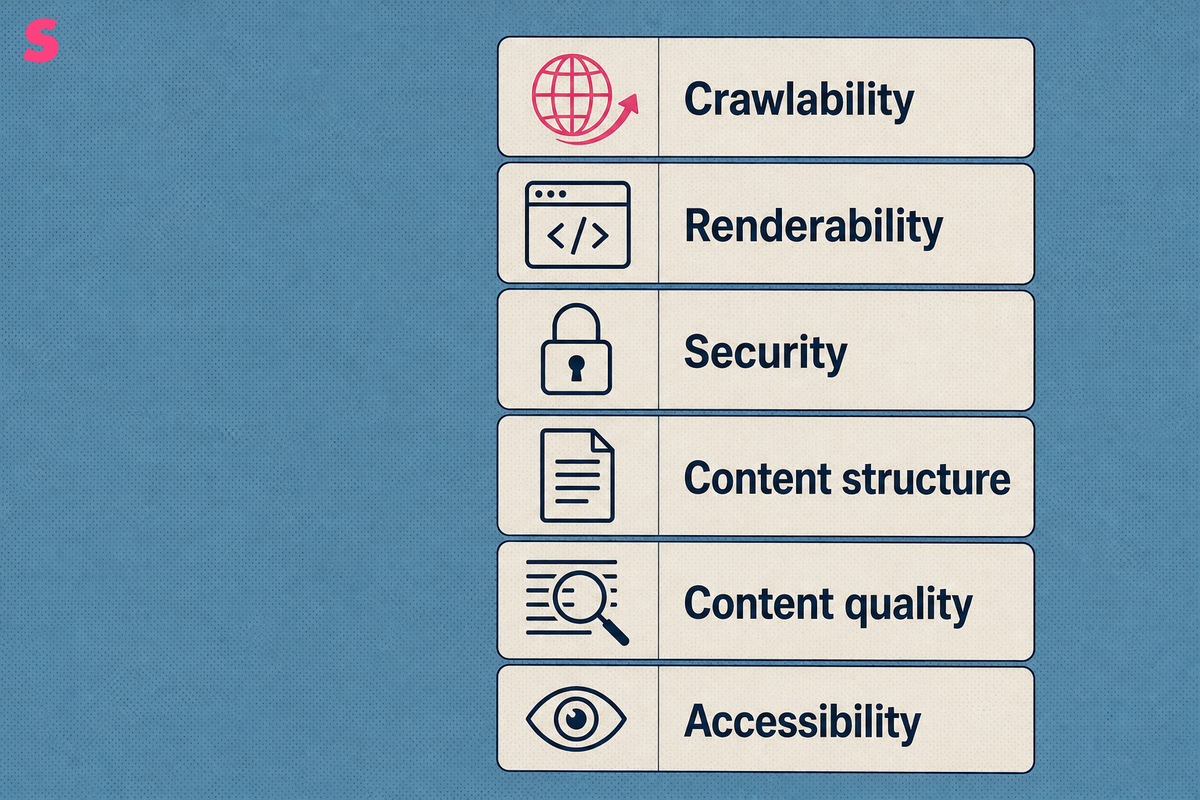
Direct retrieval checks determine whether an answer engine can obtain and parse page content. Broader security, accessibility, and page-quality reviews are important safeguards, but they do not independently determine AI retrieval or citation.
- Crawlability: Confirm that answer engines can reach the URL, robots.txt permits intended access, and the canonical tag identifies the preferred page.
- Renderability: Check rendered experience, server response behavior, and whether critical content depends on JavaScript rather than substantive server-rendered HTML.
- Security: Review HTTPS and response-header hygiene, including Strict-Transport-Security and Content-Security-Policy, as broader security safeguards.
- Content structure: Use clear headings, semantic HTML, metadata, and schema markup that matches visible content.
- Content quality: Confirm that the page answers a defined question, supports claims, and reflects current product or category knowledge.
- Accessibility: Review alt text, ARIA attributes, contrast, and explicit image dimensions as broader usability and quality safeguards.
Teams need recurring technical reviews to identify regressions and attach severity-ranked fixes to changed pages.
Crawlability is foundational, but it is only one dimension. A technically polished page cannot earn a citation if the relevant retrieval path cannot access its content.
Which AI visibility metrics matter for B2B SaaS, and how do you build a credible prompt set?
B2B SaaS teams should measure visibility at the prompt, source, traffic, and pipeline levels. Mention rate shows the share of answers naming a brand. Citation rate shows the share linking or referring to a brand’s sources. Share of voice compares a brand’s presence with competitors across the same prompt set.
Sentiment describes how an answer characterizes a brand. Answer accuracy checks whether the response states the product, category, or comparison correctly. Referral traffic measures visits from AI surfaces, while conversion influence measures whether AI-referred or AI-assisted journeys contribute to pipeline. Referral traffic and conversion influence connect most directly to revenue.
A credible prompt taxonomy includes category prompts, comparison prompts, problem prompts, and brand prompts. Category prompts test broad demand. Comparison prompts reveal evaluation-stage visibility. Problem prompts expose solution relevance. Brand prompts show what an answer engine says when a buyer already knows the company.
A team that runs the same prompt list daily can identify patterns that a weekly snapshot would average away. Answers shift with retrieval-index changes, model updates, and new competitor material. A movement that holds for four days is a trend, while a one-day spike is noise. Run prompt lists daily, then review positioning and full technical audits monthly or quarterly.
Sona AI Visibility Growth adds page-level insights, Agent Analytics, company-level visitor identification, and AI search attribution. Those capabilities give teams product context alongside prompt and source-level measurement.
A credible benchmark discloses the collection date, answer surfaces, exact prompt wording, repeat runs, and scoring rules. Common GEO mistakes include measuring one answer run, mixing informational and commercial prompts without labels, treating mention rate as revenue, and changing prompt wording between reporting periods.
What do these 2026 GEO benchmarks not show?
2026 GEO benchmarks show directional visibility patterns, not stable market share or causal revenue impact. AI answers are volatile because model updates, retrieval changes, personalization, location, and prompt wording can change a response without any change to a brand’s content.
A mention does not equal revenue. A buyer can see a brand in an answer without clicking or entering a measurable funnel. Longer content appearing alongside more citations is also an observational relationship, not proof that additional word count causes visibility.
The figures in this article come from third-party studies and dated listings. Independently reported figures should remain separate from vendor-reported claims, especially when methodology, prompt sets, and repeatability are not fully disclosed. The June 2026 brand-appearance study is useful evidence, but it is not a permanent benchmark.
Generative engine optimization GEO trends 2026 are a measurement discipline, not a prediction system. Record the date, preserve the prompt set, rerun the analysis daily, and report changes without claiming that a single answer captures every buyer experience.
How is the GEO tool market growing, and what do the tools cost in 2026?
The GEO tool market is expanding because marketers need to measure answer-level visibility, citations, and AI-referred demand. The U.S. GEO market is projected to reach USD 365.4 million in 2026 at a 42.9% compound annual growth rate, per the October 2026 listing.
Tool costs range from $10–$1,000+ per month for DIY tools and AI visibility software, while enterprise solutions range from $1,500–$50,000+, per the October 2026 listing. Eighteen GEO tools were listed as best-in-class for 2026, per the October 2026 listing. Prices and allowances below are stated as of October 2026.
| Tool | Starting price | Agency Plans? (Yes/No) | # of Answer Engines Tracked | Answer Engines | # of Daily Tracked Prompts (entry plan) | Cost per Daily Tracked Prompt | Differentiation |
|---|---|---|---|---|---|---|---|
| Sona AI Visibility | From $75/month, billed annually | Yes | 11 | Not published | 5,000 credits/month, about 56 prompts tracked daily on 3 engines | $0.45 per daily tracked prompt | Growth adds page-level insights, Agent Analytics, company-level visitor identification, and AI search attribution. |
| Goodie | From $295/month | Yes | 5 | Not published | 110 prompts daily | $0.67 per daily tracked prompt | Focus: AI visibility tracking across five models on the Core plan. |
| Otterly.ai | From $29/month | Yes | 4 | ChatGPT, Google AI Overviews, Perplexity, Microsoft Copilot | 15 prompts daily | $0.48 per daily tracked prompt | Focus: AI visibility tracking across four base engines, with paid engine add-ons. |
| PromptWatch | From $95/month | Yes | Not published | Not published | 50 prompts daily | $0.48 per daily tracked prompt | Focus: daily prompt tracking across supported models. |
Sona AI Visibility Growth adds page insights, visitor identification, and attribution on top of prompt tracking. For B2B SaaS teams, those capabilities add product context to AI search measurement.
How do B2B SaaS teams turn AI visibility findings into content and PR actions?
B2B SaaS teams should fix owned-page structure first, then build third-party evidence where buyers and answer engines encounter it. Corporate websites supplied about 78% of cited AI-answer sources in the June 2026 study, per alphaxiv.org, June 2026. The remaining citations make review sites, community discussion, video, editorial coverage, and digital PR operationally relevant.
- Repair the on-site answer. Rewrite priority pages around category, comparison, and problem prompts. Put a direct answer under each question-shaped heading, then add proof.
- Close source gaps. Identify prompts where competitors appear, inspect the cited source types, and create evidence that addresses the missing buyer question.
- Build third-party signals. Support product launches and category narratives with credible reviews, demonstrations, community participation, video, and editorial outreach.
- Report business impact. Review AI visibility beside referral traffic, assisted conversions, branded demand, pipeline, and win rates.
Traditional SEO still matters because strong pages, technical quality, and search demand create much of the source material AI systems retrieve. GEO adds a reporting layer for whether the brand appears in the answer, which source supported that appearance, and whether the resulting buyer journey contributed to commercial outcomes.
Sona AI Visibility Growth supplies page-level insights and AI search attribution for this work. For a B2B SaaS team, those capabilities support a reporting sequence: diagnose prompt gaps, improve the page or supporting evidence, rerun the prompt list daily, and assess visibility alongside demand and pipeline movement.
What are the frequently asked questions about GEO?
What is generative engine optimization?
Generative engine optimization, or GEO, is the practice of optimizing content so AI search engines cite it in their responses. GEO targets answer-level visibility, meaning whether a brand, entity, page, or source appears in an AI-generated response. The work includes prompt research, extractable content structure, source evidence, technical readiness, and measurement.
How is GEO different from SEO?
GEO optimizes a brand or entity to appear in AI-generated outputs, while SEO targets rankings and clicks from traditional search results. Both matter in 2026 because they share technical foundations such as crawlability, server-rendered HTML, structured content, and authoritative pages. GEO adds citation, mention, prompt, and answer-quality measurement.
Does longer content get cited more often in AI answers?
The reported relationship between content length and citations is observational, not causal proof. Adding words alone is not a reliable GEO tactic. Structure and substance are controllable factors: answer the question directly, support claims with dated evidence, define entities precisely, and provide useful detail that a buyer can verify.
How much do GEO tools cost in 2026?
GEO tool costs range from $10–$1,000+ per month for DIY and AI visibility software, with enterprise solutions ranging from $1,500–$50,000+, per the October 2026 listing. As of October 2026, entry prices in the comparison table range from $29 per month to $295 per month, while Sona AI Visibility starts from $75 per month.
Can AI visibility be benchmarked reliably when answers change so often?
AI visibility can be benchmarked reliably only when the benchmark discloses collection dates, answer surfaces, prompt wording, repeat runs, and scoring rules. A single-run result is directional because retrieval, personalization, location, and model behavior can change answers. Daily repeat runs provide the series needed to separate sustained change from noise.
Does appearing in an AI answer lead to revenue?
Appearing in an AI answer does not automatically lead to revenue. A mention can create awareness without generating a click, trial, or measurable conversion. Teams should connect citations to referral traffic, assisted conversions, pipeline, and closed-won revenue.
Summarize this article with AI: ChatGPT · Claude · Perplexity · Google AI Mode
Last updated: October 2026