For SaaS, AEO means structuring product, pricing, comparison and documentation pages so ChatGPT, Perplexity, Google AI Overviews, and other answer engines cite your brand in their answers. Visibility relies on clear page structure, third-party mentions and fresh content, not rankings alone. Measure it using a fixed prompt set, then connect citations to pipeline; Sona AI Visibility links prompts and citations to revenue and monitors AI crawler activity. Mention counts alone reveal nothing about buyers.
What does AEO for SaaS mean, and how is it different from SEO?
AEO for SaaS means structuring product, commercial, and educational content so ChatGPT, Perplexity, Claude, Gemini, and other answer engines can use and cite it in generated answers. SaaS buyers can receive a vendor shortlist, pricing context, and implementation guidance before they visit a vendor website.
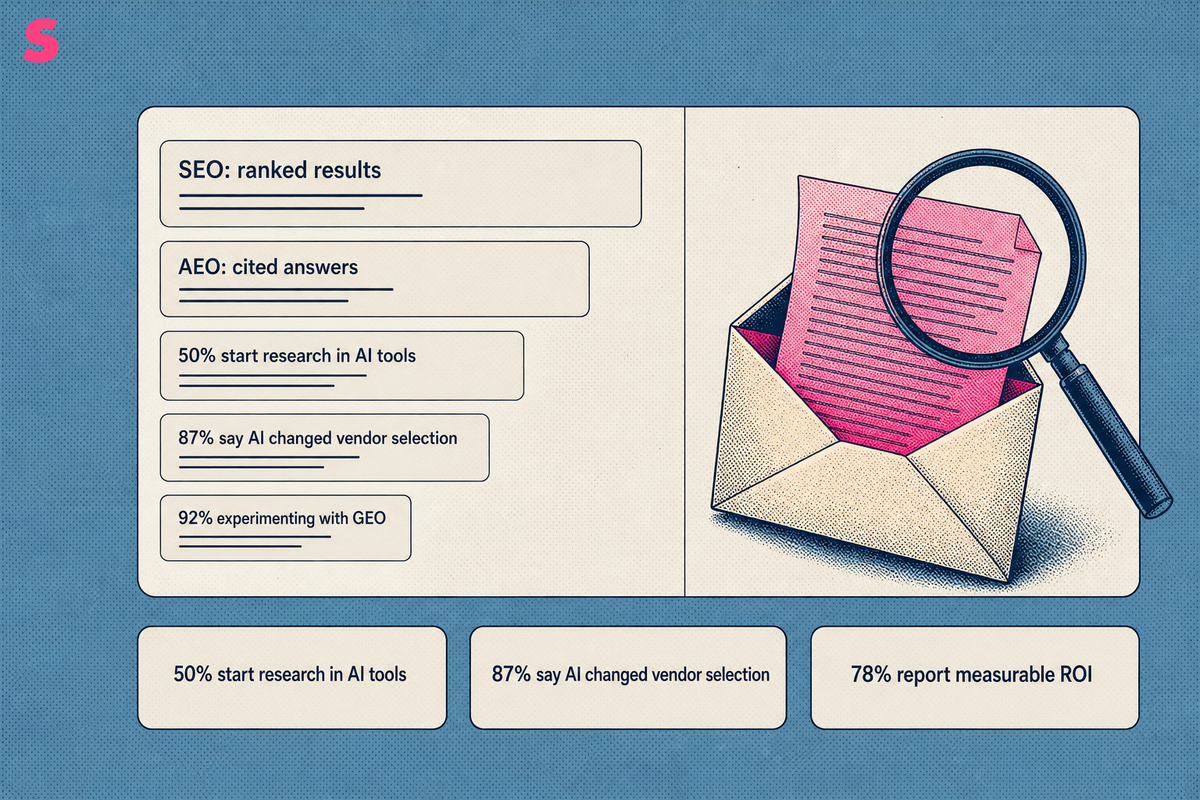
Answer engine optimization (AEO) focuses on citations and direct inclusion in AI answers. SEO focuses on visibility and clicks in ranked search results. Startupcookie.com defines AEO as structuring website content for citation by AI assistants. Both disciplines matter because SaaS buyers still use search engines while asking answer engines more detailed commercial questions.
For a SaaS marketer, generative engine optimization (GEO) for B2B is not a separate content calendar. It makes feature pages, comparison pages, documentation, pricing explanations, and use-case content easier to retrieve, verify, and summarize. LinkedIn.com reports that half of B2B SaaS buyers start research in AI tools and that 87% say AI changed vendor selection. GNW Consulting and Demand Metric research reported that 92% of surveyed organizations were experimenting with or operationalizing GEO, while 78% of investing organizations reported measurable ROI, per aol.com, June 3, 2026.
- SEO question: Which page can rank for a query?
- AEO question: Which passage answers the buyer’s question clearly enough to cite?
- SaaS commercial question: Which cited answer leads to qualified evaluation, pipeline, or revenue?
How do AI engines decide which SaaS brands to cite?
AI engines cite SaaS brands when they find accessible, specific, corroborated material that directly answers a prompt. A vague product page forces an engine to infer key details. A page that names the problem, intended user, workflow, constraints, and outcome provides usable source material.
An AI search optimization SaaS strategy should start with buyer questions, not a generic keyword list. Map implementation comparisons, integration requirements, pricing-model questions, and use-case tradeoffs to the pages that should answer them. SaaS.group identifies engine selection, index optimization, and publishing beyond a company blog as core B2B SaaS AEO practices.
Answer engines also need evidence they can reconcile. Consistent product claims across pricing pages, documentation, customer stories, analyst coverage, community discussions, and comparison pages reduce ambiguity.
- Write the buyer question in natural language.
- Assign one owned page to answer that question.
- State the product capability, relevant audience, and operating constraint.
- Support major claims with documentation or third-party evidence.
- Check whether answer engines cite the intended page or a weaker source.
Can AI engines actually crawl, read and trust your SaaS pages?
AI engines can only cite SaaS pages they can reach, render, parse, and evaluate as credible. Crawl access is the first gate. A landing page that depends on blocked bots, heavy client-side rendering, or unclear canonical tags cannot serve as a reliable source for AI answers.
SaaS teams should review technical accessibility separately from content quality. Retrieval bots affect whether a page can support a current answer, while training bots affect later model knowledge. Sona's own AI visibility data, September 2026, covers 8 answer surfaces, ChatGPT, Google AI Overviews, Perplexity, Google AI Mode, Gemini, Mistral, Qwen and Claude. This measurement counts answer surfaces in the archive.
| Technical check | What the SaaS team should inspect | Why it matters for AEO | Operating cadence |
|---|---|---|---|
| robots.txt | Allow or disallow rules for relevant AI crawlers | Blocked crawlers cannot retrieve the page for an answer | Review after crawler-policy changes |
| Server-rendered HTML | Whether essential product copy exists before JavaScript executes | Readable HTML gives crawlers stable source material | Review during template releases |
| Canonical tag | Whether the preferred product or documentation URL is explicit | Canonical signals reduce duplicate-page ambiguity | Review during migrations |
| Structured content | Headings, tables, FAQPage JSON-LD, and semantic sections | Clear structure makes claims easier to extract and cite | Review when pages change |
Technical accessibility is a dated snapshot. Re-audit monthly or quarterly, especially after a major release or site migration.
Which SaaS pages and content formats earn AI citations?
SaaS pages most likely to earn AI citations answer commercial buyer questions with concrete, well-structured detail. Start with pricing, feature, comparison, alternatives, use-case, integration, security, and documentation pages. These pages explain the tradeoffs buyers ask AI engines to summarize before contacting sales.
Feature pages need more than a feature name and promotional copy. State who uses the capability, which workflow it supports, prerequisite systems, implementation boundaries, and relevant outputs. Comparison tables and detailed use-case pages make feature differences easier for AI systems to parse and cite, according to eseospace.com.
Vague feature-page copy: Our platform provides attribution reporting for growing teams.
AEO-optimized version: Marketing operations teams use attribution reporting to combine campaign, account, and opportunity activity before reviewing channel contribution. The workflow requires connected campaign and CRM records. The report identifies the activity associated with opportunity creation, but it does not replace incomplete CRM governance. The output is a documented view of channel contribution for pipeline review.
- Pricing pages: explain packaging, billing logic, usage units, and buyer fit.
- Comparison pages: explain selection criteria, practical differences, and limitations.
- Use-case pages: connect a role, workflow, problem, and measurable business outcome.
- Documentation: answer implementation, integration, configuration, and troubleshooting questions.
- Alternatives pages: clarify when a product is appropriate and when a buyer needs a different approach.
AEO content should answer the prompt without hiding useful detail behind a demo form. SaaS teams need not publish every internal detail. They need enough factual material for answer engines to distinguish the product from generic category language.
How do you build an AEO strategy around the SaaS buying journey?
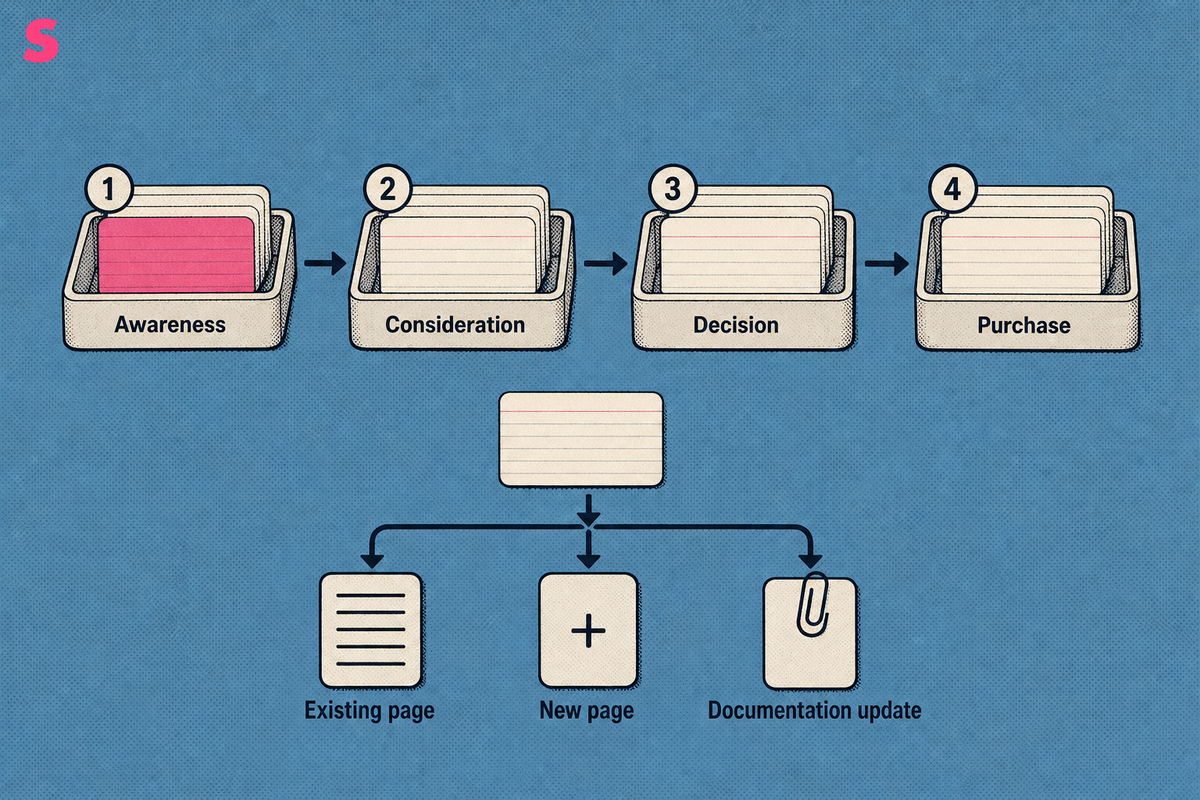
A SaaS AEO strategy organizes prompts by buying stage, then assigns each stage to pages, evidence, and conversion paths. Awareness prompts define a problem. Consideration prompts compare approaches. Decision prompts ask about integrations, pricing, implementation, security, and vendor fit.
Build a prompt map from sales calls, support tickets, search queries, win-loss notes, and product documentation. A prompt such as “best platform for multi-product attribution” belongs to a different page and buyer stage than “how does attribution modeling work.” Treating both as one keyword cluster loses the commercial distinction.
- List recurring questions from the ICP and buying committee.
- Classify each question by Awareness, Consideration, Decision, or Purchase.
- Map each prompt to an existing page, a new page, or a documentation update.
- Identify the proof required, such as an integration specification, methodology, or use case.
- Run the same prompt list daily across the answer engines your buyers use.
Daily prompt tracking reveals changes that a weekly snapshot can obscure. Answers can shift after retrieval-index updates, model changes, or competitor publishing activity. Evaluate repeated movement rather than a single result.
On Growth plans, Sona AI Visibility adds page-level insights, Agent Analytics, company-level visitor identification and AI search attribution. These capabilities help SaaS teams connect visibility analysis with commercial investigation.
How much do reviews, communities and third-party mentions affect AI visibility?
Reviews, communities, and third-party mentions affect SaaS AI visibility because answer engines synthesize evidence from more than a vendor website. A buyer asking about alternatives, implementation experiences, or product limitations expects independent discussion alongside vendor claims.
SaaS teams should not manufacture mentions. They should keep product facts consistent wherever buyers and answer engines encounter them. Validate descriptions in marketplace profiles, integration directories, community replies, analyst coverage, partner materials, and review responses.
Third-party material is especially useful for comparison prompts. A vendor page can explain intended positioning, while an external review can surface adoption context, workflow fit, and buyer language. Contradictory descriptions create ambiguity. If a pricing page, integration directory, and documentation page describe a capability differently, AI answers can repeat the conflict.
- Audit recurring product descriptions across owned and third-party sources.
- Correct obsolete pricing, packaging, and integration statements.
- Publish factual responses to recurring implementation questions.
- Use community language to improve prompt maps and documentation.
The available evidence does not quantify an independent effect size for third-party mentions. Measure the effect by holding a fixed comparison-prompt set, logging cited domains, correcting one source class such as a directory or review profile, and comparing citation and source-selection movement across repeated runs.
How can you test which AEO tactics actually move citations?
Test AEO tactics by fixing a prompt set, recording citations and sources before a change, changing one page or evidence variable, then measuring repeated results. A brand-level visibility number can provide orientation, but it does not identify a work item. Prompt-level and source-level evidence identifies the page, question, and cited material behind movement.
A reproducible test package should publish the exact prompt set, the answer surfaces tested, the baseline window, the post-change window, and a change log. For a SaaS attribution product, prompts can include: “How does multi-product attribution work?”; “What should a B2B team evaluate in an attribution platform?”; “Which attribution platform supports connected campaign and CRM records?”; and “What are the implementation requirements for attribution reporting?” Run the unchanged prompts on the same answer surfaces during both windows.
Score each response consistently: record a brand mention, a citation to the intended owned page, replacement of a weaker cited source by the intended page, and persistence across repeated runs. Report each tactic separately rather than combining feature-page edits, comparison-page changes, documentation updates, and technical fixes into one result. This article does not publish controlled tactic outcomes because no controlled test dataset accompanies the page.
A foundational GEO study tested content strategies across 10,000 queries and 25 domains, then validated findings on Perplexity, August 5, 2026. That study provides context for experimental design, but it does not replace a SaaS team’s own prompt-level baseline and intervention record.
| Test element | Baseline | Change | Measurement | Decision rule |
|---|---|---|---|---|
| Feature page | Current citation rate by prompt | Add workflow detail and implementation constraints | Daily citation and source log | Keep changes that persist across repeated runs |
| Comparison page | Current inclusion in evaluation prompts | Add selection criteria and a structured table | Daily mention, position, and cited-source log | Review the prompt cluster, not one answer |
| Documentation page | Current citation source | Clarify setup steps and integration requirements | Daily source and citation log | Retain pages that replace weaker citations |
| Technical fix | Current crawl accessibility | Resolve a blocked crawler or rendering issue | Monthly crawl review and citation trend | Confirm access before judging citation movement |
Keep a change log with the URL, prompt cluster, edit date, source changes, and observed result. The output is a comparable series over time. Severity-ranked fixes attached to a moved page turn measurement into a prioritized backlog.
How do you connect AEO visibility to pipeline and revenue?
SaaS teams connect AEO visibility to pipeline by joining AI-referred visits, identified accounts, self-reported attribution, CRM opportunities, and closed-won revenue. Mention counts show whether a brand appeared. Revenue measurement shows whether an answer-engine interaction contributed to a commercial journey.
Start with clean campaign, form, and CRM governance. Add a self-reported field such as how a buyer heard about the company, then reconcile that answer with referral, account, and opportunity data. AI research can occur without a measurable click.
- Define which lifecycle events count as qualified pipeline.
- Record AI-referred visits and self-reported AI discovery.
- Resolve activity to the account where available.
- Associate prompt clusters and cited pages with opportunity creation.
- Review pipeline and closed-won revenue by answer-engine source and buyer stage.
Measurement will not capture every zero-click interaction. It can establish whether pages and prompts receiving AI citations appear in journeys that become qualified opportunities.
Which AEO tools and agencies help SaaS teams track and improve visibility?
The right AEO tool for SaaS depends on whether the team needs prompt tracking alone or needs to connect citations and AI-referred traffic to pipeline. Evaluate prompt cadence, engine coverage, agency support, source visibility, and the ability to tie findings to commercial work.
The product comparison below uses public plan information checked in October 2026. Prices, engine coverage, and prompt allowances can change. The listed cost per daily tracked prompt is a shared comparison unit, not a quality ranking.
| Tool | Starting price | Agency Plans? (Yes/No) | # of Answer Engines Tracked | Answer Engines | # of Daily Tracked Prompts (entry plan) | Cost per Daily Tracked Prompt | Differentiation |
|---|---|---|---|---|---|---|---|
| Sona AI Visibility | From $75/month, billed annually | Yes | 11 | Not published | 5,000 credits/month, about 166 daily tracked prompts on one model or 56 across three | $0.45 per daily tracked prompt | Connects AI citations and prompts to pipeline and revenue on one account timeline |
| Profound | Free Trial; Enterprise custom pricing | Yes | 3 | ChatGPT, Gemini, Google AI Overviews | 50 prompts daily for 7 days | No public entry-plan price | Prompt tracking across its trial engines, with custom Enterprise plans |
| Peec AI | From $95/month | Yes | 3 | Not published | 50 prompts daily | $0.63 per daily tracked prompt | AI visibility tracking across self-serve and agency tiers |
| Otterly.ai | From $29/month | Yes | 4 | ChatGPT, Google AI Overviews, Perplexity, Microsoft Copilot | 15 prompts daily | $0.48 per daily tracked prompt | Monitoring across its listed answer engines, with paid engine add-ons |
| Scrunch AI | From $250/month | Yes | 4 | ChatGPT, Perplexity, Google AI Overviews, Microsoft Copilot | 125 prompts, frequency not stated | No refresh cadence published | AI visibility coverage across its Core and Enterprise plans |
Evaluate agencies on tested AI search capability, citation baselines, and a defined AEO methodology. An AEO engagement should show how the agency will learn the SaaS product, ICP, buying journey, commercial goals, and technical constraints before publishing recommendations.
What are the frequently asked questions about AEO for SaaS?
Is AEO for SaaS just SEO with a new name?
No. Technical SEO and authority work remain the base, but AI engines select and summarize passages rather than rank links alone. Page structure, third-party mentions, documentation quality, and prompt-level measurement matter beyond traditional ranking reports.
How do I know if ChatGPT or Perplexity mentions my SaaS product?
Build a fixed prompt set from real buyer questions, then run it daily across the answer engines your buyers use. Record brand mentions, citations, cited sources, position, and sentiment for each prompt. A repeated prompt log provides more useful evidence than a one-time search.
Are AI answers stable enough to use as a KPI?
AI answers vary by model, location, date, retrieval index, and prompt wording. Use trends across repeated runs of a fixed prompt set rather than treating one answer as a score. Daily tracking helps teams separate sustained movement from a one-day change.
Which SaaS pages should be optimized for AEO first?
Start with pricing, feature, comparison, alternatives, use-case, documentation, integration, and security pages. These pages answer the commercial and implementation questions buyers ask when evaluating SaaS vendors through answer engines.
Can AEO traffic be tied to pipeline?
Yes, in part. Resolve the accounts behind AI-referred visits where possible, collect self-reported attribution, and connect prompts and citations to CRM opportunities. This creates a commercial view of AI discovery rather than stopping at mention counts.
What should I ask an AEO agency before hiring one?
Ask whether the agency understands your product, ICP, buyer journey, and commercial goals. Request a citation baseline, a defined AEO methodology, examples of tested work, and a clear explanation of how the agency will measure prompt-level results and business impact.
Summarize this article with AI: ChatGPT · Claude · Perplexity · Google AI Mode
Last updated: October 2026