AEO content development involves writing and organizing pages so AI answer engines can find, understand and cite them: lead with a direct answer, followed by evidence, distinct entity definitions and schema markup. Keywords remain important, but citation-ready evidence matters more. No structure ensures a citation, so evaluate every update against a consistent prompt set. Sona AI Visibility links the resulting prompts and citations to pipeline and revenue.
What is AEO content creation, and how is it different from writing for keyword rankings?
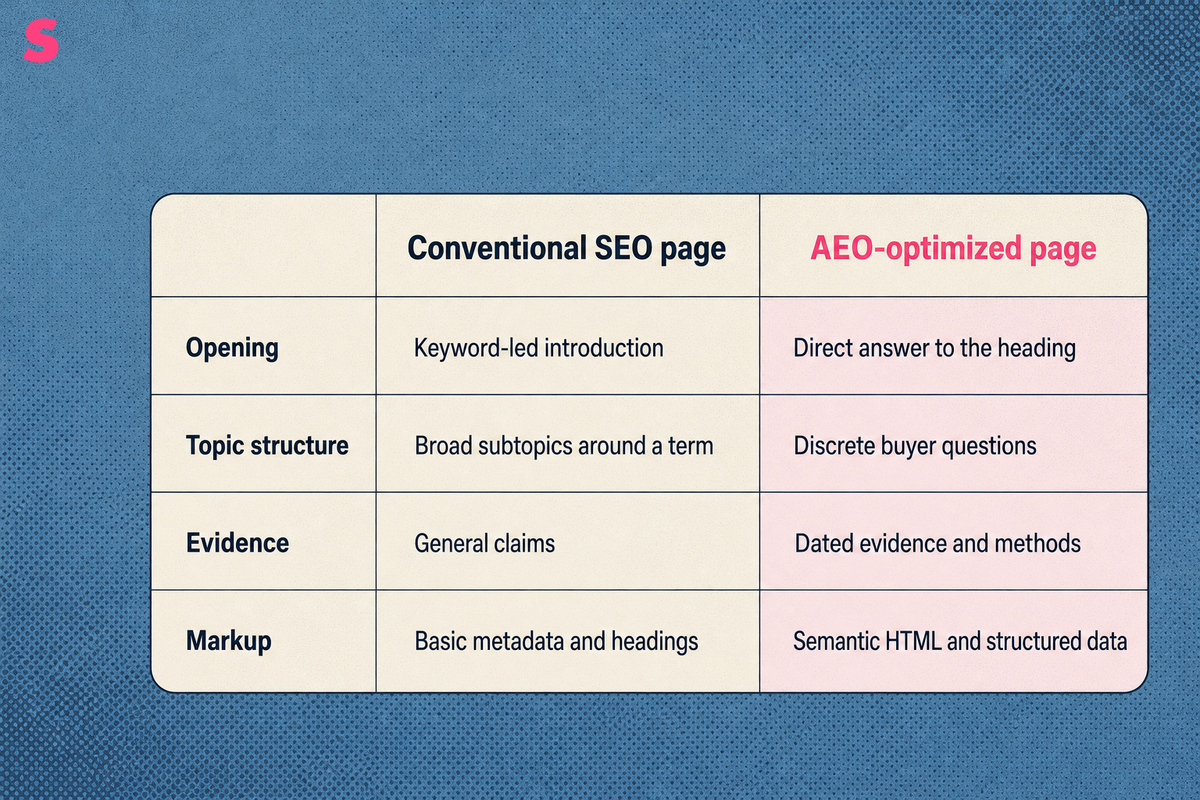
AEO content creation is the practice of writing pages that AI answer engines can interpret, retrieve, and cite in generated answers. Traditional SEO focuses on ranking a page. AEO also asks whether an AI answer accurately mentions the brand and cites the underlying source.
For marketing and content leaders, that distinction changes the deliverable. A keyword-ranked page can earn a click without resolving a buyer’s full question. An AEO page states the answer clearly enough for ChatGPT, Perplexity, Gemini, Claude, and other answer engines to extract, contextualize, and attribute.
AEO does not replace technical SEO, useful information architecture, or original subject-matter expertise. It is not a formatting tactic that guarantees inclusion in Google AI Overviews or another AI answer. Answer engine optimization (AEO) emphasizes original research, expert insight, and proof worth citing, per forrester.com.
Consider a page targeting “enterprise attribution software.” A conventional SEO draft may repeat the phrase, describe features, and point readers toward a demo. An AEO-oriented draft opens with a precise definition, explains the attribution problem, distinguishes account-level from person-level measurement, documents the method, and answers the comparison questions a buying committee asks.
What does an AEO-optimized page contain compared with a conventional SEO page?
An AEO-optimized page contains a direct answer, evidence, clear entity definitions, and a structure that lets an AI system isolate the relevant passage. A conventional SEO page can still perform well in search, but it often organizes information around a keyword theme rather than the complete buyer question.
AEO content should be concise, high-quality, and structured for featured snippets and AI-driven results, per the October 2026 listing. The practical difference is not shorter copy. Each section must remain useful when an answer engine retrieves it without the rest of the page.
| Page element | Conventional SEO page | AEO-optimized page | Operational purpose |
|---|---|---|---|
| Opening | Keyword-led introduction | One- or two-sentence answer to the heading | Provides a quotable response |
| Topic structure | Broad subtopics around a target term | Discrete buyer questions with direct answers | Matches prompt-shaped retrieval |
| Evidence | General claims and internal positioning | Dated evidence, methods, examples, and definitions | Gives an answer a basis for citation |
| Markup | Basic metadata and headings | Semantic HTML, structured data, canonical tags, and accessible media | Clarifies page meaning and ownership |
The page should also preserve SEO fundamentals. AEO is often confused with writing only FAQs, adding schema markup, or producing very short articles. Those techniques can support interpretation, but they cannot compensate for weak evidence, unclear claims, or a page that fails to answer the prompt.
How do you write content that goes beyond keywords and answers the questions AI engines retrieve?
Turn a search theme into the decision questions behind it, then answer each question with a defined claim, supporting detail, and a clear implication. Keywords indicate demand. Prompts reveal the fuller problem a buyer needs to resolve.
- Start with the decision a reader needs to make, such as choosing a measurement method or comparing implementation paths.
- List the questions that determine that decision, including definitions, constraints, trade-offs, and proof requirements.
- Write a direct answer beneath each question-shaped heading before adding nuance, examples, or exceptions.
- Attach evidence to factual claims, using dates, sources, methods, or first-party documentation.
- Assign one page to own the topic, then make its title, headings, canonical tag, and internal context consistent.
A single brand-level visibility score provides a dated snapshot, but it does not identify the next task. A prompt-level view shows which questions produce visibility and which sources appear in the answer. Sona AI Visibility connects citations to pipeline and revenue, while AI Search Insights shows the prompts buyers ask and the sources answer engines cite.
For example, a team writing about AI search attribution could build sections for “What counts as AI-referred traffic?”, “How do zero-click journeys receive credit?”, and “What evidence supports channel attribution?” Each section should stand alone. That structure gives retrieval systems a compact, unambiguous passage instead of forcing them to synthesize a conclusion from scattered marketing copy.
What does AEO markup look like in a real page, and what do answer engines actually parse?
AEO markup uses semantic HTML and structured data to clarify a page’s topic, sections, authorial context, and relationships. Answer engines parse visible copy, headings, links, metadata, server-rendered HTML, and machine-readable signals that establish what the page says and how its parts relate.
This compact example shows rendered semantic HTML and matching Article and FAQPage JSON-LD. The canonical URL is metadata rather than visible copy. The heading, answer, author, and FAQ are visible content that a reader and an answer engine can both parse.
<head>
  <link rel="canonical" href="CANONICAL_PAGE_URL">
</head>
<article>
  <h1>What is AI search attribution?</h1>
  <p>AI search attribution measures how AI-referred visits and citations contribute to commercial outcomes.</p>
  <p>By Acme Research</p>
  <section>
    <h2>How does AI search attribution differ from citation tracking?</h2>
    <p>Citation tracking records where a brand appears. AI search attribution connects AI-referred activity to commercial outcomes.</p>
  </section>
  <section>
    <h2>What counts as AI-referred traffic?</h2>
    <p>AI-referred traffic is a visit that arrives from an AI answer surface.</p>
  </section>
</article><script type="application/ld+json">
{
  "@context": "https://schema.org",
  "@type": "Article",
  "mainEntityOfPage": "CANONICAL_PAGE_URL",
  "headline": "What is AI search attribution?",
  "description": "AI search attribution measures how AI-referred visits and citations contribute to commercial outcomes.",
  "author": {
    "@type": "Organization",
    "name": "Acme Research"
  },
  "publisher": {
    "@type": "Organization",
    "name": "Acme Research"
  },
  "mainEntity": {
    "@type": "FAQPage",
    "mainEntity": [
      {
        "@type": "Question",
        "name": "What counts as AI-referred traffic?",
        "acceptedAnswer": {
          "@type": "Answer",
          "text": "AI-referred traffic is a visit that arrives from an AI answer surface."
        }
      }
    ]
  }
}
</script>
- Question heading: The visible h2 identifies the buyer question and creates a retrievable section boundary.
- Direct answer: The visible paragraph beneath the heading supplies the answer an engine can quote and contextualize.
- Author or organization: The visible byline and the Article author and publisher fields identify the responsible organization.
- Canonical URL: The canonical tag and Article mainEntityOfPage identify the preferred page version.
- Article properties: The Article headline and description repeat the rendered title and opening definition rather than introducing separate claims.
- Visible FAQ content: The FAQPage question and answer exactly match the rendered h2 and paragraph.
Structured data is descriptive metadata. Visible copy remains the source material an answer engine can retrieve and quote. Keep both versions aligned, and use FAQPage markup only when the page visibly contains genuine questions and answers.
Which content formats most often earn citations in AI answers?
The strongest citation candidates resolve a specific question with evidence: original research, expert explainers, comparison tables, definitions, implementation guides, and documented case examples. Format alone does not earn a citation. The page needs a clear claim supported by information worth reusing.
Original research and expert insight are central to AEO because answer systems need sources that add more than repeated summaries, per forrester.com. A page that rewrites public definitions gives an engine little reason to prefer it over similar pages.
| Format | Best use | What makes it retrievable | Common failure |
|---|---|---|---|
| Definition page | Explaining a specialized term | Concise definition followed by boundaries | Repeating dictionary language without context |
| Comparison page | Evaluating methods or categories | Consistent comparison criteria in a table | Uneven columns that prevent comparison |
| How-to guide | Explaining a repeatable process | Numbered steps, prerequisites, and outcomes | Skipping the operational details |
| Research page | Publishing new findings | Dated methodology and specific observations | Presenting conclusions without evidence |
Off-site material also matters. Creator AEO refers to earning brand citations through third-party creators, community members, reviewers, and other outside voices, per linkedin.com. On-site structured content and off-site third-party coverage are separate workstreams. A company blog is not the only source base an answer engine can retrieve.
Do glossary pages help AEO visibility, or are they thin content?
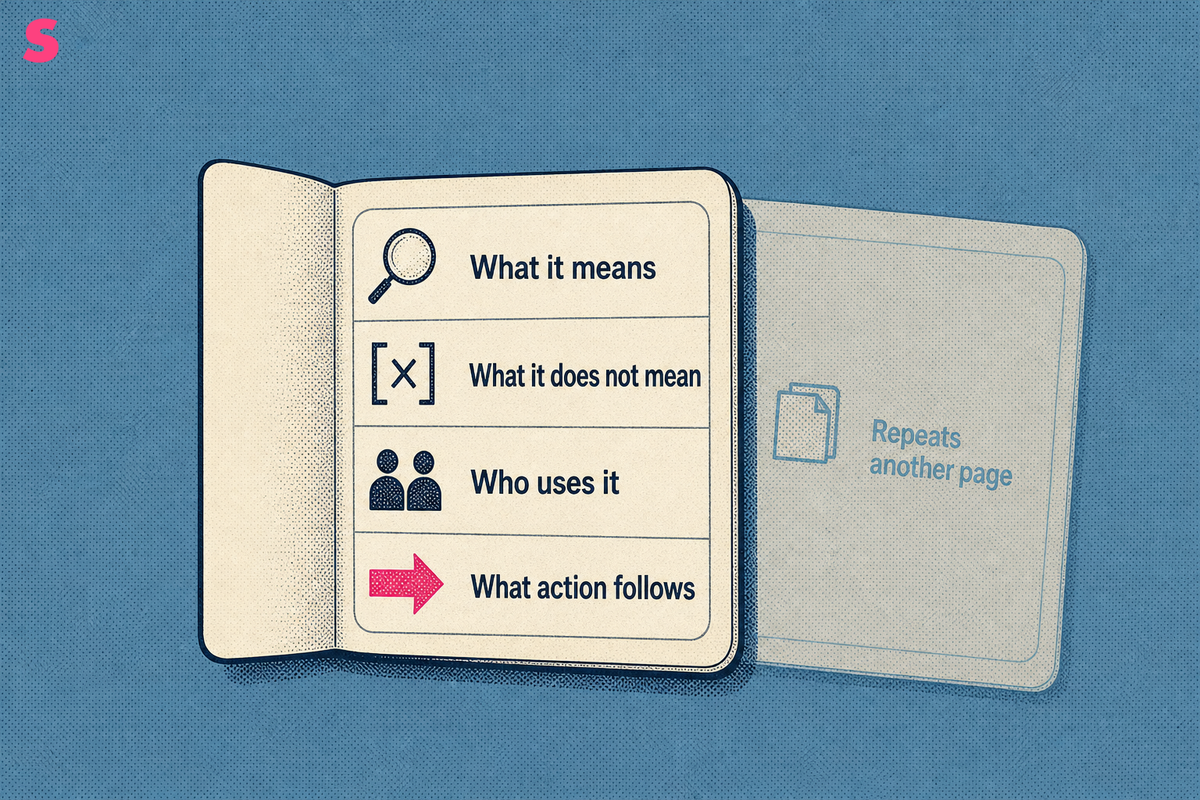
Glossary pages help AEO visibility when they define a term precisely, explain its boundaries, and connect the definition to a real decision. They become thin content when they offer only a generic sentence, repeat nearby pages, or exist solely to target a keyword.
A useful glossary entry answers four points: what the term means, what it does not mean, who uses it, and what action follows from understanding it. For example, an entry for “AI search attribution” should distinguish AI-referred visits from citations, explain why zero-click research creates measurement gaps, and direct readers toward relevant implementation concepts.
Use a glossary page when the term has stable meaning and recurring commercial relevance. Use a larger explainer when the reader needs a process, comparison, or technical implementation. The distinction prevents a glossary from becoming a fragmented collection of pages that each answer too little to earn retrieval.
Every glossary page needs a clear canonical purpose. If a product page, blog post, and glossary entry define the same term in nearly identical language, the site creates competing sources instead of one authoritative reference.
How should AEO content change for voice search and AI assistants?
AEO content for voice search and AI assistants should use complete natural-language questions, concise spoken answers, and clear follow-up detail. Voice queries often contain more context than typed keywords, while AI assistants can ask follow-up questions and synthesize several sources into one response.
Start each answerable section with one or two sentences that can be read aloud without losing meaning. Then add the caveats a professional buyer needs. A voice assistant benefits from a direct response, but the underlying page still needs evidence, precise terminology, and enough context to avoid misleading simplification.
- Write headings as the questions a buyer would ask.
- Define abbreviations on first use, such as answer engine optimization (AEO).
- Answer pronouns and references explicitly instead of relying on nearby context.
- Use numbered sequences when the reader must perform a process.
- Keep tables for decisions involving several comparable criteria.
Run the same prompt list daily because answer engines shift with retrieval-index changes, model updates, and new competitor material. Use repeated measurement to distinguish persistent movement from isolated answer volatility. Keep full technical re-audits on a separate monthly or quarterly schedule.
What must be true of a page technically before an AI engine can use it?
An AEO page must be reachable, indexable where appropriate, readable without fragile rendering dependencies, and internally consistent before an AI engine can use it. Strong copy cannot earn a citation if retrieval bots cannot fetch the page or parse its primary content.
Check robots.txt rules, canonical tags, response status, server-rendered HTML, page performance, security headers, structured data validity, and accessibility. The goal is not to permit every crawler without review. The goal is to make an intentional access decision for each relevant retrieval, agent, and training bot category.
Treat an audit as a point-in-time diagnostic. Resolve the findings attached to the affected page, then rerun the review after implementation to confirm that the primary content remains accessible and internally consistent.
Sona AI Visibility also tracks AI crawler activity from server logs or a lightweight edge worker. That evidence helps distinguish a content problem from an access problem. A page cannot become a reliable source for an answer engine that never reaches it.
What does it cost to start checking whether AEO content earns citations?
AEO tracking can start with a narrow prompt set and expand as the team identifies commercially important questions. Published 2026 entry pricing ranges from $29 per month to $495 per month, depending on prompt volume and engine coverage, per ud.com.hk, August 26, 2026.
The comparison below uses published entry-plan details as of October 2026. A lower unit price does not establish better fit. Define the engines, prompts, refresh cadence, and revenue questions the tracker must support before choosing a plan.
| Tool | Starting price | Agency Plans? (Yes/No) | # of Answer Engines Tracked | Answer Engines | # of Daily Tracked Prompts (entry plan) | Cost per Daily Tracked Prompt | Differentiation |
|---|---|---|---|---|---|---|---|
| Sona AI Visibility | From $75/month, billed annually | Yes | 11 | Not published | 5,000 credits/month, about 56 prompts tracked daily across three engines | $0.45 per daily tracked prompt | Connects AI citations and prompts to pipeline and revenue on one account timeline |
| Peec AI | From $95/month | Yes | 3 | Not published | 50 prompts daily | $0.63 per daily tracked prompt | AI visibility tracking across self-serve and agency plans |
| Otterly.ai | From $29/month | Yes | 4 | ChatGPT, Google AI Overviews, Perplexity, Microsoft Copilot | 15 prompts daily | $0.48 per daily tracked prompt | Prompt tracking across listed answer engines |
| PromptWatch | From $95/month | Yes | Not published | Not published | 50 prompts daily | $0.48 per daily tracked prompt | Prompt and response tracking with agency tiers |
| Goodie | From $295/month | Yes | 5 | Not published | 110 prompts daily | $0.67 per daily tracked prompt | AI visibility tracking across Core, Pro, and Enterprise plans |
Sona AI Visibility tracks 11 answer engines and starts from $75/month billed annually, as of October 2026. Sona’s own AI visibility data covers 8 answer surfaces, ChatGPT, Google AI Overviews, Perplexity, Google AI Mode, Gemini, Mistral, Qwen, and Claude, as measured in September 2026. Keep the measurement set fixed, log citations by prompt and engine, and review the trend against pipeline outcomes rather than treating one score as a conclusion.
What are the frequently asked questions about AEO content creation?
Is AEO content creation just rebranded SEO?
No. Technical SEO and useful content remain the foundation, but AEO adds answer-level questions: whether an AI system mentions the brand, cites its URL, represents its claims accurately, and includes it among relevant alternatives. AEO changes the measurement target from rank position alone to retrieval, citation, and representation.
Can any content format guarantee a place in AI answers?
No. AEO improves retrievability, clarity, authority, and citation likelihood. It is not a guaranteed ranking tactic. Test changes against a fixed set of prompts, run that prompt list daily, and separate persistent movement from one-day answer volatility.
How long should the direct answer at the top of an AEO page be?
Keep the direct answer concise enough to quote whole. One or two sentences should define the term or answer the heading. Put necessary nuance, evidence, examples, and constraints directly beneath that answer rather than burying the conclusion after a long introduction.
Does schema markup make AI engines cite a page?
Not by itself. Schema such as FAQPage or Article describes the page’s structure and makes interpretation easier, but the copy still has to earn the citation. Use markup to clarify real visible content, not to manufacture authority or add claims the page does not support.
Are AI answers too volatile to measure?
Volatility is real, but fixed prompt sets, scheduled reruns, engine-specific tracking, and citation logs make directional trends measurable. A team that runs the same prompt list daily can identify patterns that a weekly snapshot averages away.
Are AEO tools too expensive for a small team?
Published entry prices start around $29 per month, per ud.com.hk, August 2026. A small team can begin with a narrow set of high-intent prompts, establish a baseline, and expand coverage after connecting citations and AI-referred activity to meaningful commercial questions.
Summarize this article with AI: ChatGPT · Claude · Perplexity · Google AI Mode
Last updated: October 2026