Prompt volume estimates how often people ask AI assistants a particular question over time, making it the AI-era equivalent of keyword search volume. Since platforms do not release query logs, all figures are modeled from consumer panels, clickstream, or keyword demand and are most useful for relative prioritization. Reported October 2026 entry prices range from $29 to $250 monthly. Sona AI Visibility goes further by connecting the prompts behind citations to pipeline and revenue.
What is prompt volume data, and how does it differ from keyword search volume?
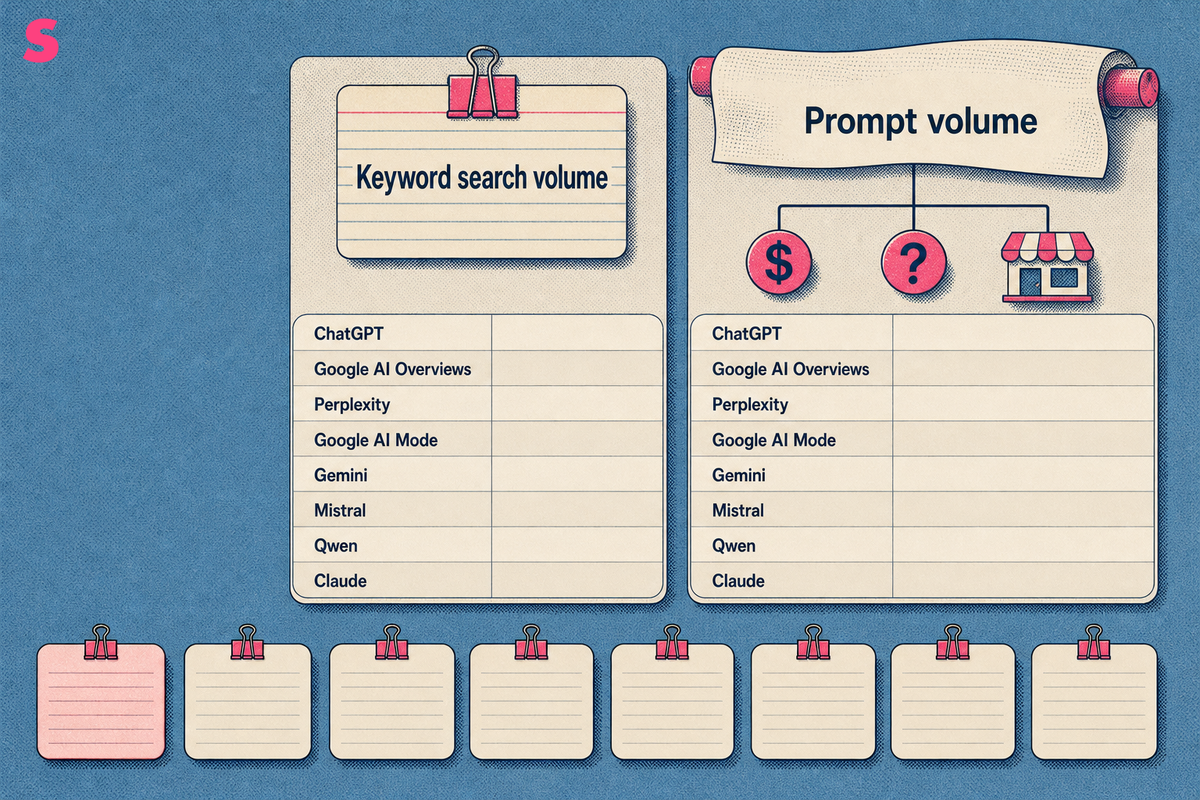
Prompt volume data estimates how often people ask a particular question, topic, or query in AI assistants during a defined period. It helps marketing teams assess demand for conversational questions, not only short keyword strings entered into conventional search engines.
Keyword search volume measures searches such as AI attribution software. Prompt volume measures fuller requests such as Which AI attribution software is best for a B2B SaaS company? The first signals demand. The second reveals buyer context, comparison criteria, and buying stage.
AI assistants receive questions that combine several intents in one request. A buyer can ask about alternatives, implementation requirements, pricing concerns, and industry fit in a single prompt. Traditional keyword data remains useful, but it does not capture every conversational framing that can produce an AI answer, citation, or referral.
Sona AI Visibility data from September 2026 covers 8 answer surfaces: ChatGPT, Google AI Overviews, Perplexity, Google AI Mode, Gemini, Mistral, Qwen and Claude. Demand and citations can vary by answer surface even when a prompt expresses the same underlying need.
Is prompt volume a count of real ChatGPT queries?
No. Prompt volume is rarely a complete count of real ChatGPT queries because AI platforms do not publish audited query logs for every topic, country, user segment, and answer engine. It is an estimate derived from datasets, models, or reported platform activity.
Some datasets use consented consumer data across AI platforms. Others model likely AI demand from related search behavior. A tool can report a prompt-volume figure useful for prioritization without claiming access to every conversation in ChatGPT, Perplexity, Gemini, Claude, and other answer engines.
A complete query count would require every relevant assistant to expose the same logs, use the same geography, and define a prompt identically. That measurement standard does not exist. The practical question is whether a tool applies one method consistently enough to compare topics, prompt families, and changes over time.
Use the figure as a demand signal, not an audited census of AI search behavior.
How do AI visibility tools estimate prompt volume without query logs?
AI visibility tools estimate prompt volume through samples, behavioral datasets, search-demand models, or platform-reported activity. Each method produces different evidence, so buyers should establish what a figure represents before using it for content priorities.
| Method family | Primary input | What the estimate represents | Main interpretation risk |
|---|---|---|---|
| Consumer panels | Consented AI usage from participating users | Observed prompts scaled from a sample | Panel composition can skew toward certain audiences |
| Clickstream-derived topic volume | Observed browsing and topic behavior | Demand associated with AI-related journeys | Topic activity does not prove the exact prompt wording |
| Search-demand modeling | Related keyword demand and adoption assumptions | Modeled AI demand for a topic or question | The multiplier determines much of the output |
| Platform-reported data | Published datasets or platform activity disclosures | Reported prompts, conversations, or answer activity | Coverage can vary by engine, market, and date |
An October 2026 listing described one large conversation dataset with more than 400M anonymized real-user conversations across AI assistants, 10 countries, and weekly refreshes. An August 2026 listing described Semrush Prompt Research as containing more than 261M prompts, including 126M US-based prompts and 58.4M ChatGPT-specific prompts.
Modeling-based products take a different route. An October 2026 listing described one tool using a 45% default AI-adoption multiplier to estimate monthly AI demand from related keyword volume. The result provides a directional estimate, but its quality depends on the multiplier assumptions.
Sona AI Visibility connects tracked prompts and citations to pipeline and revenue, while prompt-volume estimates help teams decide which prompts deserve tracking first. Demand modeling identifies where to look. Measurement shows whether those questions create commercial outcomes.
What are prompt families and intent clusters, and why do they matter for prompt volume?
Prompt families group multiple phrasings of the same buyer need, while intent clusters organize those families by the job a buyer is trying to complete. The structure prevents teams from treating every wording variation as an unrelated content opportunity.
For example, a comparison family might include best AI attribution platform, AI attribution software alternatives, and which attribution tool works with AI search traffic? The wording differs, but the buyer is evaluating vendors. A content team should assess the family as one commercial opportunity before deciding whether separate pages are justified.
- Informational prompts seek explanations, frameworks, or definitions.
- Comparison prompts evaluate vendors, categories, or alternatives.
- Buying prompts focus on pricing, implementation, trials, or purchasing decisions.
Prompt volume data organizes demand behind comparison, buying, and informational questions. A prompt family combines related phrasings, then prioritizes the family by intent rather than isolated wording variations.
A family-level view also reduces false precision. Ten closely related prompts represent one topic with several conversational entry points, not ten independent markets.
Is prompt volume the same as the number of prompts a tool lets you track?
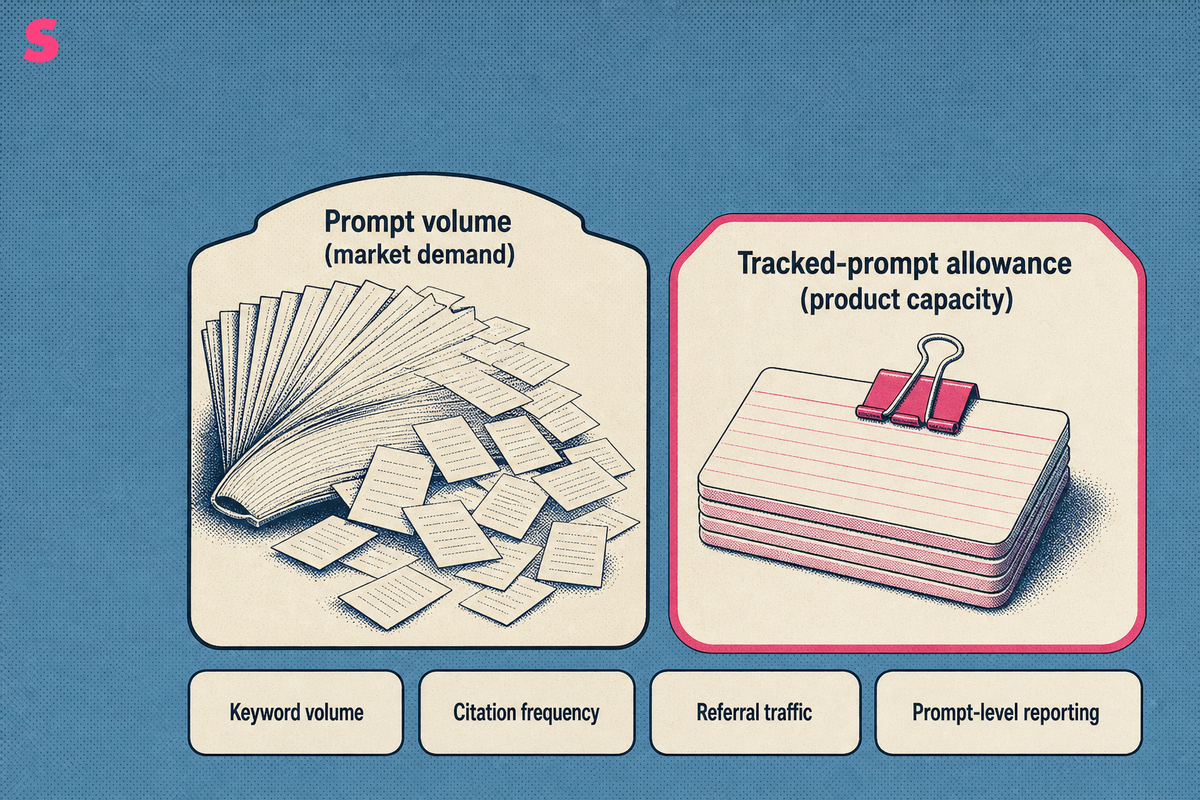
No. Prompt volume estimates market demand, while a tracked-prompt allowance is the number of questions a software plan monitors. One measures audience behavior. The other measures product capacity.
AI visibility pricing often includes several units: tracked prompts, answer checks, credits, generated responses, or engine runs. A plan with 100 prompts does not mean the topic has a volume of 100, and a topic with high estimated demand does not require tracking every possible phrasing.
Prompt demand is also commonly confused with keyword volume, citation frequency, and referral traffic. Keyword volume measures conventional search behavior. Citation frequency records how often an answer cites a source. Traffic records visits reaching a site. Each metric answers a different question.
A brand-level visibility score is not a work item. Sona AI Visibility connects prompts and citations to pipeline and revenue, and its prompt-level reporting shows which questions and cited sources sit behind a broader brand result. The operational unit is the specific prompt, source, page, and buyer journey.
How much does prompt volume data cost in 2026?
Prompt-volume access and AI visibility tracking are priced through subscriptions, prompt allowances, response allowances, or custom enterprise agreements. The figures below were read in October 2026. They describe tracking capacity, not estimated market demand for a topic.
| Tool | Starting price | Agency Plans? | # of Answer Engines Tracked | Answer Engines | # of Daily Tracked Prompts (entry plan) | Cost per Daily Tracked Prompt | Differentiation |
|---|---|---|---|---|---|---|---|
| Sona AI Visibility | From $75/month billed annually | Yes | 11 | ChatGPT, Gemini, Google AI Mode, Google AI Overviews, Perplexity, Claude, DeepSeek, Grok, Copilot, Qwen, Mistral | 5,000 credits/month, about 56 daily tracked prompts across three engines | $0.45 per daily tracked prompt | Connects AI citations and prompts to pipeline and revenue, with page-level gap prompts for pages that should appear but do not |
| Profound | Custom pricing | Yes | 3 | ChatGPT, Gemini, Google AI Overviews | 50 prompts daily on the trial | Entry-plan price unavailable | Prompt-volume dataset and AI visibility analysis |
| Peec AI | From $95/month | Yes | 3 | Three selectable language models | 50 prompts daily | $0.63 per daily tracked prompt | AI visibility tracking across selectable models |
| Otterly.ai | From $29/month | Yes | 4 | ChatGPT, Google AI Overviews, Perplexity, Microsoft Copilot | 15 prompts daily | $0.48 per daily tracked prompt | Prompt tracking across AI answer engines |
| Scrunch AI | From $250/month | Yes | 4 | ChatGPT, Perplexity, Google AI Overviews, Copilot | 125 prompts, frequency not stated | Refresh cadence unavailable | AI answer and citation visibility across listed engines |
The comparison table separates plan allowances from estimated market demand. Sona AI Visibility pricing and plan capacity are from Sona pricing, October 2026. Competitor plan figures were read in October 2026. Confirm refresh cadence, billing terms, and engine coverage before treating entry prices as directly comparable.
A $29 monthly plan can suit a focused prompt set. A larger plan becomes relevant when a team needs separate families for categories, competitors, regions, and buying stages. The decision should follow the number of meaningful questions, not a desire to maximize prompt inventory.
How do you compare prompt volume figures across different vendors?
Compare prompt-volume figures by method and unit before comparing the number itself. More tracked prompts does not mean better demand data because one product can count individual phrasings while another reports clustered families, answer checks, or generated responses.
- Data method: Determine whether the figure comes from panels, clickstream, search-demand modeling, or reported platform data.
- Geography: Check country coverage and whether the estimate represents one market or several.
- Engine coverage: Confirm which answer engines contribute to the data or tracking result.
- Clustering rules: Ask whether close variants are counted separately or rolled into a family.
- Refresh rate: Confirm the collection date and update frequency.
- Unit: Distinguish prompts, prompt families, checks, answers, credits, and citations.
- Uncertainty: Look for sample limitations, model assumptions, and stated confidence boundaries.
A team running the same prompt list daily can see changes that a weekly snapshot averages away. An answer can shift after a retrieval-index change, model update, or competitor publication. A movement that holds for four days is a trend. A one-day spike is noise.
Use daily tracking for prompt lists, then review positioning and competitive implications quarterly. Those schedules support different decisions.
How reliable is prompt volume data, and is it still worth using?
Prompt volume estimates support relative prioritization and directional trends, not exact forecasts of AI queries. Their value comes from comparing topics with a consistent method rather than claiming a precise count of every question submitted to an assistant.
Critics argue that these estimates rely on extrapolation, small samples, and bias rather than direct measurement. That criticism is valid when a vendor presents a modeled figure as a complete market census or when buyers compare figures produced with incompatible data methods.
Use the data with discipline. Compare one tool’s estimates against its own history, apply the same geography and clustering rules, and validate the highest-priority families with observed citations, referral behavior, and pipeline evidence.
Sona AI Visibility creates a comparable record by tracking prompts over time and connecting cited answers to commercial outcomes. A dated score is a snapshot. A series of observations shows whether a change persists.
How do you use prompt volume data to prioritize content and measure AI visibility?
Use prompt-volume estimates to rank prompt families by likely demand and buying intent, then validate the highest-priority questions against citations, pages, and revenue evidence. High volume alone is insufficient. A lower-volume comparison prompt can deserve priority when it signals an active buying decision.
- Choose a high-demand comparison family, such as questions about AI attribution software alternatives.
- Select one representative comparison prompt and inspect which brands and pages AI answers cite.
- Identify whether the cited pages are vendor pages, independent comparisons, implementation guides, or pricing pages.
- Compare those cited sources with the page your company expects to own for that question.
- Create or improve the page only when the gap aligns with a meaningful buying stage and revenue opportunity.
For example, a team may find that a high-volume comparison family repeatedly cites competitor comparison pages while its own site has only a general product page. The gap is a missing answer to buyer evaluation criteria such as implementation, pricing structure, or attribution coverage.
Sona AI Visibility connects prompts and citations to pipeline and revenue, and shows page by page the prompts a site should appear in but does not through Site Pages gap prompts. AI crawler activity begins the same path because a page must be reached before it can become a source for an AI answer.
AI Search Insights helps teams connect keywords, buyer prompts, cited sources, and page performance when deciding which prompt family deserves the next content or technical work item. The goal is not to publish for every variation. The goal is to cover questions tied to commercial intent and measure what happens afterward.
What are the frequently asked questions about prompt volume?
Is prompt volume the same as ChatGPT search volume?
No. Prompt volume is a modeled estimate of how often a question is asked across AI assistants, while ChatGPT does not publish a complete count of its queries. A prompt-volume figure can include data from several answer engines, a consumer panel, a modeled estimate, or a combination of sources.
Can I see the exact prompt volume for my brand or category?
Not as an audited number. Tools show estimated or sampled volume, so treat the figures as relative signals for comparing topics rather than exact counts. The most useful comparison is between prompt families measured with the same geography, method, and refresh period.
Does prompt volume replace traditional keyword research?
No. Keyword volume still guides conventional search strategy, while prompt volume adds evidence about conversational questions and where AI answers mention brands. Use keyword research to understand established search demand, then use prompt families to expose fuller buyer questions.
Why do two tools report different prompt volume for the same topic?
Two tools can differ in data source, geography, engine coverage, clustering rules, and refresh frequency. They can also count different units, including individual prompts, prompt families, checks, answers, or generated responses. The figures are not interchangeable without those definitions.
How many prompts should I track to get useful data?
Start with the prompt families tied to your buying journey. Intent quality and representative sampling matter more than a large allowance of loosely related variants. Track category, comparison, pricing, implementation, and competitor prompts when those questions map to real revenue opportunities.
How often is prompt volume data refreshed?
Refresh frequency varies by vendor. Some datasets report weekly refreshes, while other products update less often or publish no cadence. Check the refresh rate and date coverage before comparing figures, and run the same strategic prompt list daily when monitoring AI visibility changes.
Summarize this article with AI: ChatGPT · Claude · Perplexity · Google AI Mode
Last updated: October 2026