LLM visibility is how often and how favorably a brand appears in answers from AI engines such as ChatGPT, Gemini and Perplexity. Teams commonly measure it through mention rate, mention position, sentiment and share of voice. Most tools stop at counting mentions; Sona AI Visibility connects the prompts and citations behind them to pipeline and revenue. Treat LLM visibility as a buying signal tracked against a fixed prompt set, not as a renamed SEO ranking.
What is LLM visibility, and how does it differ from traditional SEO visibility?
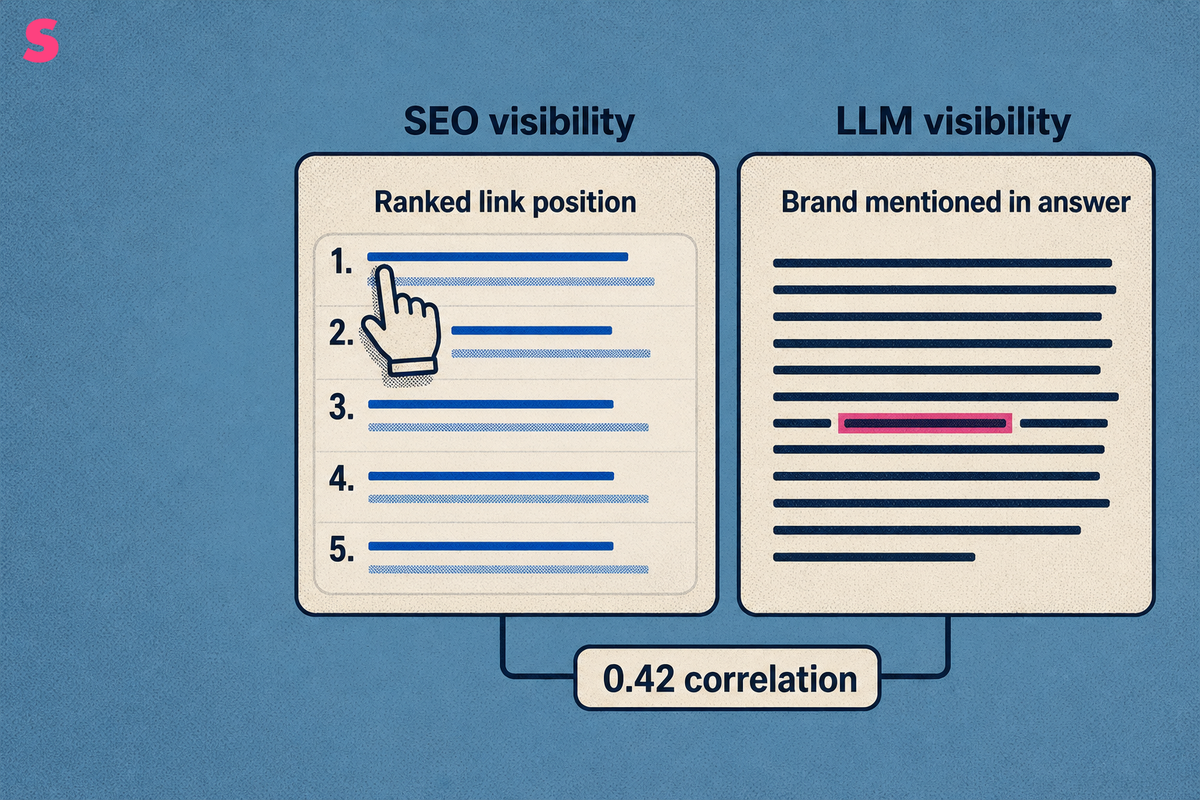
LLM visibility is how often, how prominently and how favorably a brand appears when AI engines answer questions in its category. Traditional SEO visibility measures where a page ranks in a list of links. LLM visibility asks whether the brand is included inside the generated answer at all.
Hootsuite's March 2026 article gives this definition: "LLM visibility is a measure of how AI assistants describe and position your brand in their conversations with users." That definition names description and position, not only presence.
- Unit measured. SEO tracks a ranked URL for a keyword. The AI measure tracks a brand inside an answer to a prompt.
- Output. A rank report gives a position. An AI answer gives a mention, a list position, a citation and a tone.
- Stability. A results page moves slowly. A generated answer to the same prompt shifts with the retrieval index, model updates and new competitor content.
The two measures overlap, but only partly. A 2026 AI-search study of 12,000 prompts across 6 AI systems, published on muratulusoy.de in September 2026, reported a 0.42 correlation between Google position and LLM citation rate. A high rank helps. It does not settle the answer.
What does LLM brand visibility include: mentions, citations, recommendations and sentiment?
LLM brand visibility covers four behaviors: whether an engine mentions the brand, cites its pages, recommends it, and what tone it uses. LLM visibility is commonly measured across mention rate, mention position, sentiment and AI share of voice, per sona.com, published April 29, 2026 and updated October 7, 2026.
- Mention. The brand is named in the answer text.
- Citation. The answer links to or credits a source page, on the brand's own site or on a third party.
- Recommendation. The engine actively suggests the brand for the user's need instead of only listing it.
- Sentiment. The tone of the description: positive, neutral or negative.
A worked example shows how the parts separate. Take a prompt asking for the best attribution software for B2B teams. One engine names five vendors, places the brand third, describes it favorably, and links to a review site rather than the brand's own page. The result is a mention at position three, positive sentiment, no citation of the brand's pages, and at most a soft recommendation.
Mention rate is the share of sampled answers that name the brand. If a brand appears in 12 of 40 sampled answers, its mention rate is 30%. AI share of voice divides the brand's mentions by all mentions of the brands being tracked.
Is LLM visibility just SEO, AEO or GEO under a new label?
No. SEO, answer engine optimization (AEO) and generative engine optimization (GEO) are practices a team performs. LLM visibility is the outcome measured afterward. Confusing the two leads teams to report activity, such as pages published, instead of a result, such as inclusion in answers.
The practices feed the metric, but a strong SEO program does not guarantee it. The September 2026 muratulusoy.de study of 12,000 prompts across 6 AI systems found that 41% of brands dominating Google were underrepresented in ChatGPT and Perplexity.
LLM visibility also has clear boundaries. People often confuse it with four neighbors:
- Not rankings. A rank is a position in a list of links; an answer has no fixed list.
- Not AI referral traffic. Visits are a downstream effect. A buyer can read an answer that names the brand and never click.
- Not training-data presence. A model that knows a brand from training and an engine that retrieves its pages live work by different mechanisms.
- Not a brand awareness survey. The measure samples what engines output, not what people recall.
Why does LLM visibility matter for B2B SaaS companies and their buyers?
LLM visibility matters because B2B buyers ask AI engines which vendors solve their problem and receive a shortlist before they visit any website. A brand missing from that answer is missing from the shortlist, and the team has no keyword or referral record showing the loss.
Three consequences follow for anyone carrying a pipeline target:
- Shortlist exposure. Vendors named in the answer get evaluated. Vendors left out are never compared.
- Dark traffic. Some AI-influenced visits may appear as direct or unattributed, particularly when the buyer does not click directly from the AI answer or tracking data is not preserved, so the channel can look smaller than it is.
- Competitive framing. The engine states the evaluation criteria and the order of vendors, which sets terms before the buyer reaches a sales page.
Most AI visibility tools tell you whether you were mentioned. Few can tell you what that mention was worth. Sona AI Visibility connects citations to pipeline and revenue on one account timeline, and tracks which AI crawlers are reaching your pages, so a mention becomes something you can measure rather than a number to report.
How do you measure LLM visibility with prompts, response samples and competitor benchmarks?
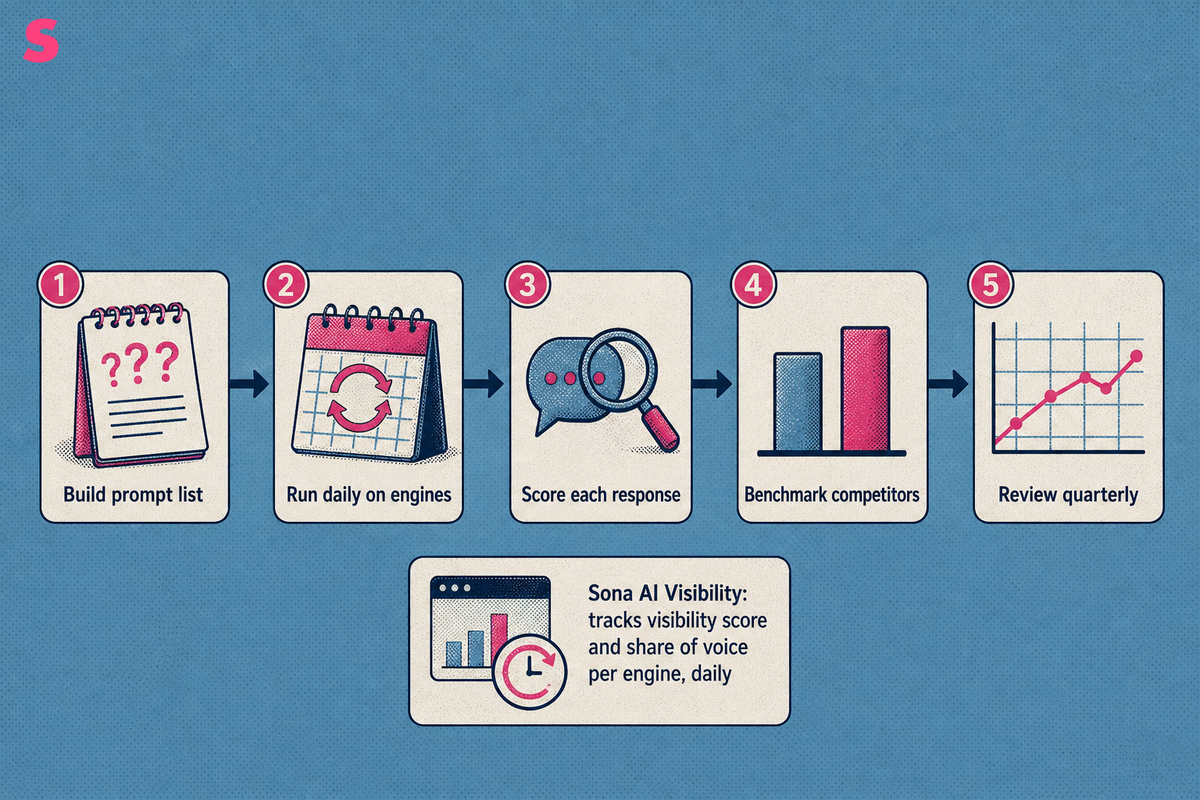
You measure it by running a fixed set of buyer prompts across several engines on a schedule, sampling the responses, and scoring each for mention, position, sentiment and share of voice against named competitors. The procedure has five steps.
- Build the prompt list. Write buyer questions at category, comparison and problem level. Keep the list fixed so runs stay comparable.
- Run it daily on several engines. Daily runs reveal patterns that a weekly snapshot averages away. A change sustained across repeated runs is stronger evidence than a single-run fluctuation.
- Score every response sample. Record whether the brand is named, where it sits, which sources are cited and what tone is used.
- Benchmark competitors. Run the same prompts for a named set of rivals and compute share of voice.
- Read the series. A score is a dated snapshot. Only a comparable series of scores shows a trend. Review positioning on a quarterly cycle.
Collection method changes the result. Some tools capture the end-user experience directly, scraping the response the way a person would see it, ads and formatting included. Others pull from a vendor's official API, which returns a structured response that does not necessarily match the screen. The two methods can capture different answers.
A single brand-level score is not a work item. It says the brand is absent from some share of answers and nothing about which prompt or source to fix. In Sona AI Visibility, AI Search Insights tracks visibility score and share of voice per engine every day and shows which prompts surface the brand and which sources the engines cite, so the gap becomes a named prompt.
Which AI engines, including ChatGPT and Google AI Overviews, should a brand monitor?
A brand should monitor every engine its buyers use for research, and at minimum ChatGPT, Google AI Overviews, Perplexity, Gemini and Claude. Google AI Mode belongs on the list as well. Engines retrieve and phrase answers differently, so a brand strong in one can be weak in another.
Sona's own AI visibility data, September 2026, covers eight answer surfaces: ChatGPT, Google AI Overviews, Perplexity, Google AI Mode, Gemini, Mistral, Qwen and Claude. The range is that wide because the same prompt produces different answers on each surface.
Prioritize in this order:
- Engines in your own data. Start with the engines that appear in AI referral reports and in self-reported answers on demo forms.
- Google surfaces. Add Google AI Overviews and Google AI Mode, because they answer inside the search journey buyers already use.
- Remaining engines. Add the others as budget allows, since each extra engine consumes tracked answers.
What factors influence whether an AI engine mentions, cites or recommends a brand?
Five factors drive inclusion: whether AI crawlers can reach the page, whether the content is structured to be extracted, whether the source is fresh, whether third-party sources describe the brand consistently, and whether the page answers the prompt directly. Google rank adds a partial input, given the 0.42 correlation in the muratulusoy.de study of September 2026.
- Crawler access. Retrieval bots fetch pages to feed a live answer; training bots fetch to train a model. A robots.txt or WAF rule that blocks retrieval bots removes the page from live answers, and a page no crawler reaches earns no citation.
- Content structure. Schema.org markup, including FAQPage JSON-LD, lets engines extract question-and-answer content directly. Server-rendered HTML and semantic headings ease parsing.
- Recency. Engines with web retrieval weight recency, so a page untouched for months loses ground against fresher sources on the same topic.
- Source authority. Engines cite third-party sources such as review sites and industry publications, so what those sources say shapes recommendation and sentiment.
- Prompt fit. A page either answers a specific prompt or it does not.
A page can be crawlable and well marked up and still lose the citation to a fresher competitor. Check each factor separately.
How do LLM visibility tracking tools compare on price, engine coverage and prompt limits?
Published entry prices for the tools below run from $29 to $295 per month, and one vendor quotes by sales only. The tools compared, starting with Sona AI Visibility, are Profound, Otterly.ai, Scrunch AI, AthenaHQ and PromptWatch. Prices were read from each vendor's own pricing page in September and October 2026.
Published prompt limits are not comparable. Sona sells credits where 1 credit equals 1 AI answer, Otterly.ai and PromptWatch sell prompt slots, and Scrunch AI splits custom prompts from industry prompts. The cost column therefore uses one shared denominator: one prompt, on one model, checked once a day. It states a unit price and ranks nothing.
| Tool | Starting price | Agency Plans? (Yes/No) | # of Answer Engines Tracked | Answer Engines | # of Daily Tracked Prompts (entry plan) | Cost per Daily Tracked Prompt | Differentiation |
|---|---|---|---|---|---|---|---|
| Sona AI Visibility | Brands from $75/month (Starter) and $249 (Growth), agencies from $199/month, all billed annually. 14-day free trial, no credit card. Unlimited seats and API/MCP access on every plan | Yes | 11 | ChatGPT, Gemini, Google AI Mode, Google AI Overviews and Perplexity on standard, plus Claude, DeepSeek, Grok, Copilot, Qwen and Mistral on premium | 5,000 credits/month on Starter 5K, which is about 166 prompts tracked daily on one model, or 56 across three. 1 credit = 1 AI answer | $0.45 per daily tracked prompt | Connects AI citations and prompts to pipeline and revenue on one account timeline; resolves the anonymous accounts behind AI-referred visits |
| Profound | Quote-only, no public pricing. 7-day free trial: 50 prompts, run daily. No self-serve price is published: a 7-day trial and custom Enterprise pricing only | Not published | 3 | ChatGPT, Gemini and Google AI Overviews | 50 prompts run daily on the 7-day trial; Enterprise allowances are custom | No refresh cadence published | Custom Enterprise pricing with a 7-day trial |
| Otterly.ai | From $29/month (Lite), $189 (Standard), $489 (Premium) billed monthly, or $25, $160 and $422 a month billed annually; Enterprise custom. Free trial, no commitment. 15% off annual; unlimited team members on every plan; Enterprise starts from 1,000 prompts | Not published | 4 | ChatGPT, Google AI Overviews, Perplexity and Microsoft Copilot | 15 prompts on Lite, 100 on Standard, 400 on Premium, checked daily on every plan | $0.48 per daily tracked prompt | Unlimited team members on every plan; Enterprise starts from 1,000 prompts |
| Scrunch AI | From $250/month (Core); Enterprise custom. 7-day free trial of Core. Core: 125 prompts, 5,000 responses/month, 5 user licenses, 1 brand workspace | Not published | 4 | ChatGPT, Perplexity, Google AI Overviews and Copilot | 125 unique prompts and 5,000 responses/month on Core | $1.51 per daily tracked prompt | Splits custom prompts from industry prompts |
| AthenaHQ | From $295/month (Starter) billed monthly, 17% off annually; Enterprise custom. Free Essential tier with 300 credits. 17% off annual; 1 credit = 1 AI response; API access and extra credits are paid add-ons | Not published | 11 | ChatGPT, Perplexity, Google AI Overviews, Google AI Mode, Gemini, Claude, Copilot, Grok, DeepSeek, Meta AI and Mistral | 3,600 credits on Starter, where 1 credit is 1 AI response. 300 credits on the free Essential tier | $2.46 per daily tracked prompt | Credit-based plans, with a free Essential tier |
| PromptWatch | Essential $95/month, Professional $245, Business $579. 7-day free trial on Essential and Professional | Yes | 4 of 11 | Not published | 50 prompts and 6,000 responses/month on Essential | $0.48 per daily tracked prompt | Published agency plan from $199/month |
Among vendors that publish a count, entry-plan engine counts run from 3 to 11. A count says little without the names, so check which engines a plan includes before comparing price.
What can a B2B team do to improve its visibility in AI-generated answers?
A B2B team improves its visibility by removing technical blockers first, then publishing pages that answer specific buyer prompts, then strengthening the third-party sources engines cite. Five steps, in order.
- Test bot access. The Sona AI Crawl Checker tests AI crawlers against a URL and returns the reason each blocked bot fails, such as a robots.txt disallow or a WAF 403.
- Score technical readiness. The Free AI Readiness Checker runs a set of technical checks on a page and returns a readiness score. That score is a dated snapshot; re-run it to build a series.
- Fix by severity. Work through the highest-severity findings first, such as missing FAQPage schema, before cosmetic ones.
- Close gap prompts. For each prompt where a page should appear and does not, write or revise the page to answer it directly.
- Earn third-party coverage. Identify the sources cited in answers for the category and get accurate descriptions of the brand placed there.
Run each task on its own clock. The prompt list runs daily. A technical re-audit and a competitor benchmark run monthly, and a positioning review runs quarterly. None of this guarantees a result; it supplies the data and the ranked fixes that let a team pursue one.
Frequently Asked Questions
What is LLM visibility in simple terms?
LLM visibility is how often, how prominently and how favorably a brand shows up when AI engines answer questions in its category. A visible brand is named early, described well and cited as a source across many engines and prompts.
What is the difference between LLM visibility and SEO?
SEO measures ranking in a list of links, while LLM visibility measures inclusion inside a generated answer. The overlap is real but partial. A 2026 study on muratulusoy.de, September 2026, reported a 0.42 correlation between Google position and LLM citation rate across 12,000 prompts and 6 AI systems.
How do you measure LLM brand visibility?
Run a fixed set of buyer prompts across several engines on a schedule, daily where possible. Then track mention rate, position, sentiment and share of voice against named competitors, and read the results as a series rather than a single score.
Is a mention the same as a citation in an AI answer?
No. A mention names the brand in the answer text. A citation links to or credits a source page. A recommendation goes further and actively suggests the brand. One answer can contain any one of the three without the others.
Does ranking well on Google guarantee visibility in ChatGPT?
No. The 2026 study of 12,000 prompts across 6 AI systems, published on muratulusoy.de in September 2026, found that 41% of brands dominating Google were underrepresented in ChatGPT and Perplexity. Rankings are an input, so a brand needs its own prompt-level measurement.
How much does LLM visibility tracking cost?
Sona AI Visibility starts from $75/month for brands, billed annually, and other published entry plans in October 2026 ran from $29 to $295 per month. Prompt allowances vary by plan, broader multi-engine plans reach hundreds of dollars per month, and some Enterprise tiers are quote-only.
Summarize this article with AI: ChatGPT · Claude · Perplexity · Google AI Mode
Last updated: October 2026