Enterprise AI search optimization services increase how frequently and accurately a brand is mentioned and cited in responses from ChatGPT, Gemini, Google AI Overviews, Perplexity, and other answer engines, using audit, content and entity work, plus tracking. Published October 2026, retainers range from roughly $3,000 to more than $68,000 per month, so assess current visibility before buying. Sona's fully managed services begin at $5,500 per month, in addition to a Sona AI Visibility plan. Require every provider to demonstrate prompt sampling, refresh cadence and a path to pipeline.
What do enterprise AI search optimization services include beyond traditional SEO?
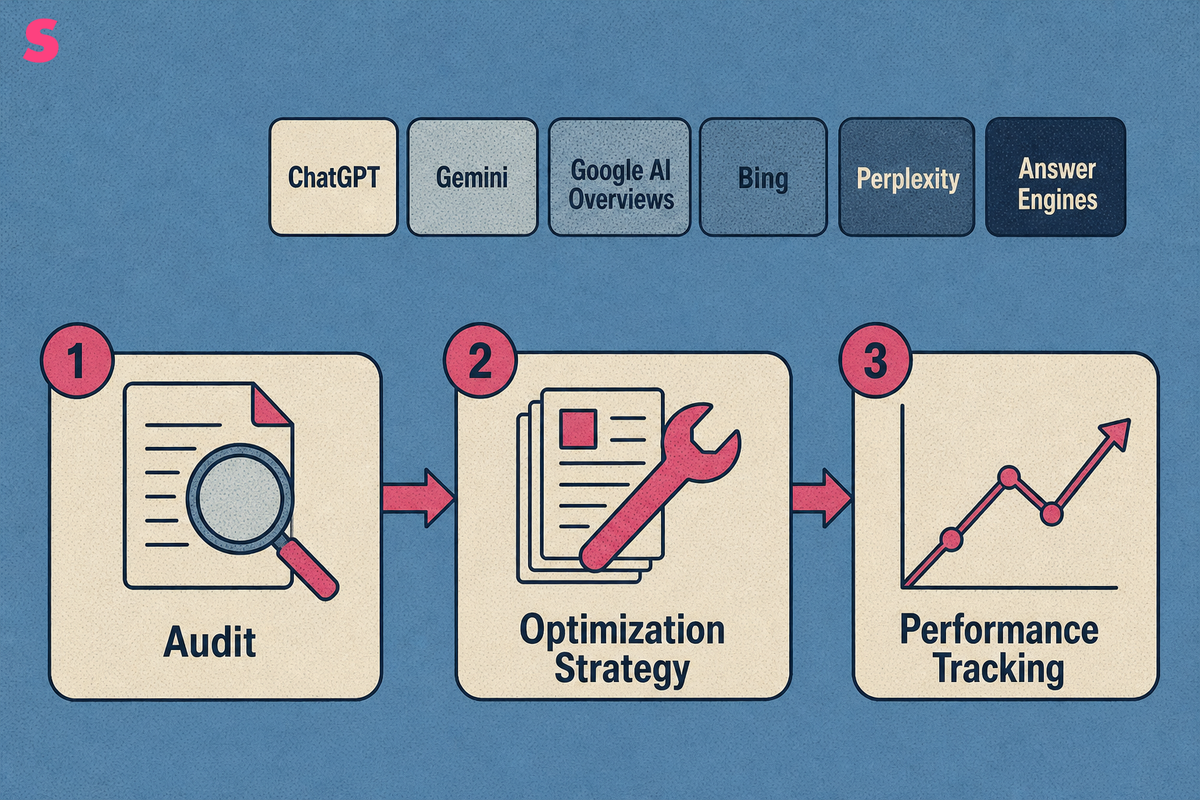
Enterprise AI search optimization services audit, improve, and measure how a brand appears when buyers ask AI systems for recommendations, comparisons, and explanations. The work spans ChatGPT, Gemini, Google AI Overviews, Bing, Perplexity, and other answer engines, where results appear as answers, citations, or brand associations rather than conventional blue-link rankings.
Generative engine optimization (GEO) focuses on visibility inside generated answers. Answer engine optimization (AEO) focuses on becoming an answer or cited source for a buyer question. Both build on SEO foundations, but measurement differs: model-specific prompts, answer inclusion, citations, cited sources, sentiment, and entity associations.
A credible service has three components. First, an audit identifies where the brand appears and why. Second, an optimization strategy improves the technical, content, and evidence inputs that answer engines retrieve. Third, performance tracking records changes in prompts, citations, traffic, and commercial outcomes over time.
Traditional SEO remains relevant because crawlability, canonical tags, structured information, and authoritative content affect discoverability. AI search optimization adds a reporting layer that shows whether an AI system names the company in a vendor comparison or cites a product page in an answer.
Which AI answer engines should an enterprise measure first?
Enterprises should begin with ChatGPT, Gemini, Google AI Overviews, Bing, Google AI Mode, Perplexity, and other answer engines because buyers use different answer experiences for research, comparison, and retrieval. The same prompt can produce different answers, citations, and brand lists on each engine.
ChatGPT and Perplexity often support conversational research journeys. Gemini, Google AI Overviews, and Google AI Mode connect more directly to Google retrieval experiences. Bing provides a separate search and assistant environment. A provider that measures only one engine cannot determine whether a brand problem is broad or platform-specific.
- Buyer prompts: Which commercial, comparison, implementation, and category questions does each engine answer?
- Brand inclusion: Does the engine name the company, describe it accurately, or include it in a recommendation set?
- Citations: Which owned pages, third-party sources, and competitor sources appear in the answer?
- Coverage: Which models, locations, languages, and answer formats are included in the measurement plan?
Engine coverage is a buying criterion, not a cosmetic feature list. A provider should state which answer engines it samples, how often it refreshes the prompt set, and whether its results reflect what a buyer sees on screen.
How do you audit your current AI search visibility before starting optimization?
An AI search visibility audit starts with a structured prompt set drawn from real buyer questions. The audit runs those prompts across relevant answer engines and records brand mentions, citations, sentiment, cited sources, competitor presence, and retrieved pages.
Build the prompt set from product categories, jobs to be done, integration questions, alternatives, implementation concerns, and commercial comparisons. Run the same prompt list daily. Daily tracking exposes changes that a weekly snapshot can average away, including retrieval-index shifts, model updates, and competitor publishing.
| Checkpoint | What to assess | What a weak result looks like |
|---|---|---|
| Content format | Whether key pages answer direct buyer questions with clear definitions, comparisons, evidence, and implementation detail. | Product pages describe features but do not answer category or evaluation questions. |
| Entity clarity | Whether the brand, products, categories, executives, and differentiators are described consistently across owned and third-party sources. | Answer engines confuse the company with another entity or produce inconsistent descriptions. |
| Answer positioning | Whether the brand appears in recommendation, alternative, implementation, and comparison prompts. | The brand appears only for navigational prompts containing its own name. |
| Zero-click risk | Whether high-intent research questions are answered before a buyer reaches the website. | AI answers cite competitors or publishers while the brand receives no referral or branded demand. |
| Platform-specific visibility | Whether inclusion, citations, and sentiment differ across ChatGPT, Gemini, Google AI Overviews, Bing, Google AI Mode, Perplexity, and other answer engines. | The company appears on one engine but is absent from comparable prompts elsewhere. |
| Crawlability and AI crawler access | Whether robots.txt, WAF rules, canonical tags, server-rendered HTML, and page performance allow retrieval systems to access important pages. | High-value pages return blocked, incomplete, duplicate, or JavaScript-dependent content. |
| Third-party evidence | Whether credible sources corroborate the company’s category claims, product capabilities, and market position. | Answer engines rely on competitor pages, directories, or outdated reviews for category context. |
| Structured information | Whether Schema.org markup, FAQPage JSON-LD, metadata, and semantic page structure make facts easy to extract. | Pages contain useful information but bury it in unstructured copy or inconsistent markup. |
A brand-level visibility score is a dated snapshot, not a work item. Prompt-level reporting identifies the questions that fail, the sources each engine cites, and the pages requiring attention. Sona AI Visibility connects prompt and citation evidence to the page and account journey, so teams can investigate a missing answer rather than react to a single domain score.
Technical diagnostics should follow a separate schedule. Use a monthly or quarterly technical re-audit for crawlability, structured information, and page regressions. A technical readiness check assesses whether systems can crawl and parse the site, while prompt tracking measures whether the brand appears in answers.
What optimization work actually changes what AI engines say about a brand?
AI search optimization changes the inputs answer engines retrieve and cite, not a future answer itself. Providers can improve crawlability, structured information, answer-ready content, entity consistency, and third-party evidence. No provider controls a model’s response after a buyer submits a prompt.
Technical work addresses indexability, robots.txt directives, canonical tags, server-rendered HTML, schema validation, page speed, and security headers. Content work turns vague category copy into pages that answer discrete commercial questions, explain tradeoffs, state product boundaries, and provide extractable evidence.
Entity and brand work aligns the company description across product pages, documentation, executive profiles, directories, reviews, and earned coverage. Digital PR and third-party evidence matter because answer engines often cite independent sources when buyers ask which provider to choose.
- Technical foundation: Make important pages retrievable, canonical, structured, and stable.
- Answer extraction: Use direct headings, clear definitions, tables, comparisons, and evidence-backed claims.
- Entity consistency: Use the same product names, category language, and factual descriptions across channels.
- External corroboration: Build credible third-party evidence that supports the brand’s claims.
Optimization should begin with audit findings. A provider that publishes generic AI content before identifying missing prompts, cited sources, and crawler barriers is producing activity without a measurable hypothesis.
How do providers track AI mentions, citations, sentiment and pipeline impact?
Providers track prompt-level mentions, citations, sentiment, answer position, competitor inclusion, referrals, conversions, and assisted commercial outcomes. Mention tracking is the baseline. A meaningful difference is whether reporting extends from visibility measurements to page-level insights, visitor identification, and AI search attribution.
AI answers vary by user, location, model, date, retrieval index, and conversation history. Providers should disclose their sampling method, refresh frequency, model coverage, location settings, and confidence limits. Daily prompt tracking provides enough resolution to distinguish a four-day trend from a one-day spike.
Sona AI Visibility Growth adds page-level insights, Agent Analytics, company-level visitor identification, and AI search attribution. Sona Marketing Measurement has a Growth plan from $599/month billed annually.
Pricing and plan details as of October 2026.
| Tool | Starting price | Agency Plans? (Yes/No) | # of Answer Engines Tracked | Answer Engines | # of Daily Tracked Prompts (entry plan) | Cost per Daily Tracked Prompt | Differentiation |
|---|---|---|---|---|---|---|---|
| Sona AI Visibility | From $75/month, billed annually, as of October 2026 | Yes | Up to 11 (3 on Starter) | Not published | 5,000 credits/month, about 166 daily tracked prompts on one model or 56 across three | $0.45 per daily tracked prompt | Growth adds page-level insights, Agent Analytics, company-level visitor identification, and AI search attribution. |
| Profound | Custom pricing, as of October 2026 | Yes | Up to 9 (3 on free Trial) | ChatGPT, Gemini, Google AI Overviews | 50 prompts daily during the trial | Custom pricing; unit cost unavailable. | Enterprise AI visibility tracking across up to nine engines. |
| Peec AI | From $95/month, as of October 2026 | Yes | Up to 13 (3 of 6 on Starter, plus add-ons) | Not published | 50 prompts daily | $0.63 per daily tracked prompt | AI visibility tracking with self-serve and agency plans. |
| Otterly.ai | From $29/month, as of October 2026 | Yes | Up to 7 (4 on Lite, 3 as paid add-ons) | ChatGPT, Google AI Overviews, Perplexity, Microsoft Copilot | 15 prompts daily | $0.48 per daily tracked prompt | Prompt monitoring across four engines on the Lite plan. |
| Scrunch AI | From $250/month, as of October 2026 | Yes | Up to 9 (4 on Core) | ChatGPT, Perplexity, Google AI Overviews, Copilot | 125 prompts, refresh cadence not published | No refresh cadence published | AI visibility tracking across four engines on Core. |
| AthenaHQ | From $295/month, as of October 2026 | Yes | 11 | Not published | 3,600 credits/month, unlimited prompts, refresh cadence not published | No refresh cadence published | AI visibility measurement using response credits and multiple models. |
| PromptWatch | From $95/month, as of October 2026 | Yes | Not published | Not published | 50 prompts daily | $0.48 per daily tracked prompt | Prompt and response monitoring with agency tiers. |
| Goodie | From $295/month, as of October 2026 | Yes | Up to 14 (5 on Core) | Not published | 110 prompts daily | $0.67 per daily tracked prompt | AI visibility monitoring across five models on Core. |
Most AI visibility tools report whether a brand was mentioned. Sona Marketing Measurement provides the attribution foundation for treating AI search as a measurable channel alongside paid and organic activity.
How do the leading AI SEO agencies compare?
Leading AI SEO agencies differ in B2B specialization, technical depth, content production, digital PR capability, attribution work, and contract structure. Enterprise buyers should compare what each agency executes, how it measures AI visibility, and whether its engagement model matches the company’s markets and internal resources.
Pricing and plan details as of October 2026.
| Agency | Focus | What's included | Pricing |
|---|---|---|---|
| Sona | AI search optimization and measurement for brands using AI Visibility. | done-for-you services on top of an AI Visibility Growth plan or above. | Launch from $5,500/month, Accelerate $7,500/month, Amplify $9,500/month. |
| DerivateX | Full-service SEO and GEO agency for B2B SaaS. | GEO, LLM SEO, entity optimization, content production, digital PR, backlinks, technical SEO, and migrations. | $5,000–$12,000/month; Enterprise scoped individually. |
| Breaking B2B | SEO and AI search for B2B and SaaS companies. | AEO, GEO, LLM SEO, technical SEO, content, link building, Reddit, and YouTube marketing. | From $4,000/month; enterprise plans $8,500–$14,700/month; Category King from $40,000/month. |
| Discovered Labs | Organic search agency for the AI era serving B2B companies. | AEO, GEO, technical and content SEO, Reddit marketing, digital PR, link building, and an AI Visibility Tracker. | €6,995/month, €10,995/month, or from €15,995/month for custom work. |
| Omniscient Digital | SEO and GEO for B2B software brands. | LLM optimization, citation analysis, technical assessment, roadmap development, content, digital PR, and monitoring. | From $10,000/month. |
| iPullRank | AI search and GEO through relevance engineering. | Relevance engineering, GEO, content strategy, technical SEO, attribution, measurement, and brand monitoring. | Not published (quote only). |
| Foundation | GEO agency for B2B companies. | GEO strategy, technical SEO, LLM advertising, content distribution, thought leadership, digital PR, attribution, and analytics. | Not published (quote only). |
| Siege Media | Full-service GEO agency for established brands. | Research reports, digital PR, bottom-of-funnel content, community presence, affiliate partnerships, and content refreshes. | Not published (quote only). |
| TripleDart | AI-native organic growth for B2B SaaS. | GEO, AEO, technical SEO, content briefs, drafts, refreshes, programmatic optimization, and paid media. | From $5,000/month. |
Contract terms vary materially. DerivateX uses 90-day pilots for its $5,000 and $8,000 plans, while its $12,000 plan has a six-month minimum. Breaking B2B offers six- or twelve-month engagements. Discovered Labs operates month-to-month by default, and Siege Media positions its work for brands able to commit to a six-month or longer horizon.
For complex B2B SaaS or multi-market programs, fit depends on the operating model. DerivateX targets B2B SaaS companies from $5 million to $50 million ARR. iPullRank serves start-ups through Fortune 500 category leaders. Foundation focuses on B2B SaaS, AI, martech, cybersecurity, developer tools, and enterprise technology.
How much do enterprise AI search optimization services cost per month?
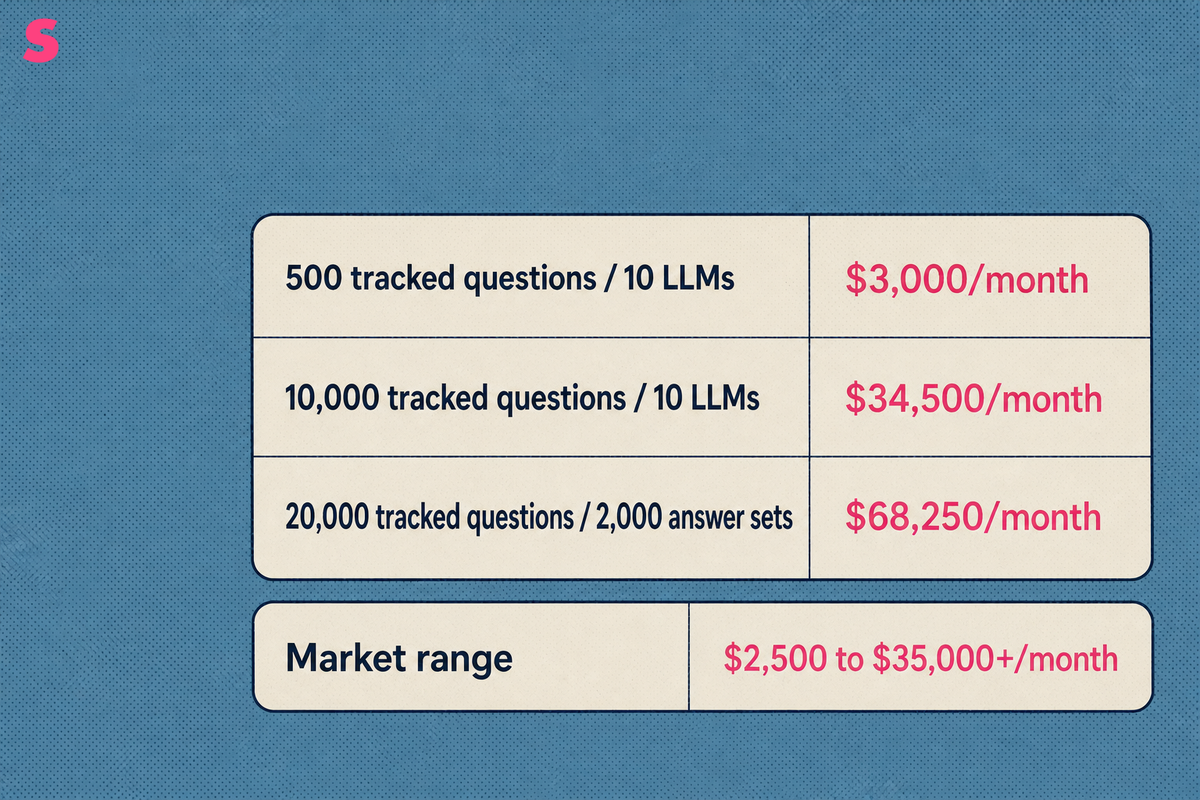
Enterprise AI search optimization services range from about $2,500 per month for entry-level AI content optimization to $8,000–$35,000 per month for comprehensive programs in October 2026 listings. Enterprise GEO budgets average upwards of $20,000 per month in October 2026 listings, while specialized scopes and large prompt inventories can cost more.
Published launch-level services begin around $3,500 per month, growth programs around $6,000 per month, and enterprise plans from $10,000 per month in October 2026 listings. Published starting prices across the category span $99 to $15,000 per month, but those figures can represent different units, including tracked questions, models, answer sets, content production, technical work, or advisory support.
One October 2026 enterprise pricing structure lists $3,000 per month for 500 tracked questions across 10 LLMs, $34,500 per month for 10,000 tracked questions across 10 LLMs, and $68,250 per month for 20,000 tracked questions with 2,000 answer sets. Compare pricing only after matching tracked-question volume, engine coverage, refresh cadence, service scope, and implementation responsibilities.
When pricing is quote-only, ask what the retainer includes, which deliverables recur, whether third-party placement budgets sit outside the fee, and whether tracking volume is capped. A quoted monthly fee without those units is not a comparable commercial proposal.
What should a buyer demand from a provider before signing?
A buyer should demand a documented methodology, transparent sampling, clear reporting cadence, enterprise controls, integration requirements, and an attribution path from AI visibility to commercial outcomes. Being mentioned in an AI answer does not produce pipeline by itself. The provider must show how it will connect visibility to qualified traffic, branded demand, assisted conversions, or sales influence.
- What prompt set will you track? Ask for buyer questions, categories, alternatives, use cases, and markets rather than a generic keyword list.
- How are answers sampled? Require engine coverage, geography, refresh cadence, answer capture method, and confidence limits.
- What will the audit produce? Expect prompt-level gaps, cited sources, technical findings, competitor context, and prioritised work items.
- What can you influence? Require clear boundaries around crawlability, content, structured information, entity consistency, and third-party evidence.
- What enterprise controls exist? Ask about data handling, permissions, API access, CRM integration, and reporting workflows.
- How will commercial impact be measured? Require a defined path from AI-referred activity to qualified traffic, pipeline, and revenue influence.
No agency can guarantee inclusion in ChatGPT, Gemini, Google AI Overviews, or another answer engine. A guarantee confuses influence over inputs with control over a model. Published pricing can also be opaque, so buyers should request a scope that separates software, strategic work, technical implementation, content production, and external evidence programs.
Who should not buy enterprise AI search optimization services?
Enterprise AI search optimization services are not for teams with no usable content base, unclear product positioning, or no defined entity foundation. A retainer cannot compensate for missing product facts, inconsistent messaging, inaccessible pages, or an internal team that cannot approve technical and content work.
These services are also not for buyers seeking guaranteed placement in an AI answer. Answer engines change by model, retrieval source, location, date, and user context. Providers can improve the conditions for accurate inclusion, but no provider can guarantee a model’s future output.
Teams that cannot commit to a multi-month engagement should begin with an audit rather than a broad service retainer. The audit establishes the prompt set, platform gaps, cited-source landscape, crawler barriers, and technical priorities. Without that baseline, a buyer cannot judge whether a proposed program addresses a real visibility problem.
Organizations that have not measured their current position should also audit first. A defined prompt inventory and evidence log create the benchmark needed to evaluate future work, whether the company later engages an agency, expands its internal SEO team, or uses Sona AI Visibility for ongoing measurement.
Frequently Asked Questions
Can an agency guarantee that ChatGPT will mention my brand?
No. Providers can influence crawlability, authority, structured information, content quality, and third-party evidence, but no one controls a model’s future response. Treat any guarantee of a ChatGPT mention, citation, or recommendation placement as a warning sign.
What is the difference between GEO and AEO?
Generative engine optimization (GEO) targets visibility inside generated AI answers. Answer engine optimization (AEO) targets becoming the cited answer to a buyer question. The work overlaps heavily in practice, so most enterprise services bundle technical optimization, answer-ready content, entity work, and evidence development.
How much do enterprise GEO services cost per month?
October 2026 listings place enterprise GEO programs from roughly $10,000 to above $68,000 per month. Some providers publish no price and quote by scope, tracked-question volume, engine coverage, content requirements, technical implementation, and market complexity.
Is AI search optimization just SEO with new terminology?
AI search optimization shares technical and content foundations with SEO, but credible reporting goes beyond rankings and organic clicks. A provider should show model-specific prompts, citations, answer inclusion, cited sources, sentiment, and entity associations that traditional SEO reports do not capture.
Why do AI visibility numbers change from one check to the next?
AI answers vary by user, location, model, date, retrieval index, and conversation history. Ask providers to disclose their sampling method, refresh frequency, engine coverage, and confidence limits. Daily prompt tracking gives teams enough observations to distinguish sustained movement from normal answer variability.
Does being mentioned in AI answers produce pipeline?
Only when the provider can trace mentions to qualified traffic, branded demand, assisted conversions, or sales influence. Ask for the attribution path before signing. A mention count without account, conversion, or pipeline evidence is a visibility metric rather than a commercial outcome.
Summarize this article with AI: ChatGPT · Claude · Perplexity · Google AI Mode
Last updated: October 2026