Yes, AEO may increase your site's visibility in AI-powered search engines by improving the likelihood that ChatGPT, Perplexity, Google AI Overviews, and other answer engines retrieve, cite or recommend your content, although no verified ranking formula can ensure it. Benefits stem from crawlable pages, direct answers and trustworthy evidence, meaning AEO extends SEO. Track results using a consistent prompt set across multiple engines, distinguishing mentions from clicks; Sona AI Visibility links prompts and citations to pipeline and revenue while displaying AI crawler and agent activity. Test updates before relying on any tactic.
What is answer engine optimization, and how is it different from SEO and GEO?
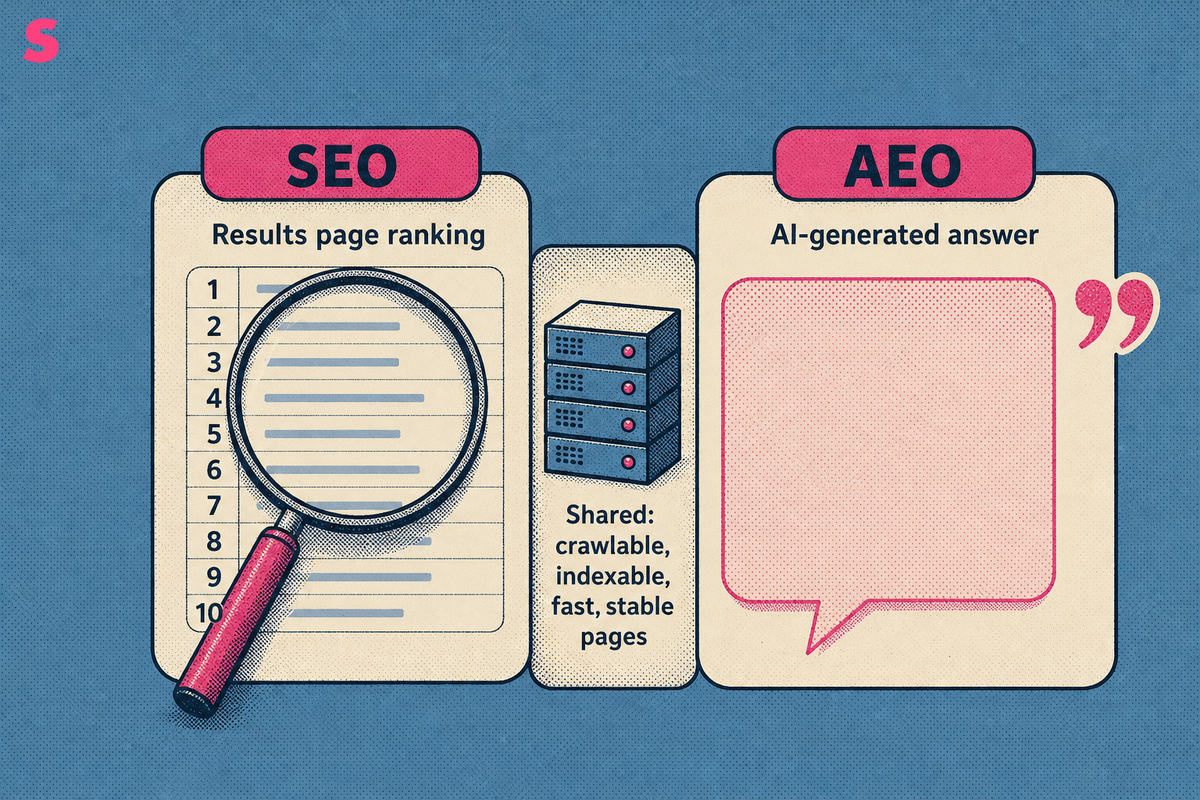
Answer engine optimization (AEO) makes website content easier for AI systems to retrieve, understand, and cite in generated answers. It aims to increase visibility through mentions and citations that can build awareness and consideration.
Traditional SEO targets rankings and clicks from search engine results pages. AEO targets inclusion in generated responses from ChatGPT, Perplexity, Gemini, Claude, and other answer engines. SEO and AEO share a technical foundation: pages still need to be crawlable, indexable, fast, and stable before an answer engine can use them. Per Digital Marketing Institute, SEO improves results-page visibility while AEO supports appearance in AI-generated answers.
Generative engine optimization (GEO) overlaps heavily with AEO. Both terms describe work intended to earn mentions and citations in AI-generated answers. Some teams use GEO for generative search broadly and AEO for direct answers, but the terms have no sharp technical boundary.
AEO is not a replacement for SEO, a guaranteed citation tactic, or a content format. A page can have schema markup, concise copy, and strong technical SEO yet remain absent from an answer because the engine selected different sources for that prompt, user context, or retrieval moment.
Can AEO actually improve my website's visibility in ChatGPT, Perplexity, Google AI Overviews, and other answer engines?
Yes, AEO can improve visibility in ChatGPT, Perplexity, Google AI Overviews, and other answer engines by increasing the likelihood that an answer engine retrieves and cites a useful page. It cannot guarantee inclusion because AI answers change across prompts, models, locations, freshness signals, and retrieval context.
The mechanism is practical. A B2B SaaS buyer might ask, “How should a RevOps team measure AI search pipeline?” A page that opens with a direct explanation, defines AI search attribution, shows the measurement steps, and supports claims with current evidence gives an engine a clearer answer to extract than a vague product page.
That page needs a purpose beyond citation. A brand mention can place a company on a buyer’s shortlist before the buyer visits its website. The operational question for marketing leaders is whether those mentions produce qualified visits, account activity, pipeline, or closed-won revenue.
Sona AI Visibility connects citations to pipeline and revenue on one account timeline, and tracks AI crawler activity from server logs, so teams can assess whether AI visibility contributes to a measurable buying journey rather than treating mentions as the final result.
What does an AI engine check before it cites a page?
When an answer engine receives a query, it interprets the request, retrieves candidate information, evaluates passages that could answer the question, synthesizes a response, and may attach citations to selected sources. Retrieval determines which pages are available, passage selection identifies usable material, answer generation combines that material, and citation selection can vary with the engine, prompt, and context.
AI engines need pages they can reach, parse, trust, and extract. Technical readiness does not force a citation, but it removes avoidable barriers between a useful page and an AI-generated answer. Fast, stable sites remain a core link between SEO and AEO visibility, per logicmonitor.com.
The Free AI Readiness Checker evaluates technical readiness and returns a site-readiness assessment. Its results describe site conditions rather than brand mentions or citations.
| Dimension | Technical or content condition | Why it matters for AEO |
|---|---|---|
| Crawlability | robots.txt rules, canonical tags, indexability, and access to page resources | These are known access conditions. A page must be reachable before it can be retrieved or cited. |
| Performance and JavaScript dependence | Load behavior, server-rendered HTML, and rendering requirements | Fast, stable pages with accessible HTML are easier to fetch and interpret. |
| Security and header hygiene | HTTPS and response headers such as Strict-Transport-Security and Content-Security-Policy | Technical hygiene supports reliable page delivery and reduces avoidable access issues. |
| Content structure | Metadata, semantic headings, and Schema.org markup such as FAQPage JSON-LD | Structured content helps machines identify entities, questions, and answerable sections. |
| Content quality and freshness | Specificity, evidence, recency, and whether copy answers the page topic directly | Answer engines need material that can support a useful response. |
| Accessibility | Alt text, ARIA attributes, contrast, and explicit image dimensions | Accessible markup improves page usability and machine-readable context, although these practices are not confirmed citation-selection requirements. |
Run technical audits periodically rather than daily. Prompt lists need daily observation because a weekly sample can average away a real shift. Full technical reviews work better monthly or quarterly, and after releases, migrations, or significant content changes.
How should a B2B SaaS page be written so AI systems can extract and cite an answer?
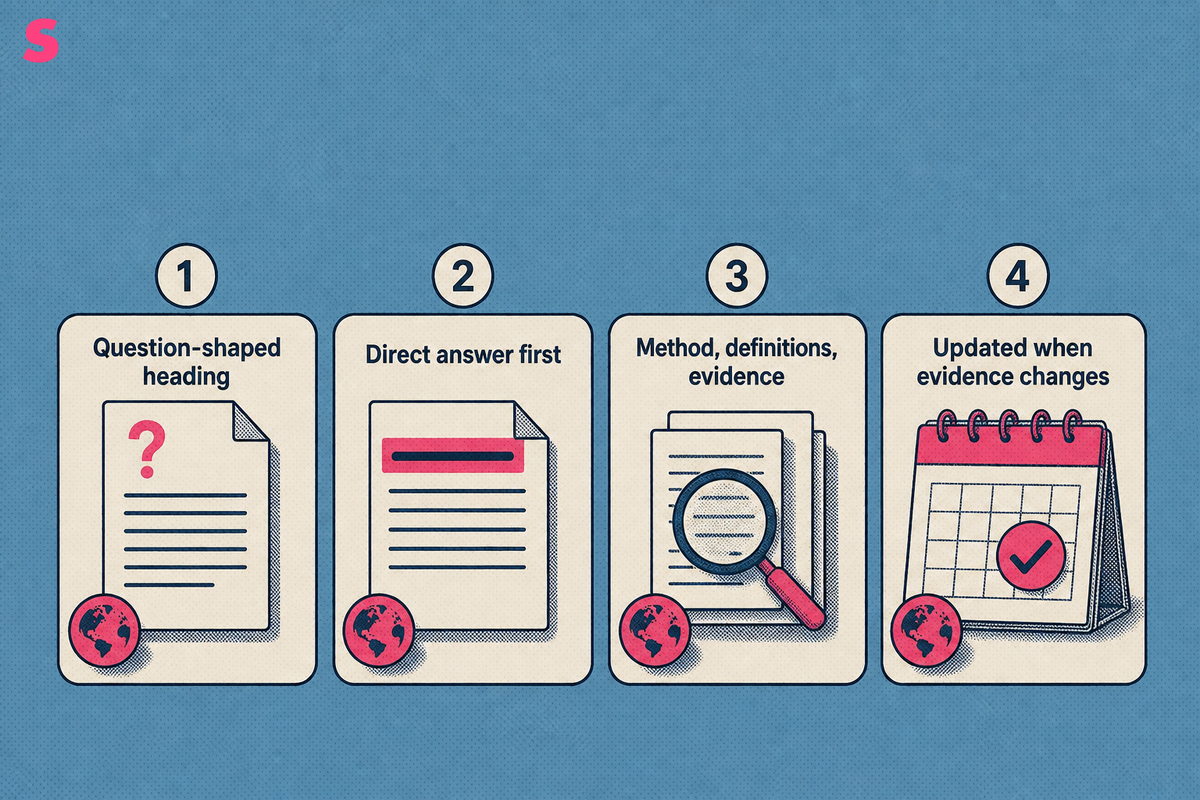
A B2B SaaS page should answer the buyer’s question early, use descriptive headings, and support claims with specific evidence. AEO content gives an answer engine a clear passage to retrieve instead of forcing it to infer meaning from promotional copy.
Consider a weak opening for a page about attribution: “Our platform transforms marketing data into actionable intelligence.” It identifies neither the problem nor the method. A stronger opening states that AI search attribution connects AI-referred visits and self-reported discovery to accounts, pipeline, and revenue, then explains the measurement process.
Use question-shaped headings that match buyer research, such as “How do you identify AI-referred visitors?” Follow each heading with a direct answer, then add method, definitions, constraints, and dated evidence. Update pages when the product, market, or supporting evidence changes, because stale claims weaken the page’s usefulness.
- State the answer before the product positioning.
- Use precise terms such as canonical tag, server-rendered HTML, and buying stage.
- Support assertions with original research, documentation, customer evidence, or transparent methodology.
- Keep one topic per page so the page has a defined retrieval purpose.
Off-page signals also matter. Third-party coverage, reviews, original research, and consistent topical authority can shape what an AI system associates with a company. AEO depends on the credibility of the page, the site, and the wider information environment.
How do you measure whether AEO is working?
Measure AEO with a representative prompt set, repeated daily across the answer surfaces your buyers use, then separate visibility from traffic and revenue. The archive behind Sona’s own AI visibility data, September 2026, covers 8 answer surfaces: ChatGPT, Google AI Overviews, Perplexity, Google AI Mode, Gemini, Mistral, Qwen and Claude.
Build prompts across buyer personas, use cases, problem stages, and commercial intent. Include category, comparison, integration, and implementation questions. Running the same prompt list daily reveals changes that a weekly snapshot can average away, because retrieval indexes, model updates, and competitor publishing can change an answer.
- Measure share of voice, citation rate, sentiment, linked mentions, and referral traffic.
- Record the page cited, the competitor set, the engine, and the prompt wording.
- Test a defined page group before and after changes, while keeping the prompt set stable.
- Review visibility daily, then review strategic patterns quarterly.
Most trackers stop at mention counts; Sona AI Visibility connects prompts and citations to pipeline and revenue. Its AI Search Insights feature shows the prompts buyers ask and how pages perform in AI answers, giving content teams a way to connect prompt coverage with specific pages.
A score is a dated snapshot. The useful output is a comparable series that shows whether a citation pattern holds across repeated observations rather than a single favorable answer captured on one day.
What do AI visibility tools cost, and how much do they cover?
AI visibility tools range from lower-cost prompt trackers to enterprise measurement platforms. Prices, engine coverage, prompt allowances, refresh cadence, and scoring rules are not standardized, so B2B buyers should compare the prompts and answer engines covered rather than using plan names as a proxy.
The comparison below reflects published pricing and coverage as of October 2026. Small prompt allowances can be too narrow for a multi-persona B2B category, where a useful set includes category, competitor, use-case, integration, and decision-stage prompts.
| Tool | Starting price | Agency Plans? (Yes/No) | # of Answer Engines Tracked | Answer Engines | # of Daily Tracked Prompts (entry plan) | Cost per Daily Tracked Prompt | Differentiation |
|---|---|---|---|---|---|---|---|
| Sona AI Visibility | From $75/month, billed annually | Yes | 11 | ChatGPT, Gemini, Google AI Mode, Google AI Overviews, Perplexity, Claude, DeepSeek, Grok, Copilot, Qwen, Mistral | 5,000 credits/month, about 56 prompts tracked daily across 3 engines | $0.45 per daily tracked prompt | Connects AI citations and prompts to pipeline and revenue on one account timeline, with page-level gap prompts. |
| Otterly.ai | From $29/month | Yes | 4 | ChatGPT, Google AI Overviews, Perplexity, Microsoft Copilot | 15 prompts daily | $0.48 per daily tracked prompt | Focus: AI search prompt tracking across four answer engines on its Lite tier. |
| Scrunch AI | From $250/month | Yes | 4 | ChatGPT, Perplexity, Google AI Overviews, Microsoft Copilot | 125 prompts, refresh cadence not published | No refresh cadence published | Focus: AI search visibility monitoring across answer engines. |
| Goodie | From $295/month | Yes | 5 | Not published | 110 prompts daily | $0.67 per daily tracked prompt | Focus: AI visibility tracking with Core, Pro, and Enterprise plans. |
Tool selection should follow the measurement question. A team monitoring prompt-level mentions has different requirements from a team measuring page diagnostics, crawler activity, account identification, attribution, and revenue.
What are the limits of AEO, and when will it not move the needle?
AEO will not move the needle when the underlying page has little useful evidence, the offer does not match buyer demand, or the team measures only mentions without downstream outcomes. No proven universal ranking formula exists for AI answers.
An answer can vary by prompt wording, user context, location, model version, freshness, and retrieval sources. That variability makes a one-off screenshot weak evidence and broad claims such as “add schema markup and get cited” unreliable.
AEO overlaps with SEO because both disciplines require crawlable pages, clear information architecture, useful content, and technical quality. The incremental AEO work is the deliberate design of extractable answers, prompt-level measurement, and citation analysis.
Use a controlled test to isolate the effect. Select a defined group of comparable pages, establish a daily prompt baseline, make a documented set of changes, and compare the same prompts over a fixed window. Record changes in citations, referrals, and conversion behavior separately.
Mentions do not equal revenue. An AI response can name a brand without producing a click, lead, trial, or opportunity. AEO earns attention at a research moment, but commercial value depends on the buyer journey that follows.
Should you prioritize AEO or traditional SEO first?
Priority depends on audience research behavior, acquisition model, site health, and evidence of AI-referred demand. SEO remains the technical foundation, but a business whose buyers use answer engines during a long research cycle can put AEO work first once key pages are accessible.
| Business situation | AEO-first priority | SEO-first priority | Recommended operating focus |
|---|---|---|---|
| B2B SaaS with a long research cycle, buyers using answer engines, and measurable AI-referred demand | AEO first | Maintain SEO foundation | Map commercial buyer prompts to product and use-case pages, then measure citations, account activity, pipeline, and revenue. |
| New site with crawlability and indexation problems | Later | SEO first | Resolve robots.txt, canonical tags, rendering, performance, and indexability before expanding AEO work. |
| Local service business dependent on maps, local intent, and conventional SERP discovery | Later | SEO first | Prioritize local SEO, reviews, location pages, and service-page clarity because those channels drive discovery. |
| Transactional business dependent on category pages, with buyers using both conventional search and AI answers | Parallel approach | Parallel approach | Maintain category-page SEO while building direct answers for comparison, implementation, and decision-stage research. |
Use a simple decision sequence:
- If search engines or AI crawlers cannot reach key pages, prioritize SEO first.
- If discovery depends mainly on local results, maps, or conventional SERPs, prioritize SEO first.
- If buyers conduct a long research cycle through answer engines and AI-referred demand already exists, prioritize AEO first while maintaining SEO.
- If transactional category pages and AI answers both influence acquisition, run SEO and AEO in parallel.
- Run the same prompt list daily and compare outcomes against the baseline before changing the priority.
Monitoring which AI answers mention a brand is only half the job. Sona AI Visibility connects AI citations and AI-referred activity to accounts, pipeline, and revenue, so teams can distinguish visibility from commercial contribution.
For the usual B2B SaaS case, do not choose one discipline permanently. Build technically sound, indexable pages for SEO, structure them for direct AI extraction, and measure whether the resulting visibility reaches commercial buyer prompts.
What are frequently asked questions about AEO?
How long does it take for AEO to improve AI search visibility?
No reliable timeline exists because answers vary by engine, model, retrieval context, prompt wording, and page freshness. Establish a baseline prompt set, make changes to a defined page group, and compare repeated daily measurements over a fixed window.
Does AEO replace SEO?
No. AEO builds on SEO because pages must still be crawlable, indexable, fast, and stable before answer engines can understand and cite them. Treat SEO and AEO as one foundation with different outputs: rankings and clicks for SEO, citations and mentions for AEO.
Is AEO the same as GEO?
AEO and GEO overlap heavily. Both describe efforts to earn mentions and citations in AI-generated answers. Teams use the labels differently, but neither term has a universally accepted technical boundary.
Does schema markup make AI engines cite my pages?
No. Schema markup helps machines parse a page’s subject, but it does not guarantee a citation. Use schema markup as one structural signal alongside clear copy, accessible HTML, credible evidence, and current information.
Can I track AI visibility on a small budget?
Yes. Otterly.ai has a $29/month Lite tier covering 15 daily prompts across four engines as of October 2026. That allowance can be too narrow for a multi-persona B2B category, where a representative prompt set needs commercial, informational, comparison, and implementation questions.
If an AI answer mentions my brand, does that produce revenue?
Not automatically. A mention can occur without a click, lead, trial, or opportunity. Track AI visibility separately from referral traffic and pipeline, then evaluate whether cited prompts correlate with account activity and revenue.
Summarize this article with AI: ChatGPT · Claude · Perplexity · Google AI Mode
Last updated: October 2026