An AI visibility checker is a tool that asks AI engines such as ChatGPT, Gemini and Perplexity buyer-style questions and reports whether your brand is mentioned or cited. Most free versions give a one-time snapshot, so use one to set a baseline and then repeat it, because answers vary by prompt, model and location. Sona AI Visibility goes further by connecting prompts and citations to pipeline and revenue, which a mention count cannot show.
What is an AI visibility checker and what does it measure?
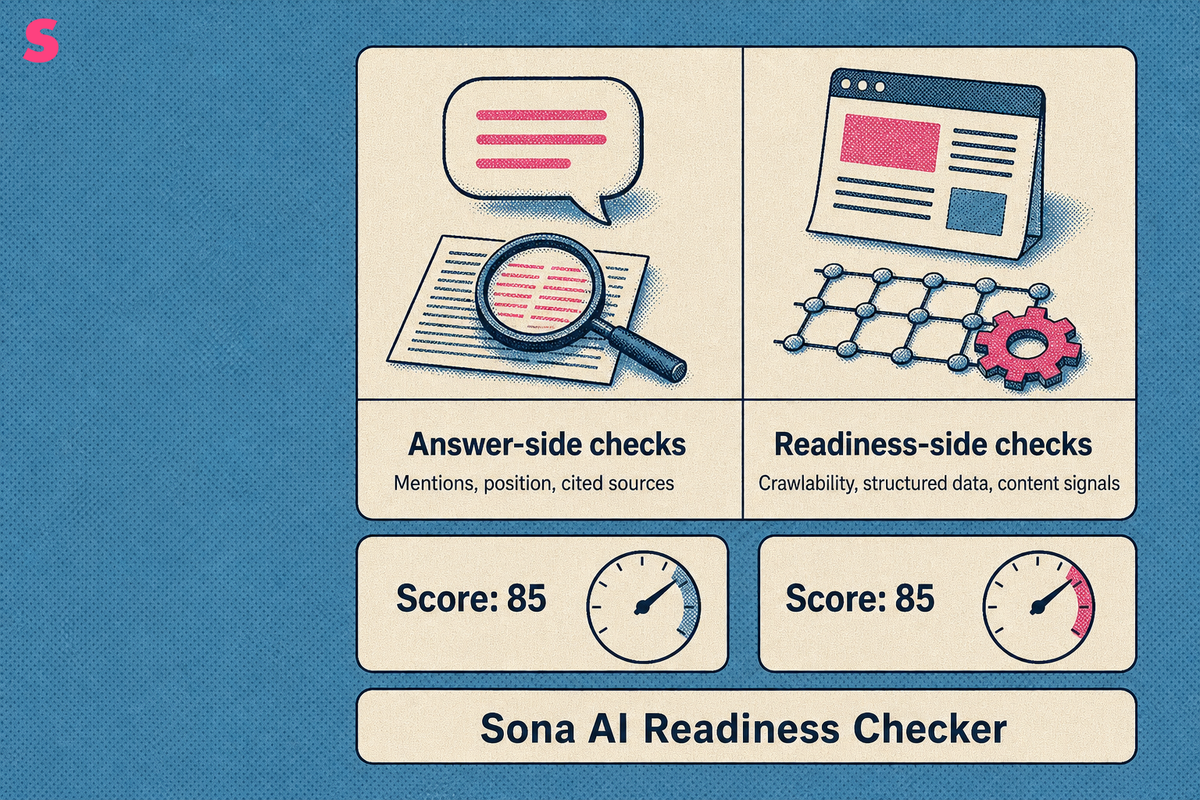
An AI visibility check tests how AI engines treat your brand or your pages and returns a score, a report or both. Online checking tools measure one of two things: whether engines mention you in their answers, or whether they can technically read your site.
Two measurement types cover almost every tool in the category:
- Answer-side checks send buyer questions to engines such as ChatGPT, Gemini, Perplexity and Google AI Overviews, then record whether your brand appears, in what position and with which cited sources.
- Readiness-side checks audit a URL for crawlability, structured data and content signals, then score how easily an AI engine can retrieve and parse the page.
Sona's AI Readiness Checker is a readiness-side tool. It audits a page for how readable it is to AI engines. It does not report whether you appear in answers.
Know which side a tool measures before trusting its number. A readiness score of 85 and a mention score of 85 describe different things.
What does "free" mean in a free AI visibility checker?
Free covers four different offers, and each gives a different amount of evidence: a one-off grader, a daily-capped checker, a capped free tier and a time-limited trial.
- One-off grader: returns a single dated snapshot of one URL or brand.
- Daily-capped checker: queries engines live but limits how many checks run per day, so a full prompt list cannot run.
- Capped free tier: AthenaHQ's free Essential tier includes 300 credits, where 1 credit is 1 AI response, so the cap falls on answers analysed.
- Time-limited trial: Sona AI Visibility gives a 14-day free trial on every plan with no credit card, and Profound gives a 7-day trial with 50 prompts run daily.
A one-off grader gives a baseline: a dated snapshot that cannot show a trend. Daily-capped checkers and capped tiers can be repeated, so they can produce a series, but their limits can narrow prompt coverage, engine coverage or how long monitoring lasts. Paid monitoring exists to lift those limits.
How were these AI visibility checking tools selected and ranked?
Seven tools were selected and ranked on five criteria, applied to published information rather than a lab test. No tool was run against a shared prompt set. Every price comes from a vendor's own pricing page read in October 2026, and every other figure carries its source.
- Access type: one-off free tool, ongoing free tier, time-limited trial or quote-only.
- Measurement type: answer-side, readiness-side or both.
- Usable allowance: the checks, credits or prompts available before payment.
- Engine coverage: the count and names of AI engines checked.
- Repeatability: whether the same prompts run daily, so results form a series.
The ordering rests on the free offer itself, and the offer types are labelled separately in each entry. Sona AI Visibility is named first as the paid-upgrade reference: its free offer is a 14-day trial, and its connection from AI citations to revenue is what a free check cannot show. The remaining six are ordered by free offer: free tools, then a free tier, then free trials, then quote-only pricing. Revenue attribution is treated as a reason to upgrade, not as a ranking criterion.
Which are the best free AI visibility checker tools in 2026?
Seven tools make the list, starting with Sona AI Visibility. Each entry follows one format: what it does, what it costs, who it suits. Prices were read from each vendor's own pricing page in October 2026.
- Sona AI Visibility. What it does: connects citations and prompts to pipeline and revenue on one account timeline, and tracks which AI crawlers reach your pages. Costs: a 14-day free trial with no credit card; brand plans start from $75/month billed annually. Suits: marketing teams that must show what AI search returns in revenue.
- Ahrefs free checker. What it does: reportedly checks six engines, including Google AI Overviews and Google AI Mode, per ud.hk, 2026-09-07. Costs: free tool. Suits: SEO teams wanting a fast multi-engine read.
- UDomain AEO Auditor. What it does: reportedly runs more than 170 structural checks and returns an AI Visibility Score, copy signals and an action plan, per ud.hk, 2026-09-07. Costs: free tool. Suits: web and content teams wanting on-site diagnosis.
- AthenaHQ. What it does: analyses AI responses on a credit basis. Costs: a free Essential tier with 300 credits; Starter from $295/month billed monthly. Suits: teams testing a platform before paying.
- Otterly.ai. What it does: checks prompts daily on every plan across four engines. Costs: free trial; from $29/month billed monthly. Suits: small teams tracking a short prompt list daily.
- Peec AI. What it does: tracks prompts daily on every plan, with unlimited users. Costs: free trial; from $95/month billed monthly. Suits: teams with many stakeholders, and agencies, since an agency offer is published.
- Profound. What it does: runs 50 prompts daily during a 7-day trial across three engines. Costs: 7-day trial, then quote-only with no public price. Suits: enterprise buyers comfortable with sales-led purchasing.
The table compares the five platform tools on price, agency plans, engines tracked and daily prompt volume.
| Tool | Starting price | Agency Plans? (Yes/No) | # of Answer Engines Tracked | Answer Engines | # of Daily Tracked Prompts (entry plan) | Cost per Daily Tracked Prompt | Differentiation |
|---|---|---|---|---|---|---|---|
| Sona AI Visibility | Brands from $75/month (Starter) and $249 (Growth), agencies from $199/month, all billed annually. 14-day free trial, no credit card. Unlimited seats and API/MCP access on every plan | Yes | 11 | ChatGPT, Gemini, Google AI Mode, Google AI Overviews and Perplexity on standard, plus Claude, DeepSeek, Grok, Copilot, Qwen and Mistral on premium | 5,000 credits/month on Starter 5K, which is about 166 prompts tracked daily on one model, or 56 across three. 1 credit = 1 AI answer | $0.45 per daily tracked prompt | Connects AI citations and prompts to pipeline and revenue on one account timeline; resolves the anonymous accounts behind AI-referred visits, 100% cookieless |
| AthenaHQ | From $295/month (Starter) billed monthly, 17% off annually; Enterprise custom. Free Essential tier with 300 credits. 17% off annual; 1 credit = 1 AI response; API access and extra credits are paid add-ons | Not published | 11 | ChatGPT, Perplexity, Google AI Overviews, Google AI Mode, Gemini, Claude, Copilot, Grok, DeepSeek, Meta AI and Mistral | 3,600 credits on Starter, where 1 credit is 1 AI response. 300 credits on the free Essential tier | $2.46 per daily tracked prompt | Free Essential tier; 1 credit = 1 AI response |
| Otterly.ai | From $29/month (Lite), $189 (Standard), $489 (Premium) billed monthly, or $25, $160 and $422 a month billed annually; Enterprise custom. Free trial, no commitment. 15% off annual; unlimited team members on every plan; Enterprise starts from 1,000 prompts | Not published | 4 | ChatGPT, Google AI Overviews, Perplexity and Microsoft Copilot | 15 prompts on Lite, 100 on Standard, 400 on Premium, checked daily on every plan | $0.48 per daily tracked prompt | Prompts checked daily on every plan; unlimited team members |
| Peec AI | From $95/month (Starter), $245 (Pro), $495 (Advanced) billed monthly, 15% off annually; Enterprise custom. Free trial. Unlimited users on every plan; 50, 150 and 350 prompts by tier; extra models are a paid add-on | Yes | 3 of 6, plus add-ons | ChatGPT, Google AI Mode, Google AI Overviews, Microsoft Copilot, Gemini, Naver AI | 50 prompts on Starter, 150 on Pro, 350 on Advanced, tracked daily on every plan | $0.63 per daily tracked prompt | Unlimited users on every plan; extra models are a paid add-on |
| Profound | Quote-only, no public pricing. 7-day free trial: 50 prompts, run daily. No self-serve price is published: a 7-day trial and custom Enterprise pricing only | Not published | 3 | ChatGPT, Gemini and Google AI Overviews | 50 prompts run daily on the 7-day trial; Enterprise allowances are custom | No refresh cadence published | Trial runs 50 prompts daily; Enterprise pricing is custom |
Cost per daily tracked prompt divides each entry price by the AI answers the plan buys per day, on one shared denominator: one prompt, one model, once a day. It is a unit price, not a ranking. Vendors that publish no refresh cadence get no figure.
Which free AI visibility checking tools cover the most AI engines?
Sona AI Visibility covers the most engines among the tools in this article, with 11 available to track, including ChatGPT, Gemini, Google AI Overviews and Perplexity. The other tools that publish a count list three to six.
- Sona AI Visibility: 11 engines.
- Ahrefs free checker: six engines, per ud.hk, 2026-09-07.
- Otterly.ai: four engines.
- Peec AI: three engines at its entry price.
- Profound: three engines, ChatGPT, Gemini and Google AI Overviews.
- AthenaHQ: engine count not published.
A workable minimum is ChatGPT, Gemini, Perplexity and Google AI Overviews, with Google AI Mode and Microsoft Copilot as useful extras. Read the engine list before comparing results, because a score across three engines and a score across eleven are different measurements.
How reliable is a single AI visibility score?
A single AI visibility score is reliable only as a dated baseline. Engine answers to the same prompt shift with the retrieval index, a model update and whatever a competitor published last week, so one number cannot separate a real move from noise.
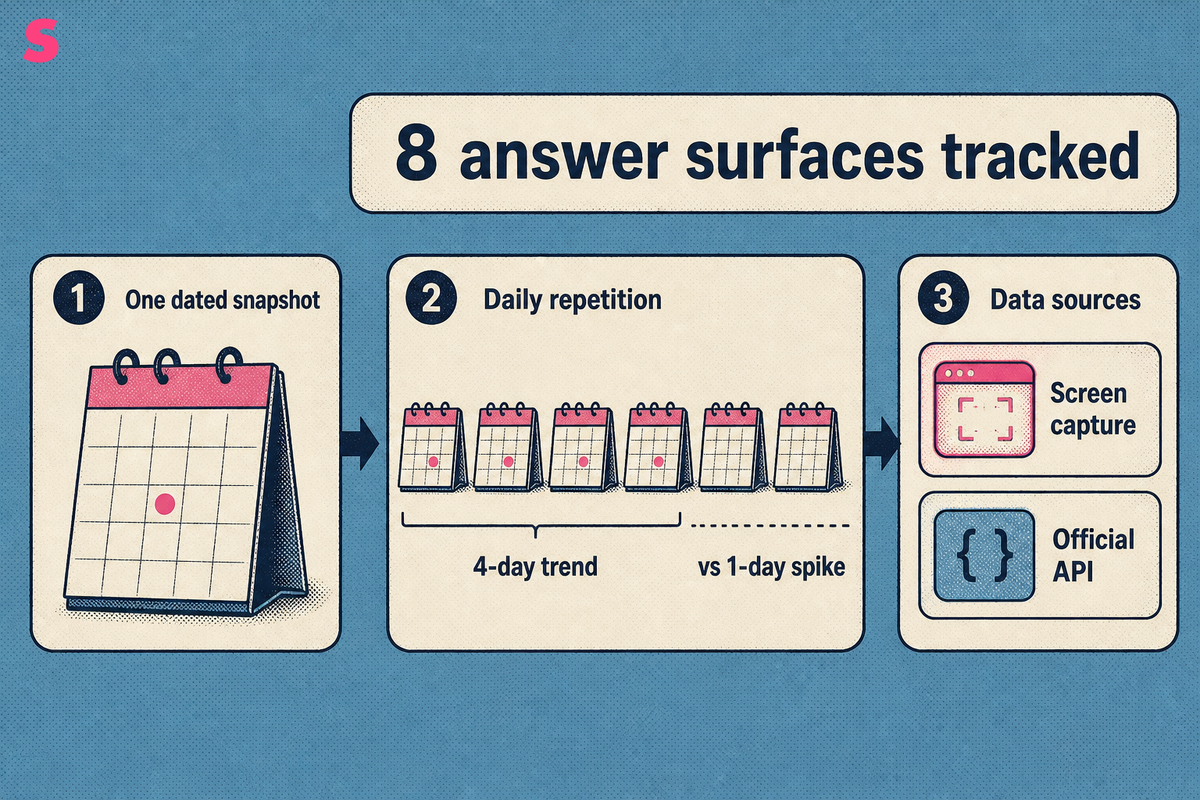
Repetition fixes that. A team that runs the same prompt list daily sees patterns a weekly snapshot would have averaged away: a change that holds four days running is a trend, and a one-day spike is not.
Sample size shows what a sturdy measurement looks like. A 2026 AI visibility index used a fixed monthly dataset of 25 million US prompts and 2.5 million UK prompts across ChatGPT, Gemini and Google AI Mode, plus a separate Google AI Overviews dataset, covering January through July 2026, per finance.yahoo.com, July 2026.
Collection method matters as well. Some offerings capture the end-user experience directly, scraping the response as a person would see it, ads and formatting included. Others pull data from an engine's official API, which returns a structured response that need not match the screen. The two methods can capture different answers. Sona AI Visibility aims to mirror the end-user experience as closely as possible, and uses both.
A brand-level score is not a work item. Sona AI Visibility's AI Search Insights shows which prompts surface the brand and which cited sources feed those answers, and maps site pages to the prompts they should appear in.
Sona's own AI visibility data, September 2026, covers eight answer surfaces: ChatGPT, Google AI Overviews, Perplexity, Google AI Mode, Gemini, Mistral, Qwen and Claude.
What does a free AI visibility checker leave out?
A free checker leaves out history, depth and consequence: a snapshot of one moment, a capped sample of prompts or engines, and no link between a mention and revenue.
- History. A one-off score has no series behind it, so a team cannot tell progress from noise.
- Prompt volume. A free tier stops at a credit cap, and each credit buys one AI response.
- Attribution. Mention counts do not show whether an AI answer produced a visit, a signup or a deal.
- Crawler access. Answer-side tools do not show whether AI bots can fetch your pages. A separate crawler check is needed to see which bots reach them and why a blocked bot fails.
Diagnosis also varies. A tool that reports only absence tells you what is missing; one that names the page and the fix tells you what to do. Prefer the second.
When does a free AI visibility checker stop being enough?
A free checker stops being enough when the question moves from whether the brand appears to what the appearance is worth. Three triggers mark that point.
- You need the same prompt list run every day, so results form a series rather than a single reading.
- Leadership asks for pipeline. Sona AI Visibility connects AI citations and prompts to pipeline and revenue on one account timeline, and resolves the accounts behind AI-referred visits without cookies.
- You need to know which prompts and pages move the number, not only the brand-level score.
The Starter plan begins at $75/month billed annually, with 5,000 credits, about 166 prompts tracked daily on one model or 56 across three, and a 14-day free trial with no credit card.
Keep two clocks. Run the prompt list daily; run a full technical re-audit monthly and a positioning and competitive review quarterly.
Which AI visibility checker should you pick for your situation?
Pick by the question you need answered, not by the highest score. The best fit by reader:
- Marketing leader proving revenue from AI search: Sona AI Visibility, which connects citations to pipeline and revenue. Agency plans start from $199/month billed annually.
- SEO lead wanting a fast engine read: the Ahrefs free checker, reported to cover six engines.
- Content or web team wanting page diagnosis: Sona's AI Readiness Checker for a page-level readiness read, or the UDomain AEO Auditor for its action plan.
- Team testing before paying: a 14-day Sona trial, or AthenaHQ's free Essential tier with 300 credits.
- Small team on a tight budget: Otterly.ai from $29/month, with 15 prompts on Lite checked daily.
- Many stakeholders or multiple clients: Peec AI, with unlimited users and a published agency offer.
- Enterprise with a sales-led process: Profound, quote-only after a 7-day trial.
Whichever tool you choose, fix the prompt list, run it daily and compare trends within that one tool.
Frequently Asked Questions
Is there a completely free AI visibility checker?
Yes. Several tools give a free snapshot with no payment, limited by checks per day, engines covered or depth of results. Three types exist: one-time graders, daily-capped checkers, and capped free tiers such as AthenaHQ's 300 credits. A one-time grader gives a baseline only; daily-capped and capped-tier products can be repeated, though their limits can narrow prompt coverage, engine coverage or monitoring duration.
How often should I run an AI visibility check?
Run one to set a baseline, then repeat it on a fixed schedule with the same prompt set. Answers shift with model updates, wording and location, so repeatable prompts matter more than any single score. Run the prompt list daily, and review technical audits monthly and positioning quarterly.
Can I compare scores from two different AI visibility checking tools?
Not directly. Each vendor uses its own prompt set, weighting, citation definition and engine mix, and a score over three engines is not comparable to one over eleven. Compare trends within one tool, not raw scores across tools.
Does appearing in AI answers mean I will get leads?
No. A brand can be mentioned without any click or conversion. Mention tracking is the baseline; Sona AI Visibility adds the connection from citations and AI-referred visits to pipeline and revenue, which shows whether a mention produced a lead.
Which AI engines should an AI visibility checker cover?
At minimum ChatGPT, Gemini, Perplexity and Google AI Overviews, with Google AI Mode and Microsoft Copilot as useful extras. Coverage differs by tool, from three published engines to 11, so check the engine list before trusting a comparison.
Can an AI visibility checking tool tell me why my brand is missing from AI answers?
Some do, through page audits, copy signals or action plans; others only report absence. Readiness-side tools return a page-level score, and the UDomain AEO Auditor is reported to return an action plan after more than 170 checks, per ud.hk, 2026-09-07. A tool that names a page and a fix is worth more than a score.
Summarize this article with AI: ChatGPT · Claude · Perplexity · Google AI Mode
Last updated: October 2026