AI search market share is the share of AI answer engine activity, tracked through sessions, referral visits, or queries, that each platform receives. ChatGPT tops every dataset, ranging from roughly 55.5% of chatbot web traffic in August 2026 to 79.08% of chatbot share in May 2026 according to StatCounter, since sources measure different behaviors. Google still controls about 90% of traditional search, according to StatCounter in May 2026. Sona AI Visibility links the prompts and citations driving that traffic with pipeline and revenue.
What does AI search market share actually measure?
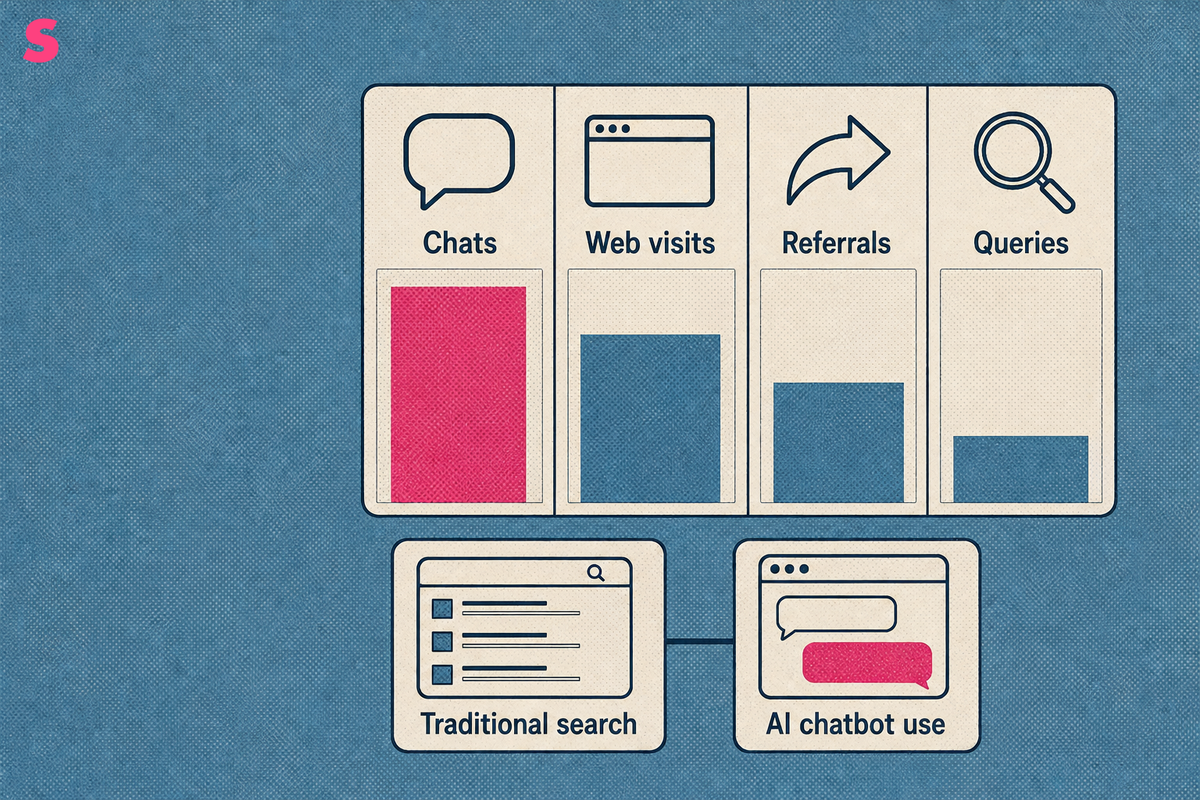
AI search market share measures how user sessions, referral traffic, or query volume are distributed across AI answer engines. The result changes depending on whether the measurement counts chats, web visits, referrals, or searches.
This distinction matters to marketing, SEO, and demand generation teams because platform share indicates where to monitor buyer questions, technical access, and referral activity. A platform with a large chatbot audience can matter strategically even when it sends little traffic to a particular site.
AI search market share differs from traditional search-engine share. Google’s search share measures activity in a conventional search engine, while AI answer platform figures may measure standalone chatbot use, AI-native search usage, or visits to a web interface. Google AI Overviews appear within Google Search results rather than operating as a separate traditional search engine.
AI search market share also differs from AI visibility for one brand. A platform can have a large audience while a brand receives few citations or referrals from that platform. B2B teams need to answer two questions: where are buyers researching, and where does the company appear when they ask commercial questions?
How many users do leading AI answer platforms reach?
ChatGPT led worldwide AI-chatbot distribution in the cited May 2026 dataset, with 79.08% share. Perplexity, Gemini, Copilot, and Claude held much smaller portions of the same chatbot-share measure, per perplexityaimagazine.com, May 2026.
| Platform | Worldwide chatbot share, May 2026 | Worldwide chatbot share, September 2025 to September 2026 | Measurement source and period |
|---|---|---|---|
| ChatGPT | 79.08% | 80.47% | perplexityaimagazine.com, May 2026; gs.statcounter.com, September 2025 to September 2026 |
| Perplexity | 7.67% | 5.84% | perplexityaimagazine.com, May 2026; gs.statcounter.com, September 2025 to September 2026 |
| Gemini | 7.03% | Not reported in the cited period | perplexityaimagazine.com, May 2026 |
| Copilot | 3.23% | Not reported in the cited period | perplexityaimagazine.com, May 2026 |
| Claude | 2.98% | Not reported in the cited period | perplexityaimagazine.com, May 2026 |
| DeepSeek | 0.01% | Not reported in the cited period | perplexityaimagazine.com, May 2026 |
Traffic-based listings show a different distribution. A January 2026 listing placed ChatGPT at 60.7% of global AI-chat-assistant traffic, Gemini at 15%, and Copilot at 13.2%. An August 2026 listing put ChatGPT at 55.5% of AI-chatbot web traffic, Gemini at 25.6%, and Claude at 9.3%.
These figures measure different behaviors. Sona AI Visibility helps teams monitor how their brands appear across answer engines, while public platform-share figures indicate where monitoring deserves initial attention. Market-wide audience share cannot reveal which engine sends qualified visits to an individual site.
Why do estimates of leading-platform share range from 55.5% to 79%?
ChatGPT’s reported share ranges from 55.5% to 79.08% because each estimate uses a different denominator, geography, and date range. A chatbot-share dataset, a web-visit dataset, and an AI-search estimate including Copilot are not interchangeable.
| Source type | What is counted | Geography | Period | ChatGPT figure |
|---|---|---|---|---|
| Chatbot-share table | AI-chatbot share | Worldwide | May 2026 | 79.08%, per perplexityaimagazine.com, May 2026 |
| Traffic listing | AI-chat-assistant traffic | Global | January 2026 | 60.7%, per the January 2026 listing |
| Web-traffic comparison | AI-chatbot web traffic | Global | August 2026 | 55.5%, per the August 2026 listing |
| AI-search estimate | AI-search share, including Copilot | Not stated | February 2026, updated October 11, 2026 | 73.3%, per the February 2026 listing |
| Web-visit estimate | AI-chatbot web visits | United States | September 2026 | 63.5%, per the September 2026 listing |
The United States example shows why geography matters. The September 2026 web-visit estimate gave Gemini 17.4% and Claude 13.2% alongside ChatGPT’s 63.5%, per the September 2026 listing. That distribution differs sharply from the May worldwide chatbot-share table.
Platform-adjacent and vendor-published figures can provide useful signals, but they need clear labels and independent cross-checks. Sona AI Visibility measures a brand’s presence in AI answers, not a platform’s total audience, so its data serves as brand-level evidence rather than a substitute for market-share research.
How much share does traditional search keep alongside AI Mode?
Traditional search remains far larger than AI-native search activity. Google held 90.39% of worldwide search-engine share and Bing held 5.03%, per perplexityaimagazine.com, May 2026. Across September 2025 to September 2026, Google held 89.94% and Bing held 5.29%, per gs.statcounter.com.
Google AI Mode should not be added to a separate chatbot ranking without a defined denominator. One measurement put Google AI Mode at 0.34% of Google searches from January through April 2026, per the April 2026 listing. A separate Q1 2026 estimate put Google AI Mode at 58.2% of AI-search share, while ChatGPT/SearchGPT held 18.7%, per the Q1 2026 listing.
The figures can coexist because one measures Google AI Mode within all Google searches and the other measures Google AI Mode within an AI-search category. Google AI Overviews follow the same logic: they are an answer format within Google Search, not an independent search engine. Sona AI Visibility treats Google AI Overviews as an answer surface whose citations and referrals can be measured.
AI platforms are taking 15–20% of informational query volume despite Google holding roughly 80% of search, per digitalapplied.com. For marketers, AI search adds a discovery layer rather than replacing traditional search. Content still needs to perform in conventional results and answer the fuller questions buyers ask in answer engines.
Is the leading platform’s share growing or shrinking as AI search adoption rises?
ChatGPT’s web-traffic share has declined while total visits have increased, indicating a growing market with more active competitors. Its worldwide web-traffic share fell from roughly 76% in June 2025 to about 53% by May 2026, even as total visits rose, per the May 2026 listing.
AI search traffic accounted for 9.2% of search traffic in Q1 2026, up from 7.8% in Q1 2025, per the Q1 2026 listing. Gemini also held 14.0% of AI-chatbot market share in October 2026, per the October 2026 listing. Share movement reflects expanding use of several answer engines, rather than only a transfer of existing demand.
The market-value forecast points in the same direction. The global AI search engine market was estimated at USD 16.28 billion in 2024 and projected to reach USD 50.88 billion by 2033, at approximately 12.8% CAGR, per grandviewresearch.com.
A team that runs the same prompt list daily can identify patterns that a weekly snapshot masks. Sona AI Visibility records prompt visibility over time, while daily tracking helps distinguish a four-day shift from a one-day spike caused by retrieval changes, model updates, or new competitor content.
Does traffic share equal influence over B2B buying decisions?
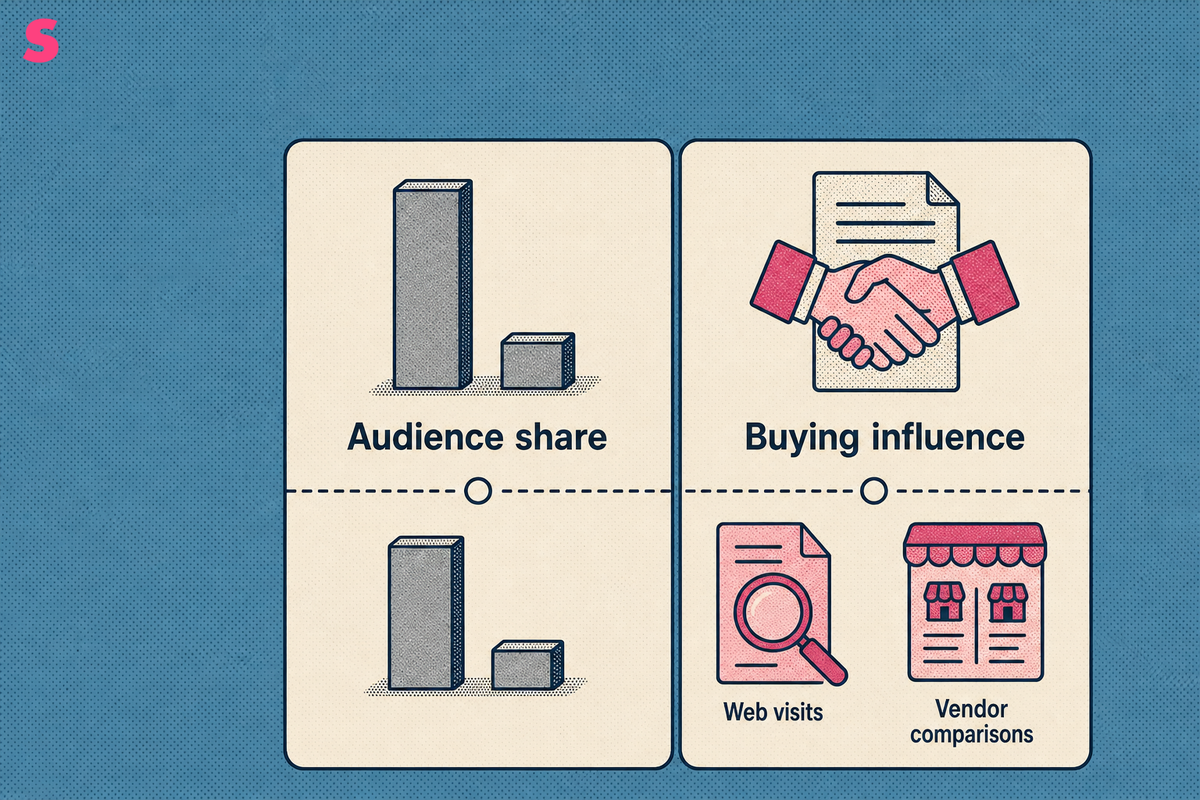
Traffic share does not equal influence over B2B buying decisions. Web visits measure audience activity, while buying influence depends on buyer questions, recommendations, and whether those interactions precede a qualified visit, demo request, opportunity, or purchase.
A smaller platform can matter disproportionately when it appears in a buyer’s vendor-comparison workflow. A platform that generates fewer overall visits can still influence high-intent research when prospects ask for product recommendations, alternatives, implementation guidance, or procurement comparisons.
Public share estimates are planning inputs, not channel-performance reports. A B2B SaaS company should compare the market benchmark with its own referral patterns, sales conversations, and buyer research behavior before allocating content or measurement effort.
The boundary is simple: audience share describes where usage happens, while commercial influence describes whether activity changes a buying journey. Neither metric replaces the other.
How can marketers assess AI search readiness for their own content strategy?
Marketers can assess AI search readiness by checking four things: which answer engines refer visits, whether AI crawlers can reach key pages, which prompts buyers ask, and whether the brand appears in those answers. Public market-share figures provide a benchmark, but site-level evidence should guide action.
- Segment analytics by identifiable AI referrals and compare the engine mix with public traffic estimates.
- Test whether retrieval and agent crawlers can access priority product, pricing, comparison, and documentation pages.
- Build a daily prompt list from buyer questions, especially commercial comparisons and implementation queries.
- Review cited pages, referral visits, and changes in visibility together.
For example, a site receiving a higher share of AI referrals from Gemini than Gemini’s 15% global AI-chat-assistant traffic estimate from January 2026, per the January 2026 listing, has evidence that its audience differs from the market benchmark. That finding supports Gemini-specific prompt monitoring and page analysis.
The Free AI Readiness Checker tests whether AI engines can technically crawl and parse a site through 35 checks across six categories, while the Sona AI Crawl Checker tests access across 45 AI crawlers. Sona’s own AI visibility data, September 2026, covers eight answer surfaces: ChatGPT, Google AI Overviews, Perplexity, Google AI Mode, Gemini, Mistral, Qwen and Claude.
Prompt monitoring should run daily. Technical re-audits belong on a separate periodic schedule, such as monthly or quarterly. A readiness score is a dated snapshot; the operating record is the comparable series of prompt and page changes that identifies where a team should investigate.
Which AI search platforms should a B2B SaaS team prioritize first?
B2B SaaS teams should prioritize platforms with the strongest combination of public share, first-party referral evidence, buyer use, and manageable optimization effort. ChatGPT and Gemini are starting points for most teams because they combine broad public reach with visible momentum across several datasets.
Perplexity deserves attention for research-led discovery, while Claude and Copilot deserve attention when referral data or customer interviews show relevant usage. ChatGPT held 79.08% of worldwide chatbot share in May 2026, while Gemini held 7.03%, Perplexity 7.67%, Copilot 3.23%, and Claude 2.98%, per perplexityaimagazine.com, May 2026.
- Public reach: assign higher priority to platforms with meaningful market share in the relevant geography.
- First-party referrals: raise priority when an engine already sends visits, engaged accounts, or demo traffic.
- Buyer behavior: use sales-call notes and research patterns to identify where prospects ask vendor questions.
- Operational effort: prioritize engines where pages are crawlable and prompt coverage can be monitored daily.
Sona AI Visibility can operationalize that checklist by tracking buyer prompts and the answer surfaces where a brand appears. Public estimates establish the broad order, while site referrals and account behavior establish the working order for one company.
How do you connect AI search share to pipeline and revenue on your own site?
Public platform-share figures describe the market, not a company’s commercial outcome. The next measurement step connects AI-referred visits and answer visibility with identifiable accounts, opportunities, and closed-won revenue.
Monitoring which AI answers mention a brand is only half the job. Sona AI Visibility closes the other half through AI Attribution, connecting AI citations and AI-referred visits to accounts, pipeline, and closed-won revenue on one account timeline, while tracking AI crawler and agent activity at the front of that path.
That measurement separates a broad market trend from a business result. A platform with modest overall traffic share can still merit investment when it produces qualified account activity, while a high-share platform warrants investigation when it produces visibility without pipeline movement.
What are the frequently asked questions about AI search market share?
Which AI search engine has the largest market share?
ChatGPT leads every dataset in the supplied research. It held 79.08% of worldwide AI-chatbot share in May 2026, per perplexityaimagazine.com, and 80.47% across September 2025 to September 2026, per gs.statcounter.com. Traffic-based estimates are lower, including 55.5% of AI-chatbot web traffic in August 2026, per the August 2026 listing, because they count different behavior.
How much of search does Google still hold?
Google held about 90.39% of worldwide traditional search-engine share in May 2026, while Bing held 5.03%, per perplexityaimagazine.com, May 2026. AI search adds a discovery layer rather than replacing Google Search, especially because Google AI Overviews and AI Mode operate within Google’s search experience.
Why do AI search market share numbers disagree?
Sources count different denominators, including chatbot share, web visits, referral traffic, query volume, and AI-search usage. They also use different regions and periods. A worldwide chatbot-share table cannot be directly compared with a United States web-visit estimate or an AI-search estimate that includes Copilot activity.
Does a smaller platform share still matter for B2B companies?
Yes. Claude held 2.98% of worldwide chatbot share in May 2026, per perplexityaimagazine.com, while one September 2026 United States web-visit estimate gave Claude 13.2%, per the September 2026 listing. Relevance depends on where a company’s buyers research vendors and which platforms send qualified referrals.
How big is the AI search market in dollars?
The global AI search engine market was estimated at USD 16.28 billion in 2024 and projected to reach USD 50.88 billion by 2033, growing at approximately 12.8% CAGR, per grandviewresearch.com. This is a market-value forecast, not a measure of user share or referral traffic.
How can I check my own share of AI-referred activity?
Measure AI referral visits to the site, confirm AI crawler activity on priority pages, and track appearance in buyer prompts across answer engines. Compare that first-party evidence with public platform-share data as a benchmark, then prioritize the engines that produce relevant visibility and commercial activity.
Summarize this article with AI: ChatGPT · Claude · Perplexity · Google AI Mode
Last updated: October 2026